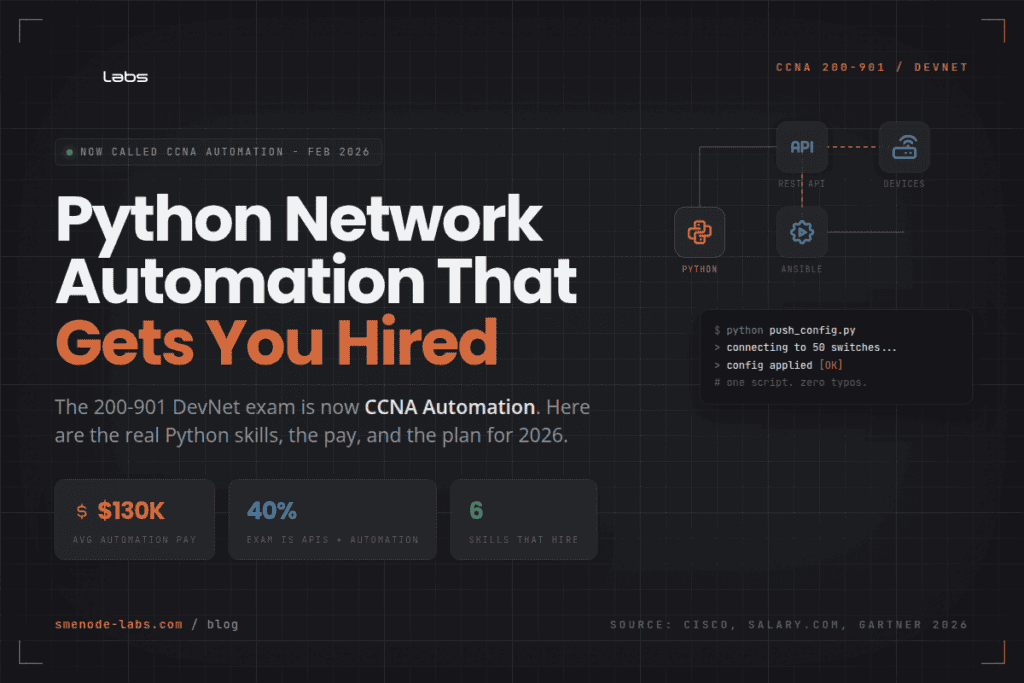
Cisco quietly renamed the exam you’re studying for. On February 3, 2026, the DevNet Associate track became CCNA Automation, and the 200-901 exam is now officially CCNA Automation (CCNAAUTO), formerly DevNet Associate (Cisco). The content didn’t change. The name did. And that name change tells you exactly where the money is going. For AZ-104 and AZ-305 lab practice, see the Azure Labs Workbook.
You already suspect this. Pure config-line network jobs are drying up, and every automation posting now lists Python as a hard requirement. That part’s real.
Here’s what this article gives you. Not exam theory. The actual Python network automation skills that turn a 200-901 cert into a job offer in 2026, ranked by what hiring managers actually test. You’ll get the real exam breakdown, current salary numbers, and a step-by-step plan to build these skills in a home lab. No fluff. Minus the hype, what AI in networking actually means for engineers is the honest version.
Let’s get into it.
Wait, is it still called 200-901 DevNet?
Yes and no. The exam code 200-901 is the same. The name is now CCNA Automation, and the old “DevNet Associate” and “CCNA DevNet” labels are being phased out.
Here’s the short version. Cisco moved its whole automation family into the CCNA/CCNP/CCIE naming most people already know. DevNet Associate became CCNA Automation. DevNet Professional became CCNP Automation. DevNet Expert became CCIE Automation (CBT source confirms the same change). If you already held a DevNet cert on February 3, Cisco auto-upgraded your badge. No re-exam. For the hiring side of the toolchain, 180 DevOps interview questions is free.
So why does the rebrand matter to you? Because it’s Cisco admitting, out loud, that automation isn’t a side track anymore. It’s the CCNA. That’s the signal. Study the skills, not just the acronym.
Speaking of skills. If you want the exam mapped to real labs instead of slides, our CCNA Automation Workbook covers every 200-901 domain with Python exercises you actually type out. It’s built for the person studying right now, with an exam booked. Worth a look before you read on. On the AWS side, the AWS Solutions Architect Workbook covers the SAA-C03 labs.
The Python network automation skills that actually get you hired
Passing 200-901 proves you can answer questions. Getting hired proves you can build things. Those aren’t the same skill set, and this is where most candidates trip.
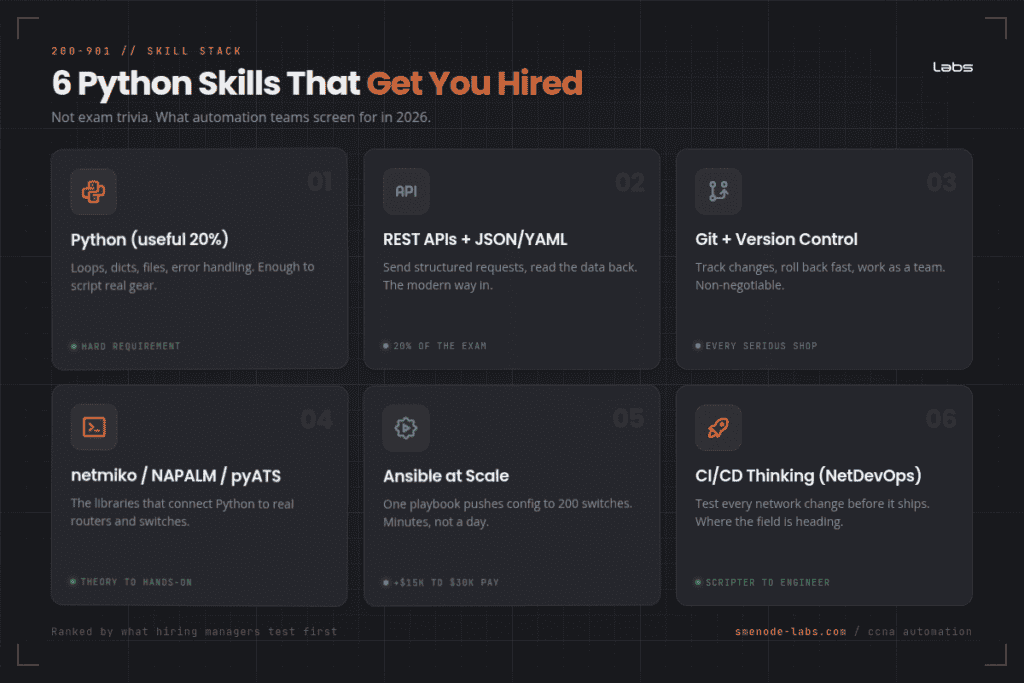
Below are the six skills employers screen for, in the order they’ll test you. Learn these and the cert becomes proof, not just a line on your resume.
1. Python (but only the useful 20%)
You don’t need to be a software engineer. You need the slice of Python that touches network gear.
That means loops, functions, dictionaries, and reading data from files. Add error handling so your script doesn’t die on the first unreachable device. That’s most of it. Honestly, the person who can write a clean 40-line script that pulls the config off 50 switches beats the person who memorised every Python library and never automated anything real.
Python shows up in nearly every network automation job posting as a hard requirement, not a nice-to-have. So this is non-negotiable. But the bar for entry is lower than you think. Here’s a concrete first project: the free BGP automation lab PDF, Python and Netmiko across multiple autonomous systems.
2. REST APIs, JSON, and YAML
This is the biggest chunk of the exam, and the biggest chunk of the job. APIs are 20% of the 200-901 blueprint, the largest single domain.
Modern gear doesn’t want you typing commands. It wants you sending structured requests. A REST API is how your Python script asks a controller, a firewall, or a cloud platform to do something. JSON and YAML are the formats that data comes back in. Get comfortable reading both.
Think of it like ordering food through an app instead of shouting across a counter. The API is the app. JSON is the receipt. Once this clicks, half the automation world opens up.
3. Git and version control
Here’s the one that surprises people. Employers care about Git almost as much as Python.
Why? Because automation without version control is a disaster waiting to happen. Git tracks every change to your scripts and configs. It lets a team work on the same automation without overwriting each other. If you push a broken change, you roll it back in seconds. Every serious automation shop runs on Git. Full stop.
Learn git add, commit, push, pull, and branching. That’s enough to start. And put your practice scripts on a public GitHub profile, because hiring managers look.
4. netmiko, NAPALM, and pyATS
These are the libraries that connect Python to actual network devices. This is where theory becomes “oh, it moved a real config.”
- netmiko logs into devices over SSH and runs commands. The easiest entry point.
- NAPALM gives you one consistent way to talk to gear from different vendors. Cisco, Juniper, Arista, same code.
- pyATS is Cisco’s own testing framework. It checks that your network is actually in the state you think it’s in.
You won’t master all three overnight. Start with netmiko. Get one script pulling show output from a lab router. That single win teaches more than a week of reading.
5. Ansible for configuration management
Python writes custom logic. Ansible pushes standard config at scale, fast, without writing much code at all.
Say you need the same VLAN on 200 switches. Doing it by hand? A day of copy-paste and typos. With Ansible? One playbook, a few minutes, zero drift. That’s the pitch, and it holds up.
Ansible plus Python is the combo that pays. Job data shows candidates who pair Python with Ansible or Terraform pull offers $15K to $30K higher than Python alone (recruiting salary reports back this up). Learn the basics: inventory, playbooks, and a handful of network modules.
6. CI/CD thinking (NetDevOps)
This is the skill that separates a scripter from an automation engineer. And it’s the one that moves your salary the most.
CI/CD means your network changes get tested automatically before they go live, the same way software teams ship code. Push a config change, a pipeline validates it, and only clean changes reach production. It’s called NetDevOps when applied to networks, and it’s the direction the whole field is heading.
You don’t need to be an expert here to get hired at the associate level. You need to understand the concept and have built one small pipeline. Our DevOps Workbook walks through building a real CI/CD pipeline from scratch, and the same push-test-deploy mindset maps straight onto network automation. It pairs perfectly with the 200-901 material.
What the 200-901 exam actually covers
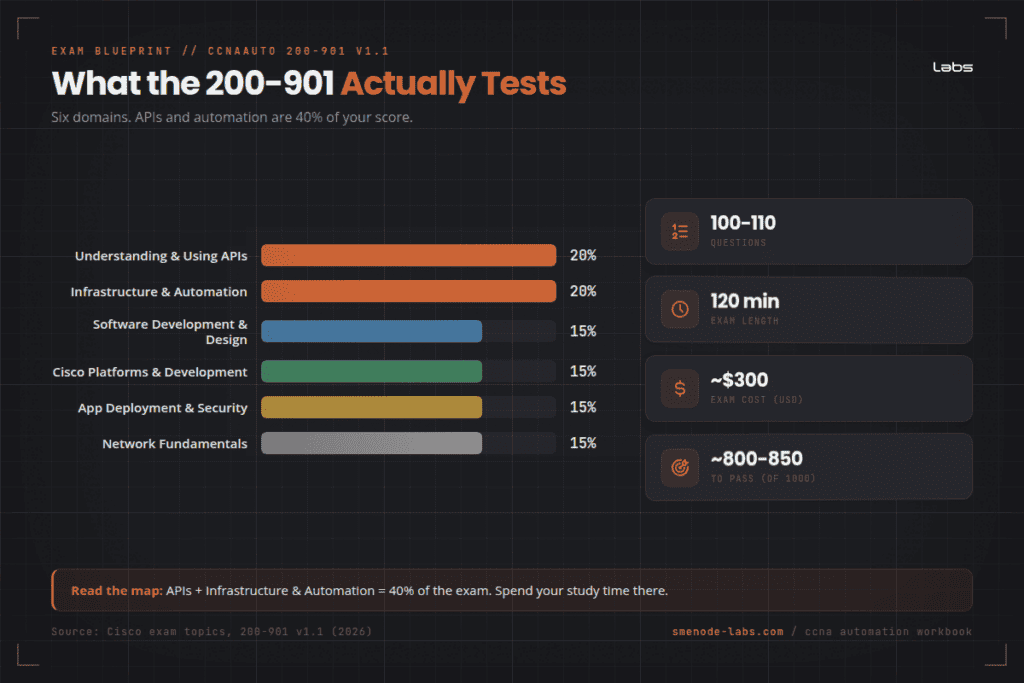
The exam is CCNA Automation (CCNAAUTO 200-901 v1.1). Around 100 to 110 questions, 120 minutes, and it costs about $300 USD plus tax (exam details). Passing score sits near 800 to 850 out of 1000.
Here’s how the six domains break down by weight. This is your study priority map:
| Domain | Weight | What it tests |
|---|---|---|
| Understanding and Using APIs | 20% | REST APIs, JSON, request/response, auth |
| Infrastructure and Automation | 20% | Ansible, controllers, config management, CI/CD basics |
| Software Development and Design | 15% | Python basics, data structures, design patterns |
| Cisco Platforms and Development | 15% | Meraki, DNA Center, SDKs, webhooks |
| Application Deployment and Security | 15% | Containers, deployment, securing apps |
| Network Fundamentals | 15% | The networking layer under it all |
Notice the pattern? APIs and automation together are 40% of the exam. Python design is another 15%. The exam is telling you where to spend your time. Listen to it.
One thing to keep in mind. The 200-901 assumes you already know networking basics, roughly CCNA-level. If subnetting and routing still feel shaky, shore that up first. The automation stuff sits on top of it, not instead of it.
How much do these skills actually pay in 2026?
Short answer? A lot more than pure networking. Let’s look at real numbers.

A Network Automation Engineer in the US averages between $110K and $130K a year, depending on the source. Salary.com puts the average around $130K (Salary.com). Senior roles push $160K to $180K. Top earners clear $198K. And CCIE Automation holders working as staff architects? North of $170K, often well past it.
Compare that to a traditional network engineer topping out around $95K to $110K in many markets, and the automation premium is obvious.
The gap comes from scarcity. Plenty of people can configure a switch. Far fewer can write the Python that configures 500 switches while they sleep. That scarcity is your edge, and it’s growing. Gartner projects that by 2026, 30% of enterprises will automate more than half of their network activities, up from under 10% a few years back (Gartner). Every one of those enterprises needs people who can do this.
The US Bureau of Labor Statistics groups these roles under computer and IT occupations, which it projects growing much faster than the average job through 2033 (BLS). Translation: the demand isn’t a fad. It’s a decade-long trend, and you’re early enough to ride it.
Here’s what actually moves the needle. Help desk techs who spend six months on Python, netmiko and Ansible and then pass the 200-901 do start getting interviews. What closes those interviews is usually the GitHub repo full of small automation scripts built while studying, not the certificate itself. The cert gets you in the room. The projects get you the job.
That’s the pattern. Every single time.
How to build the skills that get you hired
Reading about automation teaches you nothing. Building it teaches you everything. Here’s the path that works, in order.
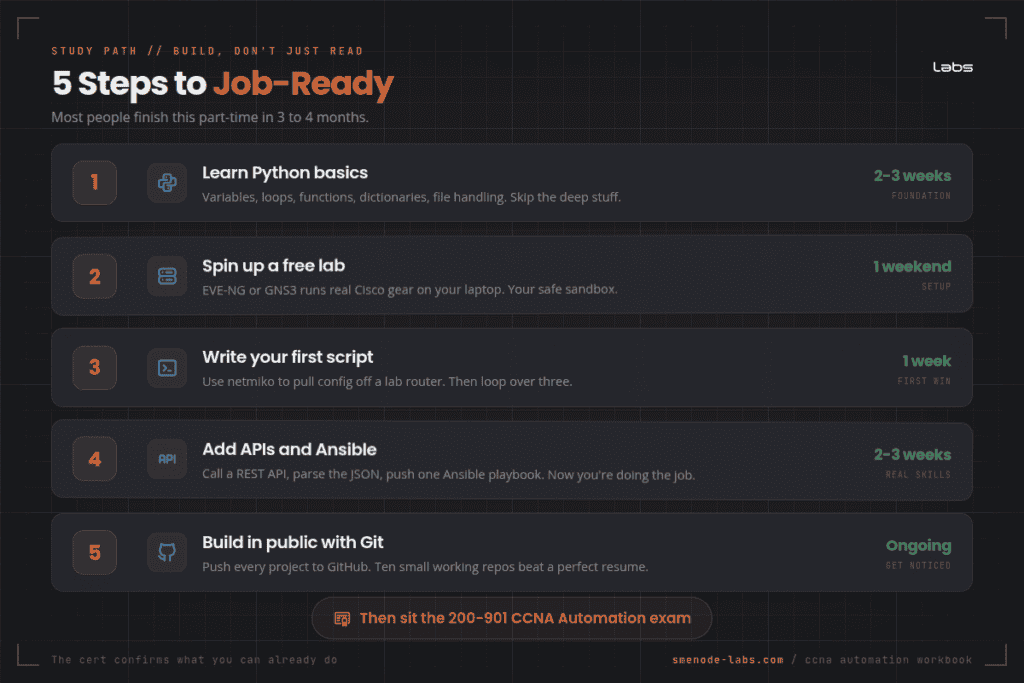
Step 1: Get Python basics down (2 to 3 weeks)
Focus on variables, loops, functions, dictionaries, and file handling. Skip the deep computer-science stuff. You want enough to write a script that reads a list of devices and does something to each one. That’s the goal.
Step 2: Spin up a free lab (1 weekend)
You need real gear to automate, and you can get it for free. Virtual labs like EVE-NG let you run Cisco routers and switches on your own laptop. That’s your safe sandbox to break things.
Not sure which lab tool to pick? We compared the main options in Cisco Modeling Labs vs EVE-NG vs GNS3, and there’s a full list of hands-on builds in CCNA labs you can build free in EVE-NG. Start with a two-router topology. Keep it small. The DevOps workbook range covers the CI/CD and Kubernetes side of the same skill set.
Step 3: Write your first automation script (1 week)
Use netmiko to log into a lab router and pull show ip interface brief. Print the output. That’s it. It sounds tiny. It’s the moment automation stops being abstract.
Then extend it. Loop over three routers instead of one. Save the output to a file. Add a line that flags any interface that’s down. Each small step builds the muscle.
Step 4: Add APIs and Ansible (2 to 3 weeks)
Practise calling a REST API from Python and parsing the JSON that comes back. Cisco’s DevNet Sandbox gives you free, always-on gear to hit with real API calls. Then write one Ansible playbook that pushes a config to your lab devices.
By now you’re doing the actual job. Not studying it. Doing it.
Step 5: Build in public and track it with Git
Push everything to a public GitHub profile. Even the ugly early scripts. A repo with ten small, working automation projects beats a perfect resume with none. Hiring managers check GitHub before they call you. Give them something to find.
This whole path takes most people three to four months part-time. Faster if you already know networking. The 200-901 cert slots in near the end, once the skills are real and the exam is just confirming what you can already do. Cloud is the other half of most automation roles, mapped in the AZ-104 Azure administrator path.
Want the structure done for you? The CCNA Automation Workbook maps this exact path to the exam blueprint, with every lab and script laid out. No guessing what to learn next.
Does the cert even matter, or just the skills?
Fair question. And the honest answer is: both, but skills win ties.
The cert gets you past the resume filter. A lot of job postings list 200-901 or “DevNet” as a preferred qualification, and recruiters screen for it. Without it, you can still get hired, but you’re fighting uphill against candidates who have it. With it, you’re in the pile that gets read.
But the skills close the deal. Nobody hires you because you passed a test. They hire you because they believe you can automate their network without breaking it. The cert says “I studied.” The GitHub repo and the lab projects say “I can do this.” You want both saying the same thing.
There’s a bigger shift happening too. Cisco added agentic AI to the CCNA itself in the latest update, which we broke down in CCNA v2.0 now tests agentic AI. Automation and AI are merging into the baseline of what a network job even is. The 200-901 puts you on the right side of that line. Skipping it doesn’t make the trend go away. It just leaves you behind it.
Common mistakes that keep people stuck
A few traps trip up almost everyone. Dodge these and you’re ahead.
Studying theory without building anything. You can read about netmiko for a month and still not be able to write a script. Open the editor. Break something. That loop is the skill.
Memorising Python you’ll never use. You don’t need decorators and metaclasses. You need loops and dictionaries. Learn the useful 20% deeply, ignore the rest for now.
Skipping Git. People treat version control as optional. Employers don’t. Learn it early, use it on every project.
Ignoring networking fundamentals. Automation sits on top of real networking knowledge. If you can’t explain what a VLAN or a routing table does, the automation won’t make sense. Keep both muscles strong.
Waiting until you feel “ready” to build in public. You never will. Post the messy scripts now. Progress beats polish, and the public repo is what gets you noticed.
Bottom line
The 200-901 DevNet exam is now CCNA Automation, and that rename is Cisco telling you automation is the new normal for network careers. The cert opens the door. The Python network automation skills walk you through it.
Here’s your recap:
- The exam is the same 200-901, now called CCNA Automation. APIs and automation make up 40% of it.
- The six skills that get you hired: Python basics, REST APIs and JSON/YAML, Git, netmiko/NAPALM/pyATS, Ansible, and CI/CD thinking.
- The pay runs $110K to $130K on average, with senior roles hitting $180K, and the Python-plus-Ansible combo adding up to $30K.
- The path is build, don’t just read. Lab it, script it, push it to GitHub, then sit the exam.
Don’t wait until you feel ready. Spin up a free lab this weekend, write one netmiko script, and watch it pull config off a router. That single script is the start of a six-figure skill.
Ready to make it structured? Grab the SMEnode Labs CCNA Automation Workbook and build every 200-901 skill with guided Python labs. And if you’d rather learn it live with an instructor walking you through real automation projects, SMEnode Academy’s CCNA Automation course takes you from first script to job-ready. An emulator with nothing in it teaches you nothing. Here are 10 free CCNA labs you can build in EVE-NG.
Your first automation script is 30 minutes away. Go write it.