Want the full lab as a free PDF? Download it now, no cost. It’s a real 7-router BGP project you automate end to end with Python. No manual CLI. Grab the file, open GNS3, run one script, watch BGP converge across 4 autonomous systems.
Here’s the short version. This free download hands you a working network automation project, not a theory dump. You get the topology, the IP plan, the full Python script, and the verification commands. Build it once and you’ve got a portfolio piece hiring managers actually recognise.
What’s inside the free PDF?
One file. Everything you need to build and automate the lab.
- The full topology – 7 Cisco routers across AS100, AS200, AS300 and AS400
- Complete IP addressing plan – every interface, loopback and subnet mapped out
- The whole Python + Netmiko script – copy, paste, run. It configures all 7 routers for you.
- eBGP and iBGP design – update-source, ebgp-multihop, next-hop-self, full-mesh iBGP
- OSPF as the IGP inside AS400 – so your iBGP loopback sessions actually form
- Step-by-step setup – Python, VS Code, GNS3, and how to pull console ports
- Verification and troubleshooting – the exact show commands and the fixes for common BGP errors
Print it, keep it on a second monitor, or follow it click by click. The free lab guide works either way.
Why bother learning network automation?
Because the pay gap is real.
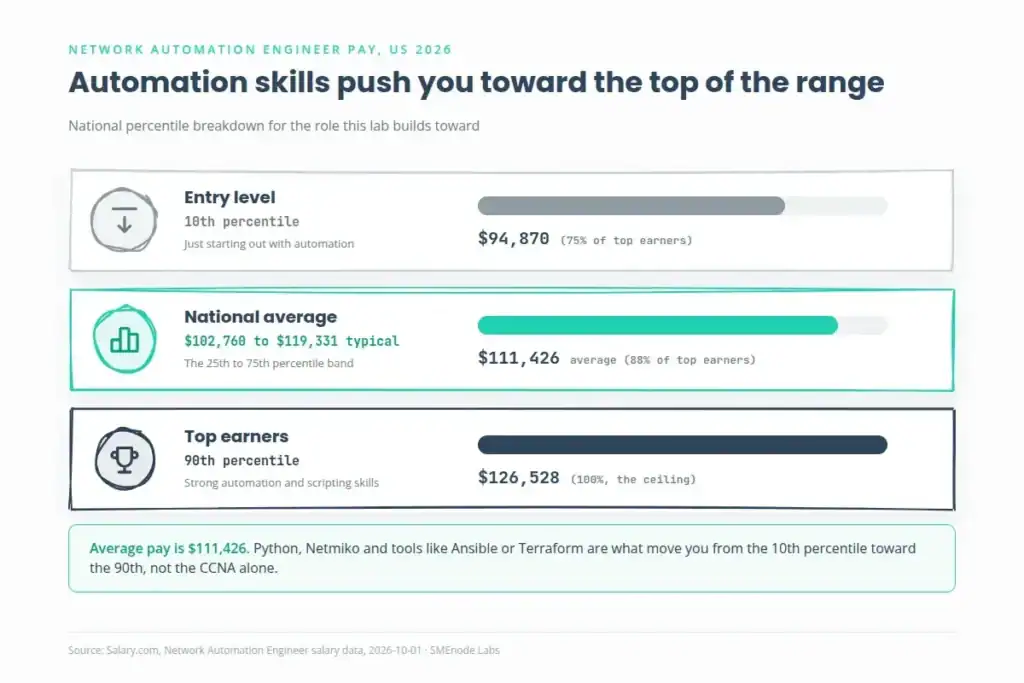
The average network automation engineer in the US earns $111,426 a year, with the middle half of the market landing between $102,760 and $119,331 (Salary.com, October 2026). Top earners at the 90th percentile clear $126,528. Automation and Python are what move you up that range, not just a CCNA badge. Thinking past the exam? The 200-901 DevNet skills that get you hired shows what employers ask for, and the CCNA Automation Workbook is built around the same 60+ labs covering Python, YANG, NETCONF and RESTCONF.
The demand side backs it up. Gartner projected that 30% of enterprises would automate more than half of their network activity by 2026, up from under 10% in 2023 (Gartner, via IT Brief). “Knows BGP” is table stakes. Automates BGP with Python is what gets you hired.
This free BGP lab sits right at that intersection. Real routing protocol, real automation, one project.
Who is this free lab for?
- CCNP and CCIE students who want a hands-on BGP project, not just flashcards
- Network engineers moving from CLI into Python and Netmiko
- Career switchers who need one strong portfolio project to show
- Anyone studying for a routing exam who learns better by building
If you’ve configured a router by hand before and you’re curious what “zero-touch” really means, start here. Get the PDF free and see it work. Want more reps after this one? 60+ hands-on automation labs cover DNA Center, Meraki and IOS-XE automation, not just BGP.
What you’ll actually build
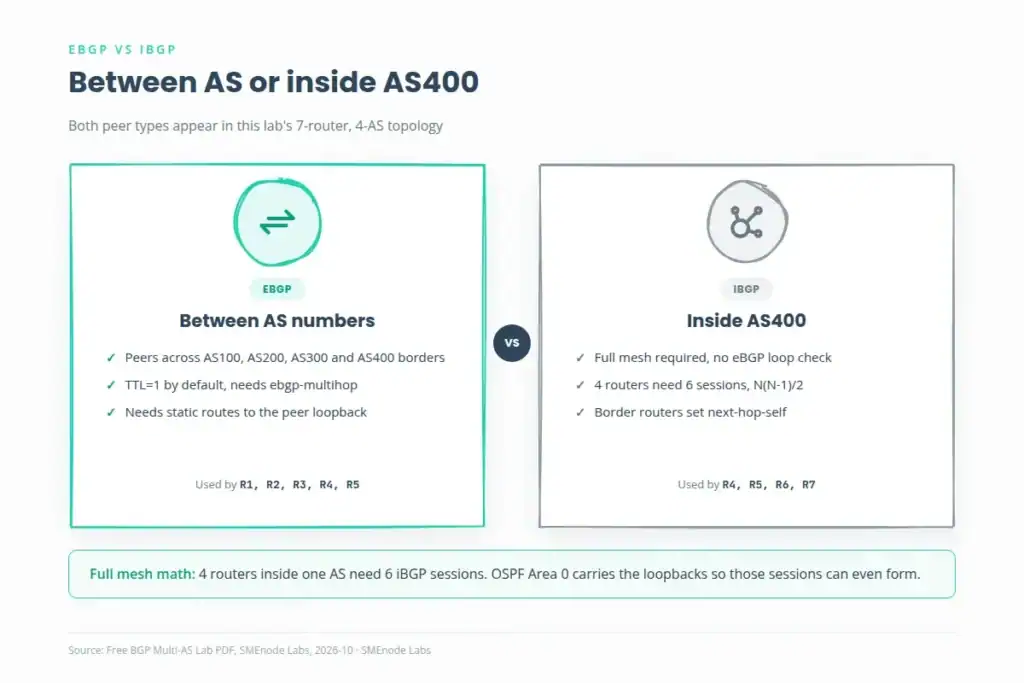
The lab is a multi-AS BGP network, the kind that mirrors how the internet is stitched together.
- 4 autonomous systems connected through eBGP border routers
- Full-mesh iBGP inside AS400 across R4, R5, R6 and R7 (6 sessions total)
- OSPF Area 0 carrying loopbacks so those iBGP sessions can form
- Best-practice BGP attributes applied consistently across every device
- One Python script that pushes IP config, static routes, OSPF and BGP to all 7 routers, then saves the config
You run it once. Ninety seconds later BGP is converging and routes are crossing AS boundaries. That’s the whole point of automation. Hours of typing become one command. Ready to go past BGP? The free Terraform Commands PDF covers the other automation tool this lab’s own next-steps point to.
How to use the download
- Grab the free PDF from the button above
- Install Python, VS Code and GNS3 (the guide walks you through it)
- Build the 7-router topology in GNS3
- Paste the automation script and run it
- Verify with
show ip bgp summaryand watch every neighbor hit Established
That’s it. No paywall, no trial. It’s a free download you keep.
This lab is one project. The 200-901 CCNAAUTO workbook is 60+ of them, with a ready-to-use lab environment so you run your first Python or NETCONF session against a live Cisco DevNet Sandbox device in under ten minutes, plus the EVE-NG ISO for everything else.