Five months into CCNA prep. Subnetting nailed, every OSPF scenario in the workbook worked through, two weeks from booking the exam. Then someone in the study group drops a link to Cisco’s v2.0 announcement. “There’s a whole AI section now,” the message says. Is your prep useless?
It wasn’t. And yours isn’t either.
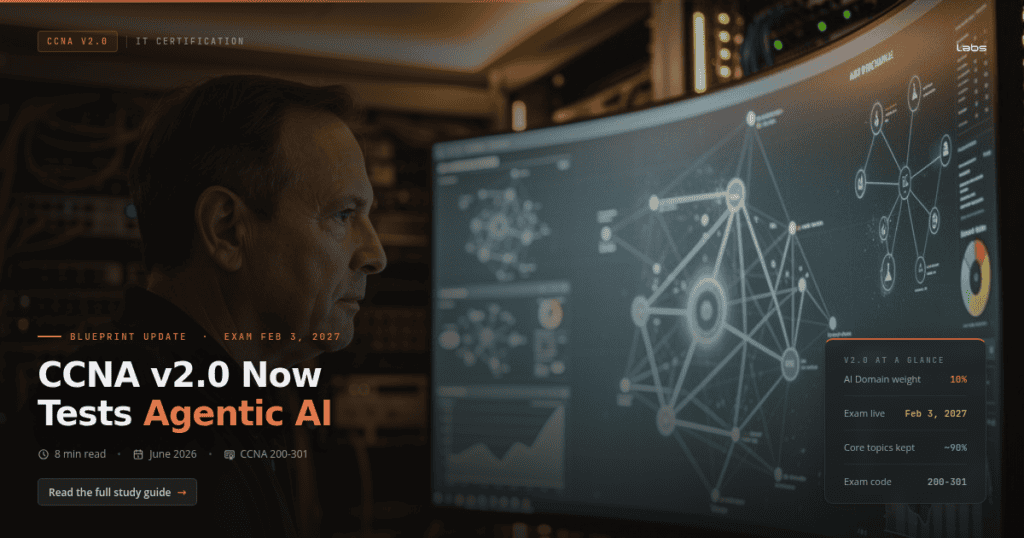
On May 20, 2026, Cisco announced CCNA v2.0 at Cisco Live in Las Vegas. It’s the biggest change to the 200-301 blueprint in nearly seven years. The exam goes live February 3, 2027. And yes, there’s a new AI domain built in. Want the condensed version to revise from? The free CCNA 200-301 PDF is 27 pages with Packet Tracer commands.
Here’s the short version: about 90% of what you’re studying still applies. The new AI section is 10% of the exam and it’s conceptual, not hands-on. But the language Cisco used in the official blueprint is specific, and the content is genuinely new.
This article covers every change, what the CCNA v2.0 agentic AI section actually expects from you, the full domain weight breakdown, and how to adjust your study plan without losing months of work.
Already studying for v1.1? Our CCNA 200-301 Workbook covers the full current blueprint with 200+ practice scenarios and hands-on labs. If you want to sit the exam before February 2027, this gets you there. An emulator with nothing in it teaches you nothing. Here are 10 free CCNA labs you can build in EVE-NG.
What Is CCNA v2.0?
Still 200-301. The exam code doesn’t change. But the blueprint does.
V2.0 was announced on May 20, 2026 and goes live on February 3, 2027. The current v1.1 exam runs until February 2, 2027. After that, every CCNA candidate sits v2.0.
The update cuts six domains down to five, introduces a brand-new AI section, significantly increases the troubleshooting weight, and dissolves the standalone Automation and Programmability domain.
Not a full rebuild. A focused refresh that reflects where networking is actually going.
CCNA v2.0 Domain Weights: Full Breakdown

Before getting into what changed, here’s the full picture. These are the five domains and their approximate exam weights for v2.0, compared to v1.1.
| Domain | v1.1 Weight | v2.0 Weight | Change |
|---|---|---|---|
| 1. Network Fundamentals / Infrastructure | 20% | 25% | +5% |
| 2. Network Access / Switching | 20% | 25% | +5% |
| 3. IP Connectivity / Routing | 25% | 20% | -5% |
| 4. Security Fundamentals | 15% | 15% | no change |
| 5. AI and Network Operations (new) | n/a | 10% | new |
| 6. Automation and Programmability (old) | 10% | dissolved | removed |
| IP Services | 10% | absorbed | restructured |
Weights are approximate. Check the official Cisco v2.0 exam topics for exact figures.
The big takeaway from this table: fundamentals and switching go up, the old automation domain disappears, and AI comes in at 10%. Routing actually drops slightly in weight. If you’ve been burying yourself in routing protocol labs at the expense of core switching and subnetting, the new weights are a reason to recalibrate.
The New AI Domain: What Cisco Is Actually Testing
This is what everyone’s been asking about since the announcement.
The new Section 5.0 is titled “AI and Network Operations.” Cisco’s official blueprint language includes this specific statement:
“As part of the exam, you may be required to evaluate output and recommendations from agentic AI and digital network assistants to support network operations and troubleshooting activities.”
Evaluate output. That phrase is deliberate. You’re not being asked to build AI systems. You’re being asked to look at what an AI tool recommends and assess whether it’s right.

The section breaks into three core areas.
1. Agentic AI in Network Operations
Most people studying for CCNA have heard of generative AI. ChatGPT, Claude, that sort of thing. But agentic AI is different, and Cisco specifically chose that term.
Generative AI creates content. You ask it a question, it returns text.
Agentic AI takes action. It doesn’t just describe a problem. It can run show commands on network devices, read the telemetry, analyse the output using a large language model, and pick a course of action, all without a human approving each step.
That’s the architecture Cisco is testing. You need to understand what agentic AI is, how it fits into modern network operations, and how it differs from Ansible-based automation.
The exam verbs here are “describe” and “explain.” Not “configure.” Not build. You’re demonstrating conceptual understanding, not lab skills.
2. Prompt Engineering for Generative AI

Honestly, this one caught a lot of people off guard when the blueprint dropped. Prompt engineering on a networking exam?
It makes sense once you think about it. Network engineers are already using ChatGPT, Claude, and Cisco’s own AI tools inside Catalyst Centre to help troubleshoot. Cisco wants to know you can use those tools responsibly and effectively.
The v2.0 blueprint covers four specific elements of prompt engineering:
| Element | What It Means | Example |
|---|---|---|
| Data classification | What sensitivity level is the data you’re sharing? | “This syslog is from a production router, classify as internal” |
| Output format | How should the AI structure its response? | “Return results as a numbered list” |
| Persona | What role should the AI take? | “Act as a senior network engineer” |
| Instructions | What task do you actually want completed? | “List any interface errors and their likely causes” |
A well-formed prompt using all four: “Act as a senior network engineer [persona]. Here is a sanitised syslog from a production router [data, classified as internal]. List any interface errors in a numbered list with likely causes [output format + instructions].”
The exam wants you to know why that prompt is well-formed. Not just that it worked.
3. Network Management Approaches
This content existed in v1.1 but got reorganised under Section 5.0 in v2.0. You need to compare five approaches: device-based, cloud-based, controller-based, automation-based, and Infrastructure as Code.
The v2.0 framing is explicitly about where AI fits into each model. Cloud-based and controller-based approaches (Cisco Catalyst Centre) are where AI features live. Device-by-device CLI management is where they don’t.
Here’s what the new domain looks like in an actual job. A junior network admin who passed v1.1 in early 2025 is already using Cisco Catalyst Centre’s AI analytics every day. The platform flags WAN link anomalies and suggests optimisations. Evaluating those recommendations, deciding which ones to act on and which to skip, is the work. The v2.0 AI domain mostly formalises what that job already looks like. Nothing scary. Just documented.
What the AI Section Doesn’t Expect From You
Let’s be direct here because there’s been a lot of anxiety since May 20.
You don’t need to:
- Write Python code to interface with AI APIs
- Understand how large language models work internally
- Train or fine-tune any AI model
- Know transformer network architecture
- Be an AI or ML engineer in any sense
The exam verbs for every AI topic in Section 5.0 are “describe,” “explain,” and “compare.” That’s Bloom’s level 2. Conceptual understanding. You need to know what these technologies are, how they apply to networking, and how to critically assess AI output when you see it.
This mirrors how v1.1 handled automation. You needed to know what Ansible is, what REST APIs are, what JSON looks like. You didn’t need to write production playbooks. Same logic applies to v2.0’s AI section.
What Else Changed in the Blueprint?
The AI domain gets the headlines. But the structural shifts elsewhere matter just as much for your prep.
Networking Fundamentals + Switching = 50% of the Exam
V1.1 had these at roughly 20% each, about 40% combined. V2.0 bumps both to 25%, so half the exam is now subnetting, VLANs, EtherChannel, STP, and Ethernet fundamentals.
If you’ve been skimming these because they felt basic, that’s the clearest signal to revisit them.
Troubleshooting Weight Increased Sharply
Probably the most significant change for how you should actually prepare.
V1.1 asked you to configure. V2.0 asks you to diagnose and fix. Topics that previously required only configuration now require troubleshooting. You can’t just know how to set something up. You need to know what breaks, why it breaks, and how to isolate the fault.
This is the biggest performance-level shift in the blueprint’s history. If you’ve been doing configuration-only labs, you need to add fault-injection practice. Build a working scenario. Then break it. Fix it. That’s the skill v2.0 rewards.
The Automation Section Was Dissolved
V1.1 had a dedicated “Automation and Programmability” domain. In v2.0, it’s gone as a standalone. Its content (REST APIs, YANG models, Ansible concepts, JSON/XML) got absorbed into Section 5.0 alongside the AI topics.
Nothing was lost. It was just reorganised. If you’re studying v1.1 materials and hit the automation chapter, that content still counts in v2.0. It just lives under a different label.
A Few v1.1 Topics Were Removed
Some specifics from v1.1 don’t appear in v2.0, including detailed physical cabling type comparisons and some topology architecture detail. These were minor exam contributors. Not worth worrying about.
Should You Take v1.1 Before February 2027?
A fair question. Here’s a realistic decision guide.
If you’re 80%+ ready right now: Book v1.1. You have until February 2, 2027. Don’t add complexity when you’re nearly done.
If you’re 50-70% into your prep: It depends. The AI section adds genuine study time. But if you already use AI tools at work or personally, the learning curve is low. Do an honest estimate of how long the remaining v1.1 content will take versus what v2.0 adds.
If you’re just starting: Target v2.0. You’ll study for the more current exam, your credential will reflect skills relevant to jobs posted right now, and the core content is the same.
One point worth knowing: v1.1 and v2.0 produce the same credential. A CCNA is a CCNA. Your recertification cycle is three years from pass date regardless of which version you sit.
How to Adjust Your Study Plan for v2.0

Here’s a five-step approach for anyone targeting v2.0 or wanting to stay prepared for it.
Step 1: Keep your current plan for core topics.
Subnetting, VLANs, STP, OSPF, ACLs, NAT, wireless fundamentals, security concepts. These are still the bulk of the exam. Don’t abandon what’s working.
Step 2: Allocate 10 to 15 hours to the AI section.
Proportional to its 10% weight. Cover agentic AI basics, the four elements of prompt engineering, and the five network management approaches. That’s enough.
Step 3: Spend time with at least one AI tool.
You don’t need expert-level skills. Spend a few sessions using ChatGPT or Claude to troubleshoot mock scenarios. Write prompts using the four components: data classification, output format, persona, instructions. Then check whether the AI’s answer is actually right. That last part is specifically what the exam tests.
Step 4: Learn what Cisco Catalyst Centre does with AI.
Catalyst Centre’s ML features, anomaly detection, network health scoring, failure prediction, are directly relevant to the exam. Understanding them at a conceptual level puts you squarely in what Section 5.0 is testing. The Cisco Learning Network has the full v2.0 blueprint and prep resources.
Step 5: Shift more practice time to troubleshooting.
Given the heavier troubleshooting weight, configuration-only labs are no longer enough. Practise diagnosing broken scenarios. Break your own labs on purpose. Fix them. Repeat.
Suggested Study Timeline (Starting from Scratch)
| Month | Focus |
|---|---|
| Months 1-2 | Network fundamentals, subnetting, switching (50% of exam) |
| Month 3 | IP routing (OSPF, BGP basics, static routes) |
| Month 4 | Security fundamentals, ACLs, AAA |
| Month 5 | AI and Network Operations section + automation concepts |
| Month 6 | Troubleshooting labs, practice exams, weak spots |
This assumes roughly 10-15 hours per week. Adjust based on your starting point.
Want lab scenarios that cover both configuration and troubleshooting? The SMEnode Labs CCNA Workbook includes both. Each topic has build-and-verify labs and fault-finding exercises. For live instruction on tougher topics, SMEnode Academy’s CCNA course covers the full blueprint with a certified instructor.
Dev had been studying CCNA for six months when the v2.0 announcement hit. He’d never used AI tools before and figured the new section meant deep ML knowledge. He spent three weeks working through machine learning courses, completely off course. When he finally read Cisco’s official v2.0 exam topics PDF, the verb column stopped him. “Describe agentic AI in network operations.” Not configure. Not build. Describe. Three weeks of ML theory for a topic that needed about 8 hours of focused reading. Don’t be Dev. Read the official blueprint topics first.
What About Study Materials Right Now?
Most existing CCNA materials, books, video courses, workbooks, were built for v1.1. That includes ours.
The good news: about 90% of v1.1 material maps directly to v2.0. For the AI domain specifically, supplement with:
- Official Cisco Learning Network – v2.0 exam topics are already published
- Cisco’s blog announcement – explains the philosophy behind the changes
- Wendell Odom’s certskills.com – the most detailed public breakdown of the v2.0 blueprint (Odom writes the official Cisco Press cert guides)
The SMEnode Labs v2.0 workbook is scheduled for the second half of 2026. It’ll cover the AI domain in full alongside updated troubleshooting labs.
Frequently Asked Questions
Does the CCNA v2.0 require coding skills?
No. The AI section uses verbs like “describe” and “explain.” No coding, no model training, no Python scripting for AI. That stays at higher cert levels.
Is a CCNA earned on v1.1 worth less than one on v2.0?
No. The credential is the same. Both certifications say “CCNA” and carry a three-year recertification cycle. No employer distinguishes between versions.
Will my v1.1 study materials be useless after the transition?
Not at all. About 90% of the content transfers. You’d need to supplement with the AI domain and adjust your troubleshooting practice. Everything else carries over.
Can I still take the v1.1 exam in 2026?
Yes. The v1.1 exam runs until February 2, 2027. If you’re ready before then, take it.
What is “agentic AI” in simple terms?
An AI system that can take actions on your behalf, not just answer questions. In networking, that means it can run commands on devices, interpret the output, and make decisions without waiting for a human to approve each step.
How much time do I need to study for the AI section?
About 10 to 15 hours for most candidates. It’s 10% of the exam and all conceptual. You’re not doing lab work in this section.
Bottom Line
CCNA v2.0 adds a 10% AI domain and increases the troubleshooting weight across the board. That’s the real story. Your core prep stays valid.
What actually changed:
- New AI and Network Operations domain (10%), covering agentic AI, prompt engineering, and network management approaches
- Networking fundamentals and switching combined = 50% of the exam (up from 40%)
- Troubleshooting weight increased sharply, biggest performance-level shift in the blueprint’s history
- Standalone Automation domain dissolved into Section 5.0
- A handful of minor v1.1 topics removed entirely
The decision is straightforward. If you’re almost ready, sit v1.1 before February 2027. If you’re just starting, study for v2.0 and get the current credential.
Either way, the hands-on troubleshooting practice you put in is the skill that carries you through.
Get the CCNA 200-301 Workbook and start building that lab confidence today.