AIOps can now cut troubleshooting time from hours to minutes. That’s not a sales pitch. That’s what happens when an AI correlates thousands of events at once and hands you the root cause before you’ve finished your coffee. The CCNA Automation Workbook runs Python and API labs against real devices in EVE-NG.
Sounds great, right? It also scares a lot of people.
If you’re a network engineer, you’ve probably wondered whether AI in networking is about to make your job disappear. Short answer: no. Longer answer, the one that actually matters for your career: the job is changing, and the engineers who adapt are pulling ahead fast. This guide breaks down what’s real, what’s hype, and exactly which skills pay in 2026. Here’s a concrete first project: the free BGP automation lab PDF, Python and Netmiko across multiple autonomous systems.
Here’s what you’ll get: a clear picture of what AI in networking looks like today, the skills employers are paying a premium for, how your certifications are shifting, and a starting plan you can act on this week. Let’s get into it.
So is AI coming for your job?
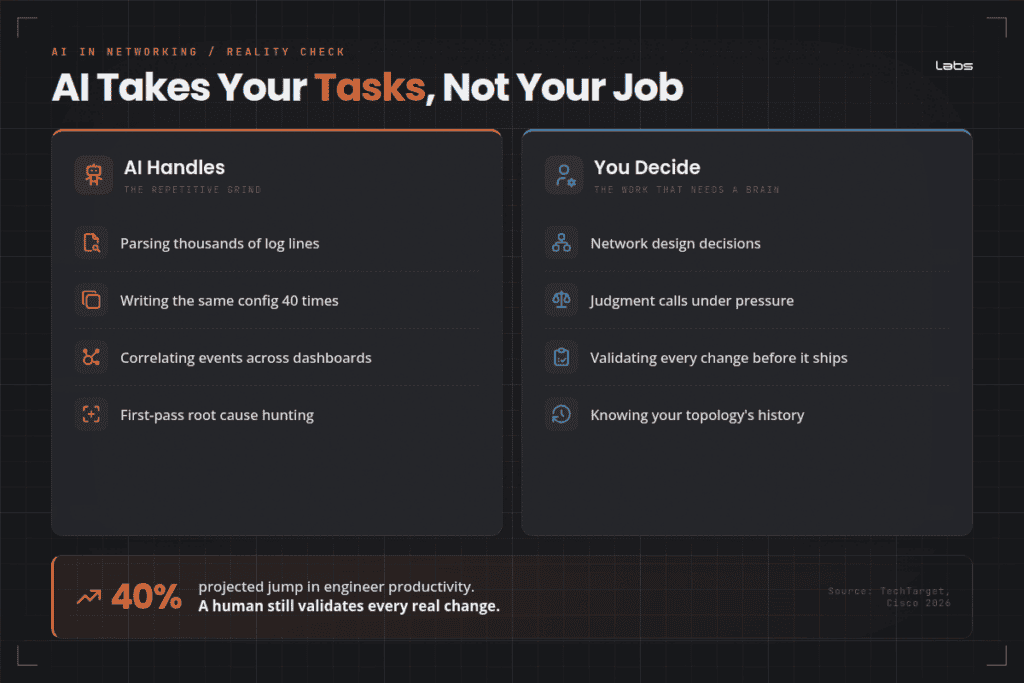
No. But it’s coming for your tasks.
Big difference. The boring, repetitive stuff, like parsing logs, writing the same config 40 times, chasing a root cause across six dashboards, that’s what AI eats first. What’s left is the work that actually needs a human: design decisions, judgment calls, knowing when the “obvious” fix will break something three hops away.
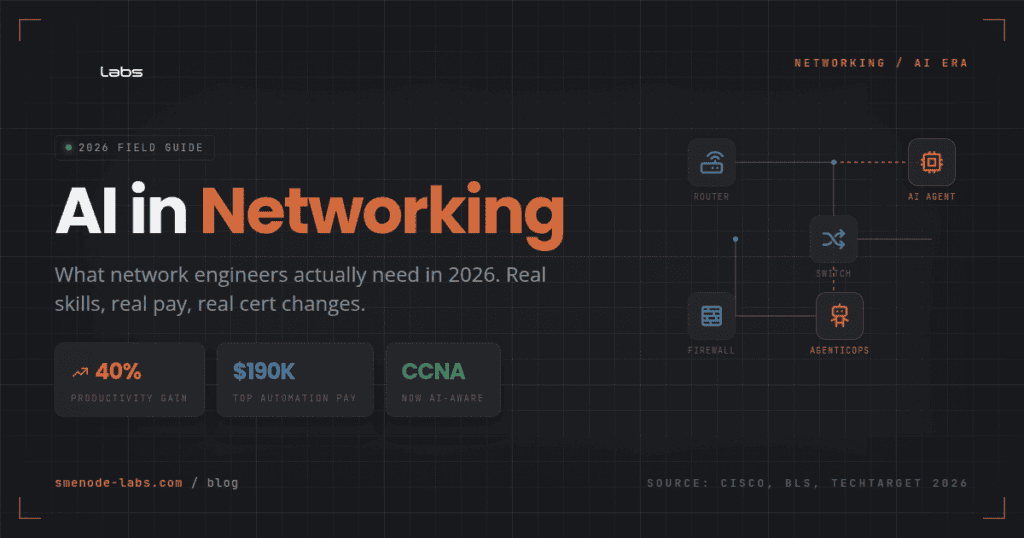
Cisco made this crystal clear at Cisco Live 2026. They unveiled AgenticOps, a model that pairs AI agents with automation and human oversight. Agents sense an issue, reason through the root cause, suggest a fix, and a human validates before it ships. Notice the last part. A human validates.
That’s the pattern across the whole industry now. AI does the grunt work. You do the deciding.
AI is projected to drive around a 40% jump in engineer productivity. Read that as a warning if you want. Or read it the way smart engineers do: one person can now cover the work that used to take three. The engineers who stay valuable are the ones who make AI do the covering.
Want to see this in practice? Our free network automation Python lab walks you through automating a real BGP setup, the exact kind of task AI tools now assist with daily. Thinking past the exam? The 200-901 DevNet skills that get you hired shows what employers ask for.
What AI in networking actually looks like in 2026
Forget the movie version. No robot is racking your switches. Here’s the real breakdown.
AIOps. This is the foundation. AI watches your network, learns what “normal” looks like, and flags the weird stuff before users complain. When something breaks, it correlates events and points at the cause instead of dumping 900 log lines on you.
Agentic workflows. The newer layer. Instead of just alerting, AI agents can now propose and stage remediation. Cisco’s rollout of agentic capabilities for Campus, Branch, and Industrial started in February 2026, with Data Center following through the year. These agents work from the same live evidence you do, and context carries across shifts, so the night team isn’t starting from zero.
Assisted config and troubleshooting. This is the part you’ll touch every single day. Engineers who get the most value combine a vendor’s built-in AI for operational tasks with a general LLM for everything else. Ask it to write a script. Ask it to explain a weird OSPF adjacency. Ask it to draft the change doc nobody wants to write.
Here’s what it looks like in a mid-sized ops team, a couple of thousand endpoints across a handful of sites. A recurring latency spike eats the team’s afternoons for two weeks and nobody can pin it. The flow data goes into an AIOps platform, and the correlation comes back quickly: a backup job hammering a single uplink every 30 minutes. The fix takes 10 minutes. Finding it used to take days. Nobody got replaced. The team got its afternoons back.
That’s AI in networking, 2026. Less magic, more muscle on the tedious stuff.
The skills that actually pay now

This is the section that matters for your paycheck. So pay attention.
The role in 2026 sits at the crossroads of networking fundamentals, automation, cloud, security, and AI. You don’t need all five at expert level. But you need to stop being a CLI-only engineer. That’s the shift.
Python first. Every roadmap points here. It’s the language of automation, and it’s how you talk to AI tools that generate and check your configs. You don’t need to be a software developer. You need to read a script, tweak it, and know when the AI-written version is about to nuke your routing table.
Automation tooling. Ansible and Terraform show up in nearly every serious job posting. Terraform alone reportedly adds around $16K to offers. Observability skills carry roughly a $38K premium. CI/CD pipeline experience adds about $35K. These aren’t nice-to-haves anymore.
AI literacy. Not building models. Interpreting them. Can you read an AI-generated alert and know whether to trust it? Can you tell when the “root cause” it found is actually a symptom? That judgment is the new differentiator.
Here’s the money part, and it’s stark. Network engineers who can automate with Python and Ansible earn roughly $150K to $190K or more. Engineers stuck on traditional CLI work? Around $95K to $145K. Same title, sometimes the same team. The gap is the skills.
The pattern is consistent. Engineers who stay purely CLI-focused plateau, however good the CLI work is. The ones who add Python and Ansible and rebuild their team’s provisioning as playbooks move into a different band, because they’re now solving a problem their employer can’t hire around easily. The networking knowledge was always there. Automation is what unlocks the number.
Ready to close your own skills gap? The SMEnode Academy salary guide breaks down exactly which skills move offers the most in 2026, backed by current market data.
The Bureau of Labor Statistics backs the demand up. Computer network architects earned a median of around $130K in 2024, with the field projected to grow 12% through 2034. The BLS notes plainly that companies investing in AI will need these workers to upgrade infrastructure. You can see the full outlook on the BLS occupational page.
One trap to avoid: trusting AI blindly
Here’s the mistake that’s already burning people. They ask an AI to write a config, paste it in, and ship it without reading it. Then something breaks at 2am and they can’t explain why, because they never understood the change in the first place.
AI is confident. It is not always right. It’ll hand you a perfectly formatted ACL that quietly blocks the wrong subnet, or a routing change that looks clean and creates a loop two hops out. The tool doesn’t know your topology’s history. You do.
So build one habit now: read every line before it ships. Ask the AI to explain its own change. If it can’t justify a line, that line doesn’t go in. This isn’t slowing you down. It’s the exact skill that keeps you employable, because the engineer who can catch the AI’s mistakes is worth far more than the one who just forwards its output.
Think of AI like a sharp junior engineer. Fast, tireless, occasionally very wrong. You’d never let a junior push to production unchecked. Same rule here.
That habit, reviewing and correcting AI output, is also what the new exams are starting to test. Which brings us to your certs.
What’s changing with your certifications in 2026?
A lot. And if you’re studying right now, you need to know the timing.
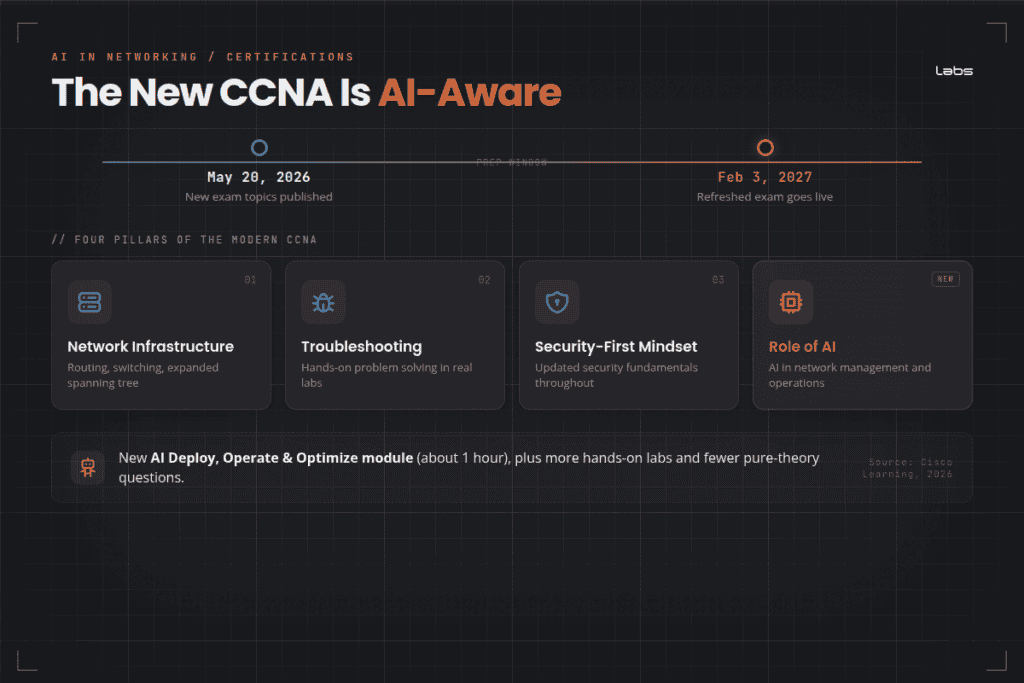
Cisco announced AI-led updates across the certification portfolio. The refreshed CCNA is the headline. New exam topics became available on May 20, 2026, and the updated exam goes live on February 3, 2027.
Here’s the part that matters. The new CCNA blueprint is built on four pillars: network infrastructure, troubleshooting and problem-solving, a security-first mindset, and understanding the role of AI in network management and operations. Yes, AI is now a named pillar of the entry-level cert. That tells you everything about where this field is heading.
There’s a dedicated AI Deploy, Operate, and Optimize module too, running about an hour. Plus more hands-on labs and fewer pure theory questions. Cisco wants proof you can actually do the job, not just recite it.
So what should you do about the timing?
If your exam is booked before February 3, 2027, you’re on the current version. Study for that. Don’t panic-switch. If you’re starting fresh and can wait, the new AI-aware blueprint is worth targeting, since it maps to what employers now want anyway. Either way, Cisco is releasing free foundational materials through Cisco U., so cost isn’t a blocker for the basics.
One thing to keep straight. A cert proves you know the fundamentals. It does not prove you can automate. Employers in 2026 want both. So treat the cert as your floor, not your ceiling.
Need current, exam-focused prep that won’t waste your time? Our CCNA workbook is built around the practical, lab-heavy skills the new blueprint rewards.
Where do you even start?
Feeling behind? Most engineers do right now. Here’s the thing. You don’t fix this in a weekend, and you don’t fix it by buying 12 courses you’ll never finish.
Start small. Pick one boring task you do every week. Automate it.
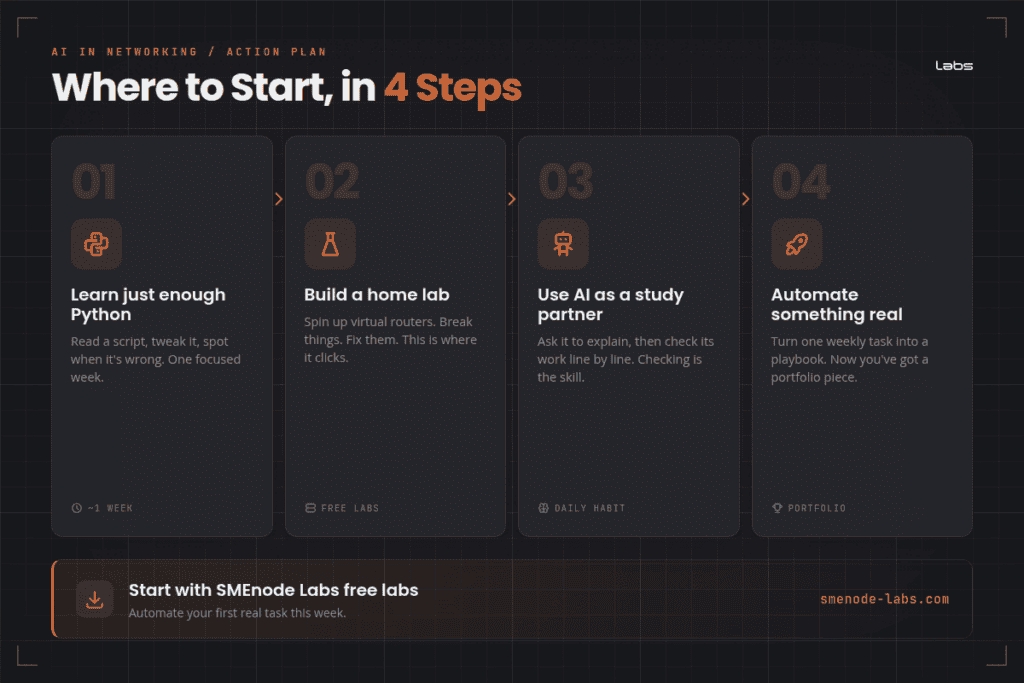
Step one: learn just enough Python. Not a computer science degree. Enough to write a script that logs into a device and pulls something useful. A week of focused practice gets you there.
Step two: build a home lab. This is where it clicks. Spin up a few virtual routers, break things on purpose, and fix them. Our free SD-Access virtual lab is a solid starting point, and the EIGRP cheat sheet keeps the fundamentals sharp while you experiment.
Step three: use AI as a study partner. Ask an LLM to explain a protocol you’re shaky on. Ask it to generate a config, then check its work line by line. That checking is the skill. You’re training the exact judgment employers pay for.
Step four: automate something real. Take that weekly task from earlier and turn it into a repeatable playbook. Now you’ve got a portfolio piece and a story for your next interview.
Start smaller than you think. Two years in and worried AI will lap you before you’ve begun? Don’t try to learn everything. Pick one thing, automating VLAN provisioning across your access switches, say, and give it three weekends. When teams reorganise, the person who has actually automated something is the one with a case to make. Small start. Big outcome.
That’s the whole play. One task, one script, one lab at a time. Compound it over a year and you’re a different engineer.
Bottom line
AI in networking isn’t the end of the network engineer. It’s the end of the CLI-only network engineer.
Here’s what to hold onto:
- AI takes tasks, not jobs. It handles the tedious work so you can do the thinking. A human still validates every real change.
- The skills that pay are Python, automation, and AI literacy. The salary gap between automators and CLI-only engineers runs $40K or more. That gap is closable.
- Your certs are going AI-aware. The new CCNA names AI as a core pillar. Study the fundamentals, but treat automation as the real differentiator.
- Start small and start now. One task, one script, one lab. Momentum beats overwhelm every time.
The engineers who win in 2026 aren’t the ones who fear AI or the ones who blindly trust it. They’re the ones who make it do the boring work while they focus on what actually needs a brain.
Ready to build the skills that move your salary? Grab our free network automation Python lab and automate your first real task this week. Your future self will thank you.