
Yes, this EIGRP PDF is free. No payment, no trial.
It’s a cheat sheet and a study guide in one. You get EIGRP from the ground up: how it picks a path, how DUAL works, the timers, the tables, authentication, and the config commands you’ll actually type on a router. Written for CCNA and CCNP students, useful for anyone who touches Cisco routing.
Most EIGRP notes online are either too thin or buried in a 900-page textbook. This one sits in the middle. Everything that matters, none of the filler.
You’ll see the packet types, the DUAL metric formula, feasible distance vs advertised distance, and a worked path-selection example with three routers. Print it, mark it up, keep it beside your lab. If VLANs are still fuzzy, start at what a VLAN is and work up.
What Is EIGRP?
EIGRP (Enhanced Interior Gateway Routing Protocol) is Cisco’s own hybrid routing protocol, built to blend distance-vector simplicity with link-state style fast convergence. Cisco published it as an open standard in RFC 7868, so it isn’t locked to Cisco gear anymore, though you’ll meet it constantly on Cisco exams and Cisco networks.
It runs directly on IP (protocol number 88), uses multicast address 224.0.0.10 for hellos and updates, and leans on the Diffusing Update Algorithm (DUAL) to stay loop-free and converge fast. Besides IPv4, it routes IPv6 too, and it’s fully supported in current IOS and IOS XE releases. EIGRP for IPv6 uses the multicast group ff02::a, listed in our IPv6 PDF.
How EIGRP Picks the Best Path: Successor and Feasible Successor
EIGRP doesn’t just count hops like RIP does. It builds a composite metric from bandwidth, delay, load, and reliability, then picks the lowest one as the successor, the route that actually gets installed in the routing table, per Cisco’s own introduction to EIGRP.

What makes EIGRP different is the feasible successor, a backup route already sitting in the topology table, ready to take over the moment the successor goes down. No query, no recalculation, no delay. A route only earns feasible successor status when its advertised distance is lower than the successor’s feasible distance, the loop-prevention rule the PDF’s own three-router example (KingKong, Ann, Carl) walks through step by step.
Default administrative distance tells you how much a router trusts EIGRP routes against routes learned from other protocols:
| Route type | Administrative Distance |
|---|---|
| Internal EIGRP | 90 |
| External EIGRP | 170 |
| Summary EIGRP | 5 |
What’s inside
- EIGRP fundamentals – Cisco origin, advanced distance vector (hybrid) behaviour, protocol number 88, multicast 224.0.0.10
- The six message types – Hello, Query, Reply, Request, Update, and ACK, plus which ones are reliable
- Timers that matter – hello 5s / hold 15s on fast links, 60s / 180s on slow links, and the Frame Relay catch
- DUAL metric formula – bandwidth, delay, load, reliability, and the K-values, shown with the full and simplified equations
- Feasible distance vs advertised distance – successor and feasible successor explained with a 3-router worked example (KingKong, Ann, Carl)
- The three EIGRP tables – neighbor, topology, and routing, plus route states (Passive, Active, SIA)
- Authentication – plaintext vs MD5, with a real key-chain config
- EIGRP vs OSPF – side-by-side comparison table
- Configuration commands – router eigrp, network, and the show commands you need for verification
- Fine-tuning – stub routers, route summarization, and unequal-cost load balancing with variance
- Named EIGRP mode – address-family config and how to migrate from classic mode
EIGRP vs OSPF: Side-by-Side
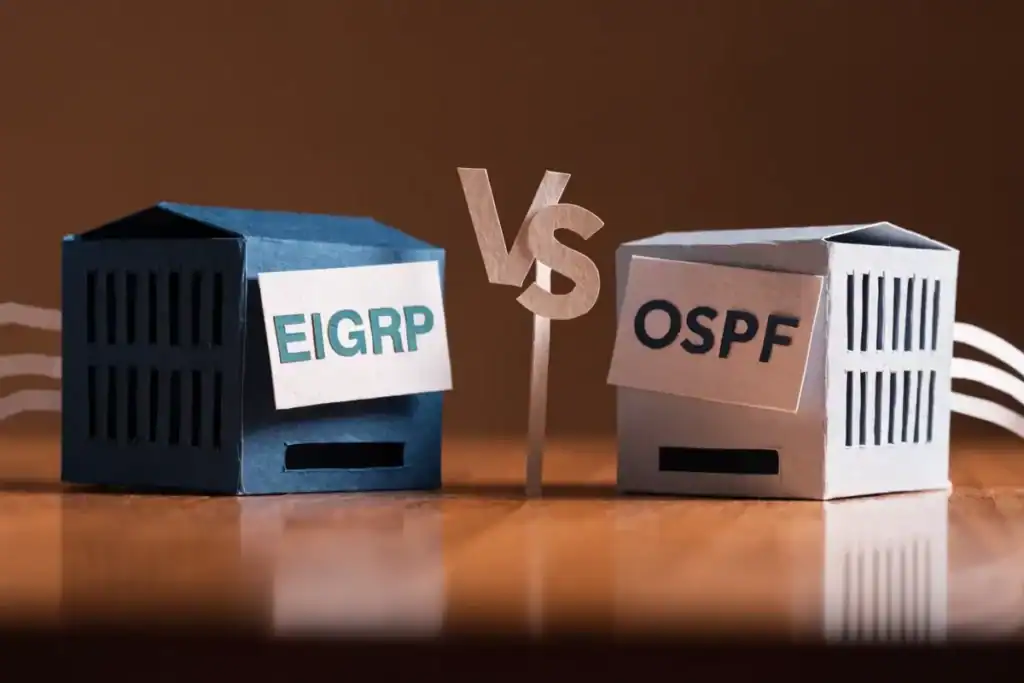
| Feature | EIGRP | OSPF |
|---|---|---|
| Routing domain | Intradomain | Intradomain |
| Size of the network | Suitable in mid-sized to large networks with up to several hundred routers | Suited in mid-sized to large networks with up to several hundred routers |
| Protocol type | Distance-vector | Link-state |
| Implementation | Easy for basic configuration | Easy for basic configuration |
| Network topology | Flat | Hierarchical |
| Convergence | Fast | Fast |
| Resource requirements | Lower CPU and memory needs | Memory- and CPU-intensive |
| Metric | Combination of bandwidth, reliability, load, and delay | Based on bandwidth/cost |
| Load balancing | Supports unequal-cost load balancing | Equal-cost load balancing only |
| Filtering and summarization | Possible on any interface of any router | Only on ABR or ASBR |
Need the full breakdown, not just the table? EIGRP vs OSPF: Which to Run and Why walks through when each protocol actually wins in production.
EIGRP Authentication: Plaintext vs MD5
Without authentication, anyone who plugs into your network can try to form an EIGRP neighbor adjacency and start injecting routes. EIGRP gives you two ways to stop that: plaintext, which sends the key in the clear (anyone with a packet sniffer reads it), or MD5, which hashes it. Use MD5. There’s no real reason to run plaintext on a production network.
A basic MD5 setup needs a key chain on each router and the authentication mode set on the interface:
key chain KingKong
 key 1
  key-string Banana

interface FastEthernet0/0
 ip authentication mode eigrp 1 md5
 ip authentication key-chain eigrp 1 KingKong
Match the key chain name and key string on both ends, or the neighbor adjacency won’t form at all.
Go deeper
This cheat sheet gets you through the theory. The CCNA Workbook puts routing concepts and OSPF into real EVE-NG labs so you configure it yourself, not just read about it.See the CCNA Workbook →
Who it’s for
- CCNA candidates learning routing protocols for the first time
- CCNP Enterprise (ENARSI) students who need EIGRP fresh before the exam
- Network techs setting up or troubleshooting EIGRP on live Cisco gear
- Anyone comparing EIGRP and OSPF who wants the differences on one page
If your exam is booked, this is the last-minute refresher you keep open the night before. Going for CCNP Enterprise or CCIE Enterprise Infrastructure next? The CCIE Enterprise Infrastructure Lab Workbook runs EIGRP alongside OSPF, BGP, and SD-Access across 120 EVE-NG labs.

No questions yet. Ask the first one.