Here’s the short version. This is a free BGP PDF you can download right now, no cost. 148 pages, written by a CCIE, covering Border Gateway Protocol end to end. If you’re studying for CCNP or CCIE, troubleshooting a real peering, or you just want BGP explained without the fluff, this is your study companion.
One file. One free download. Everything from “what is BGP” to path selection.
What’s inside
A full walk-through of how the internet actually routes traffic. You’ll get:
- What is BGP – the internet’s Exterior Gateway Protocol, in plain English
- Path vector basics – AS_PATH, loop prevention, and why BGP isn’t an IGP
- MP-BGP – IPv6, MPLS VPN (VPNv4/VPNv6), and EVPN address families
- BGP vs OSPF – scalability, convergence, and path selection compared side by side
- iBGP vs eBGP – peering rules, TTL, and ebgp-multihop
- Path attributes – LOCAL_PREF, MED, communities, and how ISPs steer traffic
- Real numbers – how the global routing table grew from about 814,000 IPv4 prefixes in January 2020 to more than 1.07 million by September 2026

What is BGP, exactly?
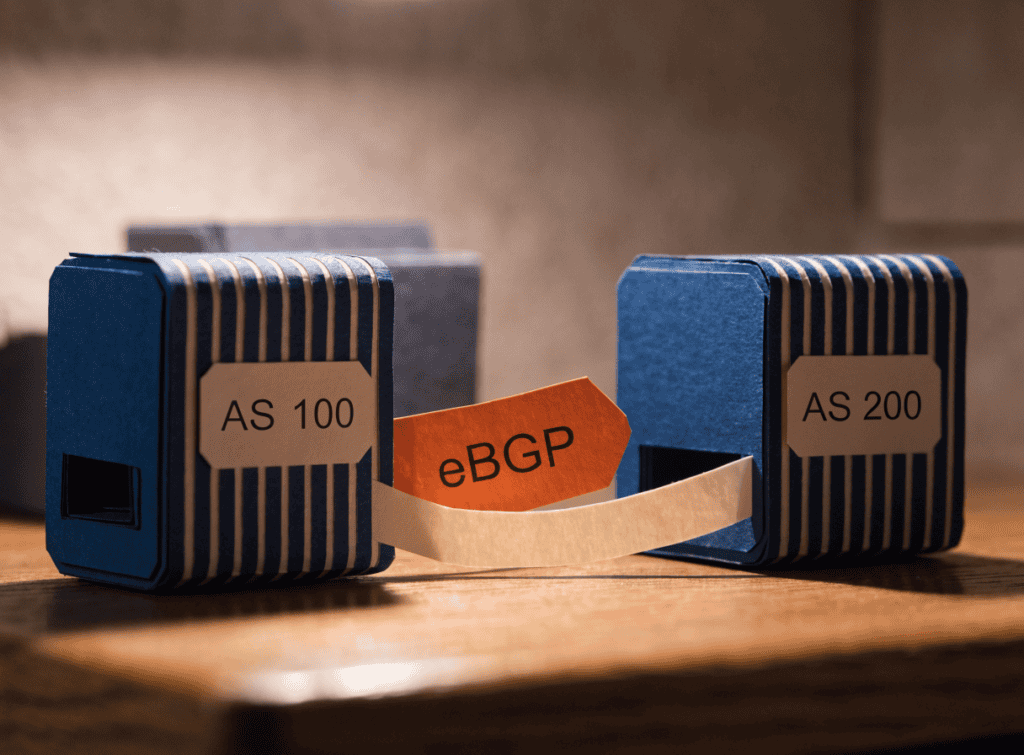
BGP (Border Gateway Protocol) is the exterior gateway protocol that connects separate networks, called Autonomous Systems (AS), so they can exchange routing information and form the global internet. Each AS is a block of IP networks and routers under one organisation’s control: an ISP, a cloud provider, a university, anyone running their own piece of the internet. When two ASes peer over BGP, they trade reachability information, which IP prefixes each one can deliver traffic to, over a TCP session on port 179.
BGP is a path vector protocol. Instead of picking routes by hop count or bandwidth the way an interior protocol does, it tracks the AS_PATH: the full list of Autonomous Systems a route has crossed. That list is what stops routing loops and lets ISPs apply policy instead of just taking the shortest path. Modern BGP is really MP-BGP (Multiprotocol BGP): the same session can carry IPv6 prefixes, MPLS VPN routes (VPNv4/VPNv6), and EVPN routes, not just plain IPv4. The guide covers all of this with the actual attribute names and command syntax, not just the theory. For the full protocol specification, see RFC 4271, the IETF standard that defines BGP-4.
BGP vs OSPF (and other IGPs)
The short answer: OSPF, IS-IS, and EIGRP route traffic inside one network. BGP routes traffic between networks. That’s the whole split, but it shows up everywhere once you start configuring both:
- Scale – OSPF is built for a single, well-defined domain. BGP carries the internet’s full routing table, over a million IPv4 prefixes.
- Path selection – OSPF picks the lowest-cost path by default. BGP runs a policy-driven algorithm through attributes like weight, LOCAL_PREF, and AS_PATH length before it settles on one best path.
- Convergence – OSPF reconverges fast after a topology change. BGP trades speed for stability, which is exactly what you want at internet scale.
- Peering – OSPF neighbors are usually discovered automatically on an enabled interface. BGP peers (also called BGP speakers) are configured by hand, one neighbor statement at a time.
The PDF walks through this as a full comparison table, plus the same breakdown against IS-IS and EIGRP, so you can see where every IGP you already know fits against BGP. Want to configure both instead of just reading about them? the workbook’s OSPFv3 and BGP route manipulation labs put them in the same 120-lab set, tested in EVE-NG. If OSPF and MPLS are more your focus right now, the free OSPF and MPLS LDP PDF covers that side in the same depth.
Who actually uses BGP?
Two groups, mostly. ISPs, CDNs, and cloud providers run BGP to connect to each other and form the internet backbone itself, that’s the primary use case. The second group is enterprises: any organisation that’s multi-homed (connected to two or more ISPs for redundancy) or that announces its own public IP address space needs BGP to tell the internet how to reach it. If you’re managing a network that peers with more than one provider, you’re already a BGP operator whether you’ve configured it yet or not.
A guide explains that part. It doesn’t make you configure a real multi-AS topology under time pressure. The CCIE Enterprise Infrastructure Lab Workbook gives you 120 labs, tested in EVE-NG, covering SD-Access fabric, SD-WAN policies, and DMVPN Phase 3 on top of BGP, built for the CCIE Enterprise Infrastructure lab exam (v1.1). And if you’d rather see BGP route manipulation automated than typed by hand, the free BGP Multi-AS Lab PDF walks through scripting it across 7 routers with Python and Netmiko.
Who it’s for
- CCNP Enterprise and CCIE candidates who want BGP explained clearly
- Network engineers running multi-homed or ISP-grade routing
- Anyone who searched “BGP tutorial” and wants a real reference, not a 3-line blog
Still deciding between BGP and an interior protocol for a design? The free EIGRP cheat sheet and study guide covers Cisco’s own interior gateway protocol in the same format, so you can compare both before you commit to a design.
A guide explains BGP. It doesn’t make you type it. When you’re ready to practise BGP route manipulation on live routers, the CCIE Enterprise Infrastructure Lab Workbook gives you 120 labs, tested in EVE-NG, for the 400-401 v1.1 blueprint.