
Proxmox and Docker don’t compete. They work at different layers of your infrastructure stack.
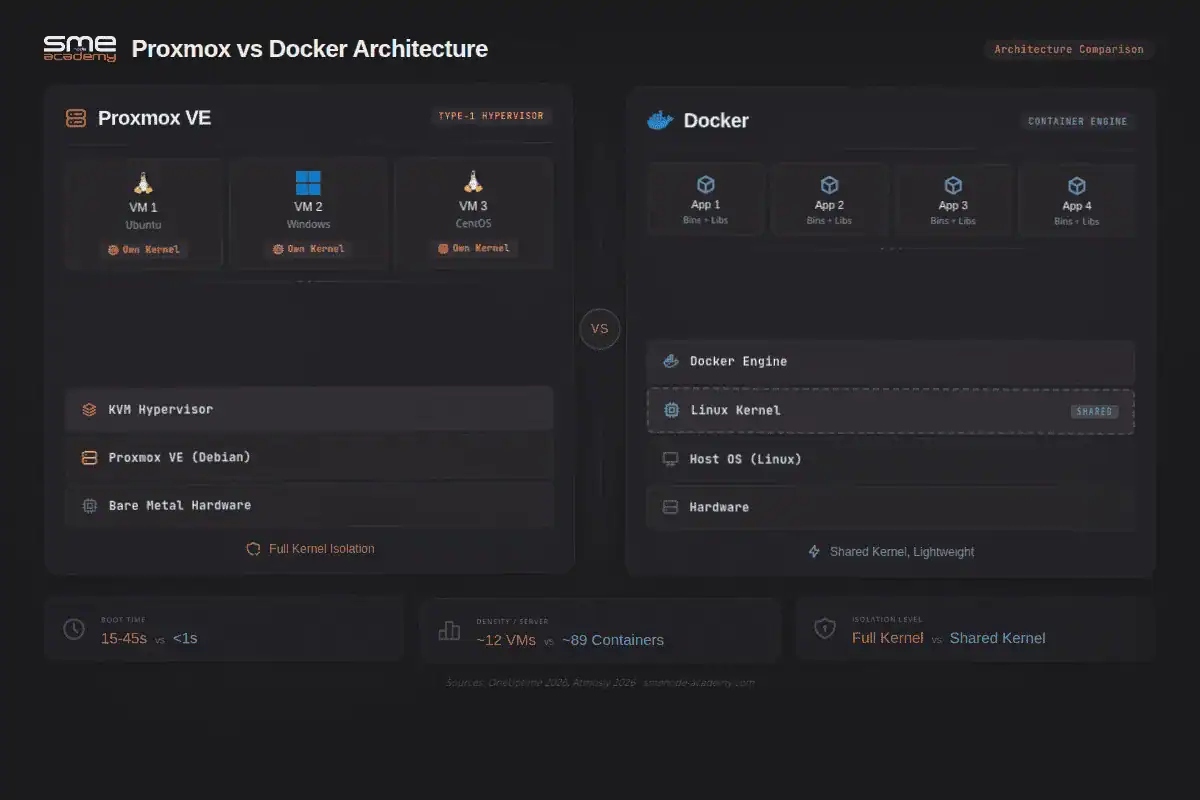
Proxmox VE is a hypervisor. It runs on bare metal and manages virtual machines and LXC containers on your physical hardware. Docker is an application runtime. It packages apps with their dependencies and runs them as containers inside an operating system.
The recommended setup for most engineers: Proxmox on the server, a Linux VM inside Proxmox, Docker installed inside that VM. You get full kernel isolation from the VM and the speed and portability of containers from Docker.
But the right answer depends on your workload, your compliance requirements, and what you’re building. Here’s how to think through it.
Quick answer:
| If You Need This | Use This |
|---|---|
| Run full operating systems like Windows, Linux, BSD | Proxmox VM |
| Run Docker Compose apps safely on Proxmox | Docker inside a Proxmox VM |
| Run lightweight Linux services with Proxmox management | Proxmox LXC |
| Run one app per container with fast deployment | Docker |
| Build a homelab with VMs and app containers | Proxmox plus Docker |
| Run production apps with better isolation | Docker inside a Proxmox VM |
| Test simple OCI images in Proxmox 9.1+ | Proxmox LXC from OCI image |
What Changed in 2026 (Read This First)
Two dates matter if you’re making this decision right now.
Proxmox VE 8 reached end of life on 31 August 2026. No more security patches, no bug fixes, no upstream support. Its Debian 12 “Bookworm” base lost security support even earlier, in July 2026. If you’re still on VE 8.x, the platform question isn’t “Proxmox or Docker” any more. It’s “how fast can I get to VE 9.”
Proxmox VE 9.2 shipped on 21 May 2026. It runs a Debian 13.5 “Trixie” base with Linux kernel 7.0, QEMU 11.0, LXC 7.0 and ZFS 2.4.
One more change reshapes the container half of this comparison. Proxmox VE 9.1 added the ability to create LXC containers directly from OCI images, the same image format Docker uses. You’ll find plenty of articles crediting this to VE 8.3. That’s wrong, and it matters, because the whole “should I just run everything in LXC now” argument only became reasonable with 9.1. Worth knowing before you build on it: Proxmox’s own release notes still mark the entire OCI-to-LXC import path as a tech preview, not a stable, production-committed feature.
Proxmox vs Docker: Quick Decision Table
| Question | Use Proxmox VM | Use Docker | Use Proxmox LXC |
|---|---|---|---|
| Running Windows alongside Linux? | Yes | No | No |
| Microservices or web apps? | No | Yes | No |
| Need GPU or PCIe passthrough? | Yes | No (needs VM underneath) | No |
| CI/CD pipeline or app testing? | No | Yes | No |
| HIPAA, PCI-DSS, SOC 2 compliance? | Yes, VMs required | No, shared kernel fails isolation | No |
| Homelab self-hosting (Plex, Home Assistant)? | Yes, as host | Yes, inside a VM | Optional |
| Fast deployment and portability? | No | Yes | No |
| Multi-tenant server isolation? | Yes | No | Limited |
| Simple Linux daemon (Nginx, Redis)? | Overkill | Yes | Yes |
| Full OS with custom kernel? | Yes | No | No |
What Proxmox Actually Does
Proxmox Virtual Environment (currently VE 9.2) is an open-source hypervisor platform built on Debian Linux. It gives you a single web interface to manage two types of workloads on a physical server: KVM virtual machines with full kernel isolation, and LXC system containers that share the host kernel.
Think of Proxmox as the management layer between your hardware and everything running on it. Proxmox handles VM creation, snapshots, backups, live migration, storage management (ZFS, Ceph, LVM, NFS), and clustering across multiple nodes.
The VE 9 series moved to a Debian 13 “Trixie” base. The versions moved a lot inside that series, so it’s worth being precise about what you’re actually running:
| Release | Debian Base | Kernel | QEMU | LXC | ZFS |
|---|---|---|---|---|---|
| VE 9.0 | Debian 13 | 6.8 | 9.0 | 6.0 | 2.2 |
| VE 9.1 | Debian 13.2 | 6.17.2 | 10.1.2 | 6.0.5 | 2.3.4 |
| VE 9.2 | Debian 13.5 | 7.0 | 11.0 | 7.0 | 2.4 |
Source: Proxmox VE Roadmap, verified October 2026.
Kernel 7.0 in VE 9.2 brings better hardware support for modern CPUs, high-speed NICs, and NVMe controllers.
What the recent releases added that shows up in real deployments:
- Create LXC containers from OCI images (VE 9.1, tech preview). Pull a standard Docker-format image and run it as an LXC container, uploaded manually or pulled from a registry. This is the feature that blurred the line between LXC and Docker.
- Dynamic Load Balancer (VE 9.2). The cluster now optimises guest placement on its own and migrates workloads to reduce imbalance.
- WireGuard and BGP in SDN (VE 9.2). Plus BGP/EVPN filtering, useful for multi-homed servers and routed fabrics.
- Custom CPU model management (VE 9.2). A proper interface for tailoring which CPU features a guest sees.
- HA arm and disarm (VE 9.2). You can suspend the HA stack during a maintenance window instead of fighting it.
- Official Arm64 support (announced 5 August 2026). VE 9.2 adds a 64-bit ARM edition that manages Arm64 VMs and LXC containers from the same interface, with support for NVIDIA Grace and Vera CPUs.
- LVM snapshots on SAN storage (VE 9.1). A long-requested feature for teams running Fibre Channel or iSCSI.
Proxmox VE now powers over 2.3 million hosts globally as of September 2026, up from roughly 1.5 million through most of 2025 and 2 million as of the VE 9.2 launch in May. The software is free to download. The enterprise subscription adds access to the stable update repository and paid support, useful for production but not required for homelabs or dev use.
What Docker Actually Does
Docker is an application container engine. It packages your app along with its dependencies, libraries, config files, runtimes, environment variables, into a portable image. That image runs identically whether it’s on your development laptop, a CI server, or a cloud VM.
Containers share the host OS kernel. They don’t boot a separate operating system. A Docker container starts in roughly a second. A KVM VM takes 15 to 45 seconds. That speed difference matters in CI/CD pipelines where you’re spinning containers up and down hundreds of times a day.
Docker is close to universal among working developers. In the 2025 Stack Overflow Developer Survey, 71.1% of all respondents and 73.8% of professional developers reported using it. That was a 17-point jump from 2024, the largest single-year increase of any technology in the survey. For context in the same survey: Kubernetes came in at 28.5% and Podman at 11.1%.
The market around it keeps growing too. Mordor Intelligence sizes the application container market at $12.64B in 2026, reaching $35.63B by 2031 at a 23.03% CAGR. This isn’t a niche tool for homelab enthusiasts. It’s the default application packaging format for professional software delivery.
Docker doesn’t manage hardware. It doesn’t run VMs. It runs processes inside container isolation. The containers share the host kernel, which is one reason containers are faster than VMs, and also one reason they provide weaker isolation.
That distinction drives most of the Proxmox vs Docker confusion. People hear “Proxmox runs containers” and wonder if they need both. You usually do. Proxmox manages the infrastructure; Docker manages the applications.
What Docker gives you in practice:
- Consistent environments from development through production
- Fast iteration cycles, so you rebuild a container image in seconds
- Easy rollback to a previous image tag
- A large ecosystem on Docker Hub (1M+ public images)
- Compose files to define multi-container apps declaratively
- Portability across any Linux host or cloud provider
- Rootless mode, BuildKit as the default builder, and a containerd image store for faster pulls
- OCI artifacts beyond images, including Helm charts, SBOMs and signed manifests
LXC vs Docker: What’s Actually Different?
This is the comparison people mean when they say “Proxmox containers versus Docker,” and it’s the one most articles skip. Both use Linux namespaces and cgroups. Both share the host kernel. They are not interchangeable.
LXC gives you a machine. Docker gives you a process.
An LXC container boots a full Linux init system with its own filesystem, its own package manager and its own service manager. You SSH into it. You run apt install. It behaves like a small VM that happens to share a kernel. A Docker container runs one process with just the dependencies that process needs, and when the process exits, the container is done.
| Proxmox LXC | Docker | |
|---|---|---|
| Container type | System container (full init) | Application container (one process) |
| Mental model | Lightweight VM | Packaged process |
| Filesystem | Persistent by default | Ephemeral, layered overlay |
| State | Lives in the container | Lives in named volumes or bind mounts |
| Boot time | 1 to 3 seconds | Under a second |
| How you deploy | Create from template or OCI image | docker run or a Compose file |
| Update model | Patch in place, like a server | Replace the image, rebuild the container |
| Managed by | Proxmox web UI and API | Docker CLI, Compose, or an orchestrator |
| Portability | Tied to Proxmox | Runs on any Linux host or cloud |
| Image ecosystem | Proxmox templates, plus OCI since VE 9.1 | Docker Hub, 1M+ images |
| GPU passthrough | Limited, via device cgroup | NVIDIA Container Toolkit |
| Live migration | Restart-based | Not built in, needs an orchestrator |
| Backup | Proxmox Backup Server, as a unit | Volume backups, plus pinned image tags |
Which is more secure? Neither has a kernel boundary, so neither is in the same class as a VM. Between the two, unprivileged LXC is the Proxmox default and it’s a sane model, with user namespace mapping so root in the container isn’t root on the host. Docker’s default is a shared daemon running as root, though rootless mode closes much of that gap. The honest answer: if the workload is untrusted or multi-tenant, both are the wrong choice and you want a VM.
Which is faster? For boot time and density, Docker. For sustained throughput inside one tenant, they’re within a few percent of each other, because both are just processes on the host kernel. Performance is rarely what decides this.
Is LXC deprecated? No. LXC 7.0 ships in Proxmox VE 9.2 and it’s one of the two workload types Proxmox is built around. What did change is the wider Linux container world moving to LXD and Incus for general-purpose use, while Proxmox kept LXC as its native system-container layer. Inside Proxmox, LXC is current and maintained.
So when do you pick LXC over Docker? Pick LXC when the thing you’re running is a service you’d otherwise put on a small server, you want it managed from the Proxmox UI, and you don’t need it to run anywhere else: Pi-hole, a reverse proxy, an internal DNS resolver, a dev database replica. Pick Docker when the thing you’re running is an application you want to version, ship and roll back, or when you want the same image running in dev and production.
How Do VMs and Containers Actually Compare on Performance?
| Metric | Docker Containers | Proxmox VMs (KVM) |
|---|---|---|
| Boot time | 0.5 to 1.3 seconds | 15 to 45 seconds |
| CPU overhead | 1-2% | 5-20% |
| Density (same server) | ~89 containers | ~12 VMs |
| Throughput | ~28% higher than VMs | Baseline |
| Latency | ~37% lower than VMs | Baseline |
| RAM per workload | 100-500 MB | 1-4 GB |
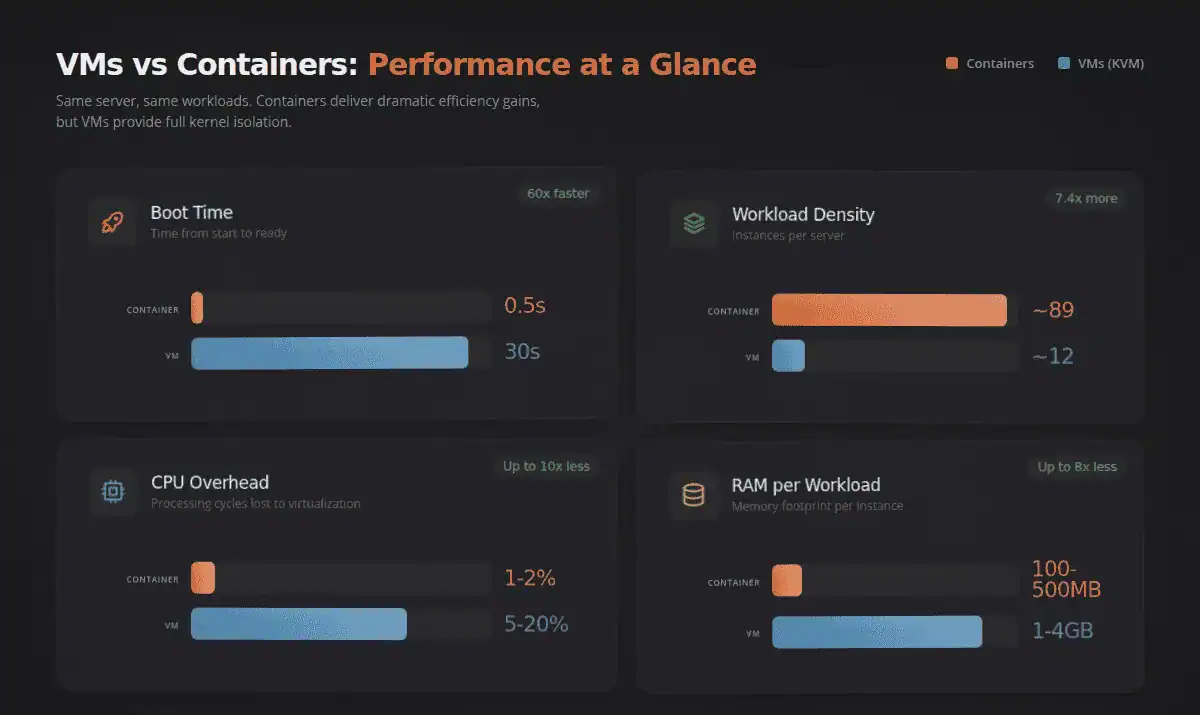
How to read this table. These figures are an aggregate of published 2025-2026 vendor and community benchmarks (OneUptime, RDEM Systems/Atmosly, and Wiz/Atmosly), not first-party testing. Treat them as orders of magnitude, not guarantees. Container and VM overhead both swing hard on storage backend, kernel version and how the guest is configured. Measure your own workload before you size hardware on someone else’s numbers.
Look at that density figure. One server can handle roughly 7x more application containers than KVM VMs at similar workloads. That ratio is the honest takeaway, more than any single number.
Density isn’t everything. VMs give you something containers can’t: full kernel isolation. If a container gets compromised, it shares a kernel with every other container on that host. A VM breach stays contained within that VM’s own kernel.
So what matters more, efficiency or isolation? Depends on what you’re running.
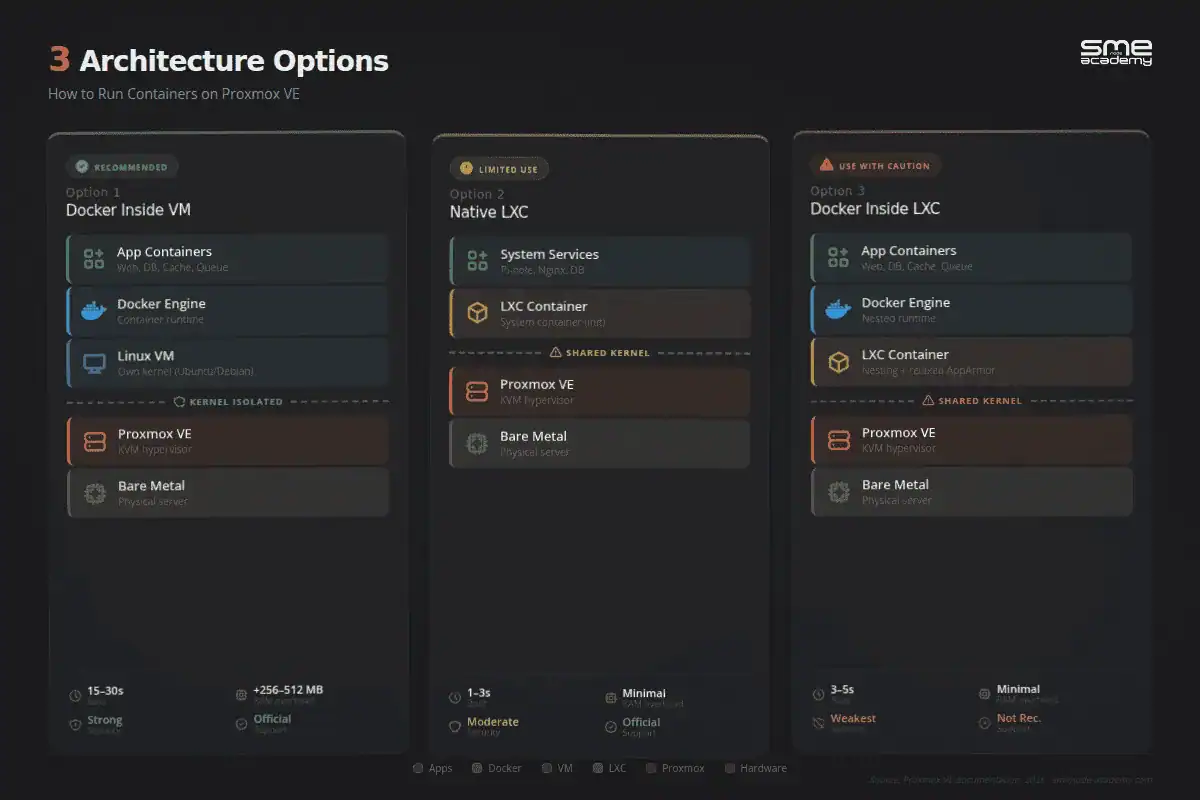
Three Ways to Run Containers on Proxmox
Here’s where it gets interesting. You don’t have to pick Proxmox OR Docker. Most people run Docker inside Proxmox. The question is how.
Option 1: Docker Inside a Proxmox VM (Recommended)
This is the production-safe approach. You create a lightweight Linux VM (Ubuntu Server or Debian), install Docker inside it, and run your containers there.
Why this works best:
- Full kernel isolation between Docker and your host
- GPU passthrough works properly for AI/ML workloads
- You can live-migrate the entire VM (Docker containers and all) to another node
- Snapshots and backups work at the VM level
- No kernel conflicts or AppArmor issues
There’s a second reason, and it’s the one that bites people: installing Docker directly on the Proxmox host rewrites iptables rules and can collide with Proxmox’s own virtual bridges, which complicates host backups and recovery. Keep the host clean.
The tradeoff? You lose 256 to 512 MB of RAM for the guest kernel, and boot takes 15 to 30 seconds instead of 1 to 3.
Worth it? For production, absolutely. For a homelab with 64GB-plus of RAM, the overhead barely registers.
Option 2: Native LXC Containers (Lightweight but Limited)
Proxmox has its own container technology built in: LXC (Linux Containers). These are system containers, not application containers like Docker. Think of them as lightweight VMs that share the host kernel.
LXC containers boot in 1 to 3 seconds, use less RAM than VMs, and integrate directly with Proxmox’s web interface. Good for running simple services like Pi-hole, Nginx, or a database.
New in Proxmox VE 9.1 (still tech preview): you can create LXC containers from OCI images, pulling a Docker-format image and running it as an LXC container.
But LXC has limits. No proper GPU passthrough. No live migration in the KVM sense. Shared kernel means shared risk.
Option 3: Docker Inside LXC (Experts Debate This One)
You can technically run Docker inside a Proxmox LXC container. It works. People have done it for years with no issues.
But here’s why many engineers avoid it in production: Docker inside LXC means nested containerization. You need to enable nesting and relax AppArmor security profiles. That’s two layers of containers sharing one kernel, and kernel updates can break the whole stack. Debugging gets harder because you’re troubleshooting two runtimes at once, and you still only have one kernel boundary, so you paid the complexity without buying isolation.
The Proxmox team doesn’t officially recommend it either.
Use it in a homelab to learn how the layers fit. Use it for internal tools where you understand the tradeoff. Don’t use it for anything regulated or multi-tenant.
| Factor | Docker in VM | Native LXC | Docker in LXC |
|---|---|---|---|
| Kernel isolation | Full (separate kernel) | Shared with host | Shared with host |
| GPU passthrough | Yes (PCI passthrough) | Limited | Limited |
| Live migration | Yes | No | No |
| Boot time | 15-30 seconds | 1-3 seconds | 3-5 seconds |
| RAM overhead | 256-512 MB extra | Minimal | Minimal |
| Security | Strong | Moderate | Weakest |
| Proxmox officially supports | Yes | Yes | Not recommended |
Where Does Your Data Live? State and Backup
This is the part that gets skipped until something breaks, and it’s where the Proxmox and Docker models disagree most sharply.
Docker containers are designed to be disposable. The container filesystem is a layered overlay that disappears when you replace the container. Anything you want to keep has to live outside it, in a named volume, a bind mount, or external storage. Plenty of teams learn this the hard way by treating a Docker volume as production storage with no backup plan behind it.
VMs and LXC containers persist by default. You patch them in place, like a server. State is just there, which is convenient until you need to reproduce the machine and discover nobody wrote down how it got that way.
That difference decides where your backup boundary sits.
Proxmox backs up VMs and LXC containers as whole units. vzdump handles the snapshot, and Proxmox Backup Server adds deduplication, incremental backups, encryption at rest and verify-on-restore. Docker has no first-party equivalent. You pin image versions in your Compose file, back up named volumes with something like restic, and rebuild the container from the image when you need to.
The clean pattern, if you run Docker on Proxmox: let Proxmox back up the VM that hosts Docker, and treat that VM snapshot as your backup of record. Your containers are rebuilt from images; only volumes and configuration are precious. One backup system, one restore procedure, one thing to test.
Test the restore. A backup you’ve never restored isn’t a backup.
Best Proxmox vs Docker Setup for a Homelab
For a homelab, use Proxmox as the base platform and Docker inside one Linux VM for most apps. This gives you one clean place for Docker Compose, Portainer, monitoring, media apps, and self-hosted services. Our guide to what a home lab actually is is a good starting point if you’re building one from scratch.
Use Proxmox VMs for services that need stronger isolation, such as pfSense, OPNsense, TrueNAS, Windows, Kubernetes nodes, or GPU workloads. Use Proxmox LXC for simple Linux services where low overhead matters more than portability.
A good homelab layout looks like this:
| Workload | Recommended Setup |
|---|---|
| Home Assistant, Jellyfin, Uptime Kuma, Nginx Proxy Manager | Docker inside Debian or Ubuntu VM |
| pfSense or OPNsense | Proxmox VM |
| Pi-hole or small Nginx service | Proxmox LXC |
| Kubernetes practice lab | 3 Proxmox VMs |
| Windows testing | Proxmox VM |
Home Assistant deserves a note, because it’s the single most-asked version of this question. The supervised Home Assistant OS install wants its own VM. If you only want the Home Assistant Container build, Docker inside your app VM is fine. You lose add-ons and the supervisor, which is the tradeoff.
Best Proxmox vs Docker Setup for Production
Production adds two requirements that homelabs often skip: compliance and high availability.
Compliance first. If you’re handling PHI under HIPAA, cardholder data under PCI-DSS, CUI under CMMC, or regulated data under SOC 2, you need to answer a direct question: does your architecture provide kernel-level isolation between tenants and workloads? Containers sharing a host kernel don’t satisfy most interpretations of these standards. VMs do. This isn’t negotiable.
For regulated workloads, the architecture is: Proxmox cluster, VMs for tenant isolation, Docker inside those VMs if needed for application packaging.
High availability second. A single Proxmox node is a single point of failure. Production should mean a 3-node cluster minimum:
- 3 Proxmox nodes with Corosync quorum
- Shared storage: Ceph (built into Proxmox), an external SAN, or NFS
- Proxmox HA groups for automatic VM restart on node failure
- VE 9.2’s Dynamic Load Balancer, so workloads redistribute after a failover without manual intervention
For application workloads inside the VMs, the pattern is Docker Compose for smaller deployments or k3s/Kubernetes for anything that needs autoscaling, rolling updates, or self-healing.
One practical note: don’t over-architect too early. A well-configured 3-node Proxmox cluster running Docker Compose inside VMs handles the workload of most mid-sized companies. You don’t need Kubernetes until you actually need Kubernetes.
Moving Off VMware? Read This Before You Choose
A lot of teams arrive at this comparison from the wrong direction. They’re not choosing a container strategy. They’re leaving vSphere after the Broadcom licensing changes, and somebody suggested containers.
Docker is not the answer to that question. Docker isn’t a hypervisor and it can’t host the Windows guests, appliances and legacy VMs that make up most VMware estates. Proxmox is the like-for-like replacement. Move the hypervisor layer to Proxmox first, then add Docker inside the Linux VMs where it earns its place.
VE 8 reaching end of life on 31 August 2026 pushed this from “sometime this year” to “now” for anyone who migrated to Proxmox early and then stopped. Go straight to VE 9.2.
Best Proxmox vs Docker Setup for DevOps
Docker is native to DevOps pipelines. GitHub Actions, GitLab CI, Jenkins, CircleCI all use Docker containers as the default build and test environment. Your Dockerfile is version-controlled. Your CI pipeline builds the image, runs tests inside a container, and pushes to a registry. Your staging environment runs the same image your CI tested.
Proxmox enters the DevOps picture when teams need:
- Isolated dev environments. Each developer gets a VM with a full Linux environment, pre-provisioned with their tools. Clean slate for every project.
- Kubernetes test clusters. Spin up a 3-node k3s cluster inside Proxmox VMs to test Kubernetes manifests before pushing to cloud. Proxmox VM templates make this fast.
- Build agents with hardware access. ML pipelines that need GPU access, hardware-in-the-loop testing, or workloads that need specific PCIe devices all benefit from VMs with passthrough.
- Safe infrastructure experiments. Snapshot a VM before testing a new Terraform module or Ansible playbook. If it breaks, restore.
The most common DevOps setup on Proxmox: developers get their own Proxmox VMs for local dev, a shared VM runs the CI/CD tooling, and app containers run inside those VMs. Proxmox manages the VMs; Docker and Kubernetes manage the containers.
Best Proxmox vs Docker Setup for SMB Servers
For small businesses, Proxmox is usually the safer base platform. It lets you separate workloads into VMs, back them up cleanly, and recover services without rebuilding the whole server.
Use Docker inside a dedicated VM for apps like internal dashboards, web apps, monitoring, password managers, and lightweight business tools. Keep critical infrastructure like firewalls, domain services, storage, and accounting systems in separate VMs.
When Should You Use Proxmox, Docker, or LXC?
Use Proxmox when you need infrastructure control. Use Docker when you need fast application deployment. Use Proxmox LXC when you want lightweight Linux services managed directly from the Proxmox UI. Use Docker inside a Proxmox VM when you want the best balance of isolation, backups, and container workflow.
Use Proxmox VMs when you need:
- Full operating system isolation (Windows, different Linux distros)
- Hardware passthrough (GPUs, network cards, USB devices)
- Compliance requirements (HIPAA, PCI-DSS, SOC 2 all favour VM-level isolation)
- Live migration and high availability
- Running Docker itself (Docker-in-VM is the recommended approach)
Use Docker containers when you need:
- Fast application deployment (spin up in under a second)
- Microservices architecture (one service per container)
- CI/CD pipelines (reproducible build environments)
- Portability (same container runs in dev, staging, and production)
- Resource efficiency (run roughly 7x more workloads per server)
Use Proxmox LXC when you need:
- Simple Linux services with Proxmox management
- Lower overhead than full VMs
- Quick web interface for container lifecycle
- OCI image compatibility (VE 9.1 and later, tech preview)
Use both together when:
- You manage infrastructure AND run applications (most real environments)
- Your homelab needs VMs for some things and containers for others
- You want enterprise-grade isolation with container efficiency
Is Docker Still Relevant in 2026?
More relevant than ever.
Some confusion comes from Docker Desktop’s licensing changes (paid for enterprises since 2021) and the rise of alternatives like Podman, containerd, and nerdctl. But Docker Engine itself is open-source and free. And the numbers hold up:
- 71.1% of all respondents and 73.8% of professional developers use Docker (Stack Overflow Developer Survey, 2025)
- That’s a 17-point jump in one year, the biggest of any technology in the survey
- Podman, the most-cited alternative, sits at 11.1% in the same survey
- The application container market is growing at a 23.03% CAGR through 2031
Docker isn’t being replaced. The ecosystem around it is growing. Podman can run Docker-format containers and its CLI is close enough that most commands transfer. Kubernetes uses containerd, which came out of Docker, under the hood. The OCI image format that Docker created is now what Proxmox LXC pulls from a registry. The format won, and that’s a bigger deal than which daemon runs it.
What About Kubernetes?
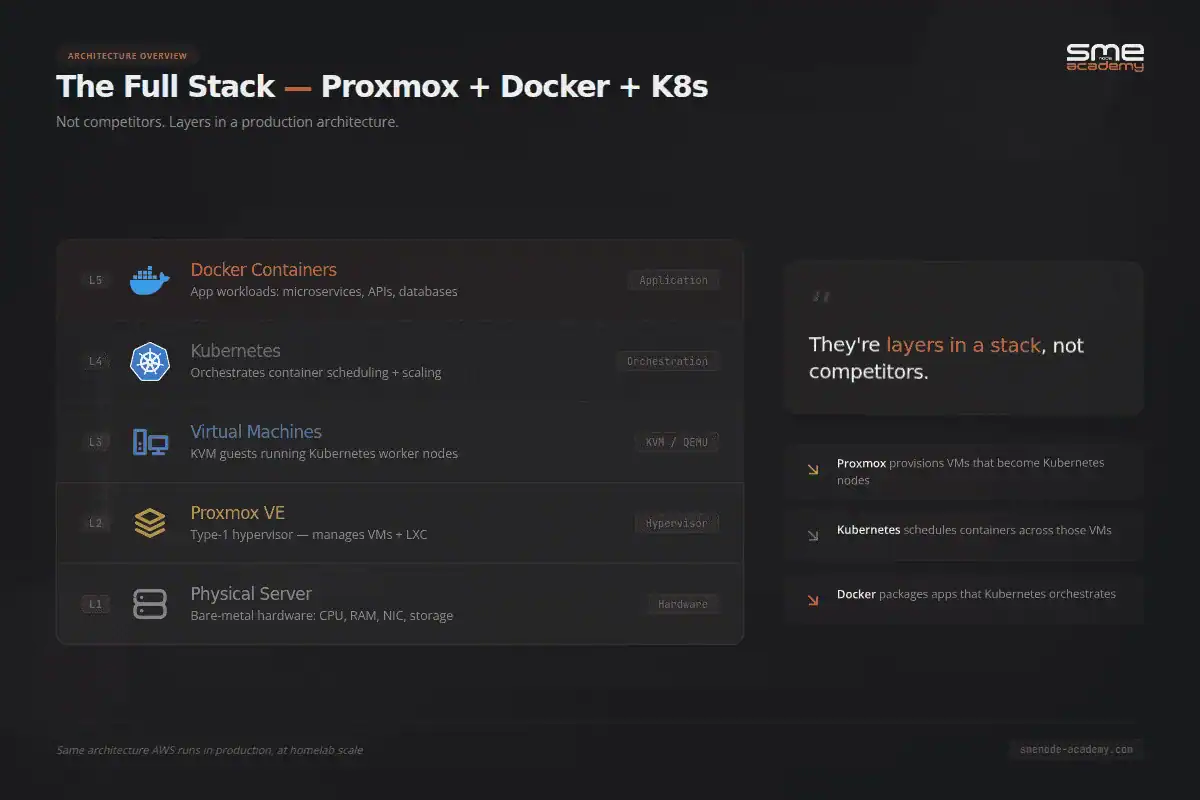
Kubernetes isn’t a replacement for either Proxmox or Docker. It’s an orchestration layer.
- Proxmox manages your physical and virtual infrastructure
- Docker packages your apps into containers
- Kubernetes orchestrates those containers at scale
Kubernetes holds 42.18% of the containerization software market (Mordor Intelligence, 2025 share data), which makes it the dominant orchestrator without making it universal. Stack Overflow’s 2025 survey puts hands-on Kubernetes use at 28.5% of respondents, well below Docker’s 71.1%. Most teams package with Docker and never need the orchestrator.
In a typical production setup, Proxmox runs the VMs, those VMs run Kubernetes, and Kubernetes manages your containers. They’re layers in a stack, not competitors.
For homelab setups, many people run a Kubernetes cluster (using K3s or Talos Linux) on top of Proxmox VMs. If you have one or two hosts, Kubernetes is almost always overkill and Docker Compose is enough. Docker Swarm sits between the two in complexity and is reasonable for three to five nodes where you want simple HA without learning Kubernetes RBAC, ingress and CNI plugins.
Why IT Professionals Need Both Skills
If you’re in IT infrastructure, networking, or DevOps, you’ll work with both VMs and containers. The industry has settled on a hybrid model where VMs handle infrastructure isolation and containers handle application deployment.
Knowing Proxmox means you understand Linux, KVM, and open-source infrastructure, storage (ZFS, Ceph, NFS, iSCSI), networking (bridges, VLANs, SDN), high availability and clustering, and migration strategies, especially from VMware.
Knowing Docker means you understand application packaging and deployment, microservices and cloud-native architecture, CI/CD pipelines and DevOps workflows, container networking and orchestration, and the foundation for Kubernetes.
Together, these skills open doors to Cloud Engineer, DevOps Engineer, SRE, and Infrastructure Architect roles, positions that typically pay $120K to $180K-plus depending on experience.
Can you run Docker inside Proxmox?
Yes, and it’s the recommended approach for most setups. Create a lightweight Linux VM in Proxmox, install Docker Engine inside it, and run your containers from there. This gives you full kernel isolation plus all the benefits of Docker’s container ecosystem. Proxmox also supports native LXC containers if you need something lighter.
Do I need Docker if I use Proxmox?
Not always, but usually. Proxmox already runs LXC system containers, so for simple Linux services you don’t need Docker at all. You need Docker when you want to deploy applications from pre-built images, run the same image in dev and production, or use Docker Compose to define a multi-service app. Most real environments end up with both, because they solve different problems.
What’s the difference between LXC and Docker containers?
LXC containers are system containers. They act like lightweight virtual machines running a full Linux init system, with a persistent filesystem you patch in place. Docker containers are application containers. They run a single process with just the dependencies it needs, and they’re replaced rather than patched. LXC integrates natively with Proxmox’s web UI. Docker gives you portability and a large ecosystem of pre-built images.
Is it better to use Docker or LXC on Proxmox?
It depends on what you’re running, not which is better. Use LXC for a service you’d otherwise put on a small always-on server and manage from the Proxmox UI, like Pi-hole or a reverse proxy. Use Docker, inside a VM, for applications you want to version, ship and roll back, or anything with a Compose file. Don’t run Docker inside LXC for production workloads.
Is LXC more secure than Docker?
Neither gives you a kernel boundary, so neither compares to a VM. Between them, Proxmox defaults to unprivileged LXC with user namespace mapping, so root inside the container isn’t root on the host, which is a good default. Docker’s classic setup runs a root daemon, though rootless mode closes most of that gap. For untrusted or multi-tenant workloads, use a VM instead of choosing between these two.
Is LXC deprecated?
No. LXC 7.0 ships with Proxmox VE 9.2 and remains one of the two workload types Proxmox manages. The broader Linux container ecosystem moved toward LXD and Incus for general-purpose system containers, which is where the confusion comes from. Inside Proxmox, LXC is current, maintained, and gained OCI image support (tech preview) in VE 9.1.
Why are people moving away from Docker?
Mostly they aren’t. Docker usage rose 17 points in the 2025 Stack Overflow survey, the largest increase of any technology measured. Where teams do move, they usually move to something that runs the same OCI images: Podman for a daemonless rootless runtime, containerd where Kubernetes already needs it, or Proxmox LXC from OCI images for simple always-on services. The complaints that drive those moves are about Docker Desktop licensing and the root daemon, not the image format.
Is Proxmox good for production environments?
Yes. Over 2.3 million Proxmox VE hosts are deployed worldwide across commercial, government, and education environments as of September 2026. Proxmox offers enterprise support subscriptions, high-availability clustering, and Ceph distributed storage. Many companies migrated from VMware to Proxmox after VMware’s licensing changes in 2024. Run VE 9.2, because VE 8 lost support on 31 August 2026.
Should I use VMs or containers for my homelab?
Both. Use Proxmox VMs for services that need isolation or hardware passthrough, like a NAS, firewall, or Windows VM. Use Docker containers inside one of those VMs for application services such as Plex, Home Assistant, Pi-hole and monitoring stacks. This is the most common homelab architecture in 2026.
What is better for security, VMs or containers?
VMs provide stronger isolation because each VM runs its own kernel. A compromised VM can’t access other VMs or the host. Containers share the host kernel, so a kernel vulnerability affects all containers. For compliance-sensitive workloads in healthcare, finance and government, VMs are generally required. For general application deployment, containers with proper security policies are fine for most use cases.
Bottom Line
Proxmox and Docker aren’t competing. They work at different layers of your infrastructure stack.
Use Proxmox when you need to manage VMs, clusters, and infrastructure. Use Docker when you need to deploy applications fast. Use LXC when you want a small managed Linux service and don’t need it to run anywhere else. Use them together when you’re building anything serious, which is most of the time.
If you take one thing away: run Proxmox on the metal, put a Linux VM on it, and run Docker inside that VM. It’s the boring answer, it’s the supportable answer, and it’s what most production shops land on.
Want hands-on practice with both? SMEnode Labs’ DevOps Workbook covers the container, orchestration, and infrastructure-as-code patterns that a Proxmox-plus-Docker stack is built on.