TL;DR – The CCNP certification is Cisco’s professional level. For CCNP Enterprise you pass two exams: 350-401 ENCOR (the core, $400, 120 minutes) and one concentration exam ($300, 90 minutes). Cisco lists $700 in exam fees. – Cisco lists no formal prerequisites. You don’t need a CCNA first, but the exams assume CCNA-level skills and more. – ENCOR has been on v1.2 since 2026-03-19. Every wireless topic moved out to a new CCNP Wireless track (core exam 350-101 WLCOR). As of 2026-11-22 Cisco hasn’t announced another ENCOR version, so v1.2 is the blueprint to study for 2027. – There are six CCNP Enterprise concentration exams: ENARSI, ENSDWI, ENSLD, ENAUTO, ENCC and ENNA. – The certificate lasts three years. Renew it with 80 Continuing Education credits, by passing exams again, or by moving up to CCIE.
Picture a network engineer with a CCNA and three years of tickets behind them. They open an ENCOR study guide they bought in 2025 and spend a whole month on wireless roaming, AP join processes and WLC tags. Then they book the exam and find out none of it is on the 2026 blueprint.
That’s a real trap for 2027. CCNP certification advice online is full of old exam topics, wrong concentration lists and prices from three versions ago.
You probably know the CCNP is the step between CCNA and CCIE. What’s less clear is what the exams actually test now, which concentration to pick, and how long it’ll really take. That’s what this guide covers.
We checked every exam code, fee and topic weight below against Cisco’s own pages and the official ENCOR v1.2 exam topics PDF on 2026-11-22. Where a number is our estimate, not Cisco’s, we say so.
Here’s what’s inside: what CCNP is, the two-exam structure, what changed in ENCOR v1.2, the full exam topics, how to choose a concentration, cost, the CCNA to CCNP gap, a six-month study plan and how to renew.
Building toward the lab side of ENCOR? The CCIE Enterprise Workbook covers OSPF, BGP, SD-Access, SD-WAN and telemetry as 120 EVE-NG labs, the same technology ENCOR tests at the core level. Download the free sample and see if the style fits you.
What is CCNP certification?
CCNP stands for Cisco Certified Network Professional. It’s Cisco’s professional-level certification. On the Cisco certification path it sits one step above the associate-level CCNA and one below the expert-level CCIE. Every CCNP track uses the same formula: one core exam that covers the track’s broad technology, plus one concentration exam that goes deep in a specialty you choose.
So when someone asks “what is Cisco CCNP certification?”, the honest answer is: it’s eight certifications, not one. Cisco’s certification index lists these CCNP tracks today:
| CCNP track | Who it’s for |
|---|---|
| CCNP Enterprise (core: 350-401 ENCOR) | Campus, branch and WAN routing and switching |
| CCNP Security (core: 350-701 SCOR) | Firewalls, ISE, VPN, secure access |
| CCNP Cybersecurity | Security operations, a separate track since 2026 |
| CCNP Automation (core: 350-901 AUTOCOR) | Network automation, formerly the DevNet Professional |
| CCNP Wireless (core: 350-101 WLCOR) | Wi-Fi design and operations, new in 2026 |
| CCNP Data Center | Data centre networking and compute |
| CCNP Service Provider | Carrier and ISP networks |
| CCNP Collaboration | Voice, video and calling |
A CCNP certificate in any of these tracks carries the same level. Which is the best CCNP certification? There isn’t one best track. It’s the one that matches the network you work on now, or the one you want to work on next. Many CCNA holders start with CCNP Enterprise because it’s the closest match to what the CCNA teaches and to what most companies run. CCNP Security is a natural choice for people already doing firewall work.
The rest of this guide focuses on CCNP Enterprise, the natural next step after a routing and switching CCNA.
CCNP Enterprise certification: how the two exams work
The CCNP certification path for Enterprise is short: the CCNP Enterprise certification needs exactly two passes. The core exam first, usually, then one concentration. You can take them in either order, and there’s no time limit between them as long as the first one is still active.
| Exam | Code | Length | Fee (USD) | Languages |
|---|---|---|---|---|
| Core | 350-401 ENCOR | 120 min | $400 | English, Japanese |
| Concentration: advanced routing and services | 300-410 ENARSI | 90 min | $300 | English, Japanese |
| Concentration: Catalyst SD-WAN | 300-415 ENSDWI | 90 min | $300 | English, Japanese |
| Concentration: enterprise network design | 300-420 ENSLD | 90 min | $300 | English, Japanese |
| Concentration: enterprise automation | 300-435 ENAUTO | 90 min | $300 | English, Japanese |
| Concentration: secure cloud connectivity | 300-440 ENCC | 90 min | $300 | English, Japanese |
| Concentration: network assurance | 300-445 ENNA | 90 min | $300 | English only |
Source: Cisco’s CCNP Enterprise page and exam pages, checked 2026-11-22.
Two bonuses people miss:
- ENCOR on its own earns the Cisco Certified Specialist – Enterprise Core. It also counts as the core exam for CCIE Enterprise Infrastructure, so nothing you study for it is wasted if you aim higher later.
- Each concentration earns its own Specialist cert too. ENARSI, say, earns a Specialist certification in enterprise advanced infrastructure.
That means you hold a Cisco credential after the first exam, not only after the second.
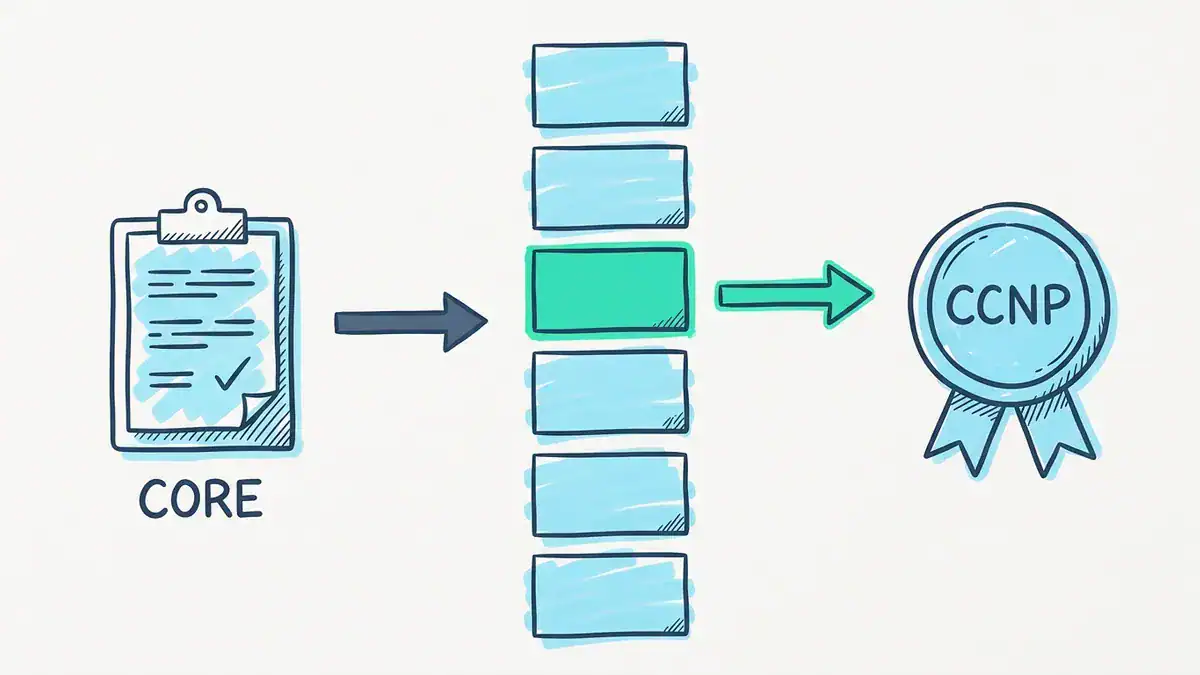
Pass the 350-401 ENCOR core, then any one of the six concentration exams (300-410, 300-415, 300-420, 300-435, 300-440, 300-445). Two passes, one CCNP Enterprise.
CCNP requirements and prerequisites
Cisco’s CCNP certification prerequisites are short: none. Every CCNP Enterprise exam page says “Prerequisites: None.” You don’t need a CCNA, a degree or a set number of years.
But “no prerequisites” doesn’t mean “no background.” The exams assume you can already build VLANs, trunks, OSPF and ACLs without looking anything up. The exams are written for people who already do this work. In our experience, people who skip the CCNA and walk into ENCOR cold spend their first two months relearning associate-level topics.
So the real CCNP requirements are skills, not paperwork.
What changed for 2027: ENCOR v1.2 and the wireless split
This is the part many CCNP study guides still get wrong.
On 2026-03-19, Cisco launched a dedicated wireless track. The new CCNP Wireless uses its own core exam, 350-101 WLCOR, and two wireless concentrations (300-110 WLSD and 300-120 WLSI). Cisco announced it on its Learning blog with “The first date to test for the new wireless exams is March 19, 2026.”
ENCOR moved to v1.2 at the same time. We compared Cisco’s v1.1 and v1.2 exam topic PDFs line by line. Here’s what actually changed:
| Topic | ENCOR v1.1 | ENCOR v1.2 |
|---|---|---|
| Wireless design (deployment models, location services, client density) | Yes | Removed |
| Wireless Layer 1, AP modes, WLC join, roaming (old section 3.3) | Yes | Removed |
| Wireless security (802.1X, WebAuth, PSK) | Yes | Removed |
| QoS | Wired and wireless configs | QoS configs, no wireless mention |
| Multicast | RPF, PIM, IGMP | Adds SSM, bidir and MSDP |
| Domain 6 name | Automation | Automation and Artificial Intelligence |
| Catalyst Center | DNA Center workflows | Traditional and AI-powered workflows |
| Domain weights | 15/10/30/10/20/15 | Unchanged |
So the weights stayed the same, but the content inside them shifted. Wireless is gone, multicast got deeper, and AI shows up in the automation and assurance wording.
If you passed the old wireless concentrations (300-425 ENWLSD or 300-430 ENWLSI) in the last three years, Cisco’s blog says you can take the new WLCOR to earn CCNP Wireless.
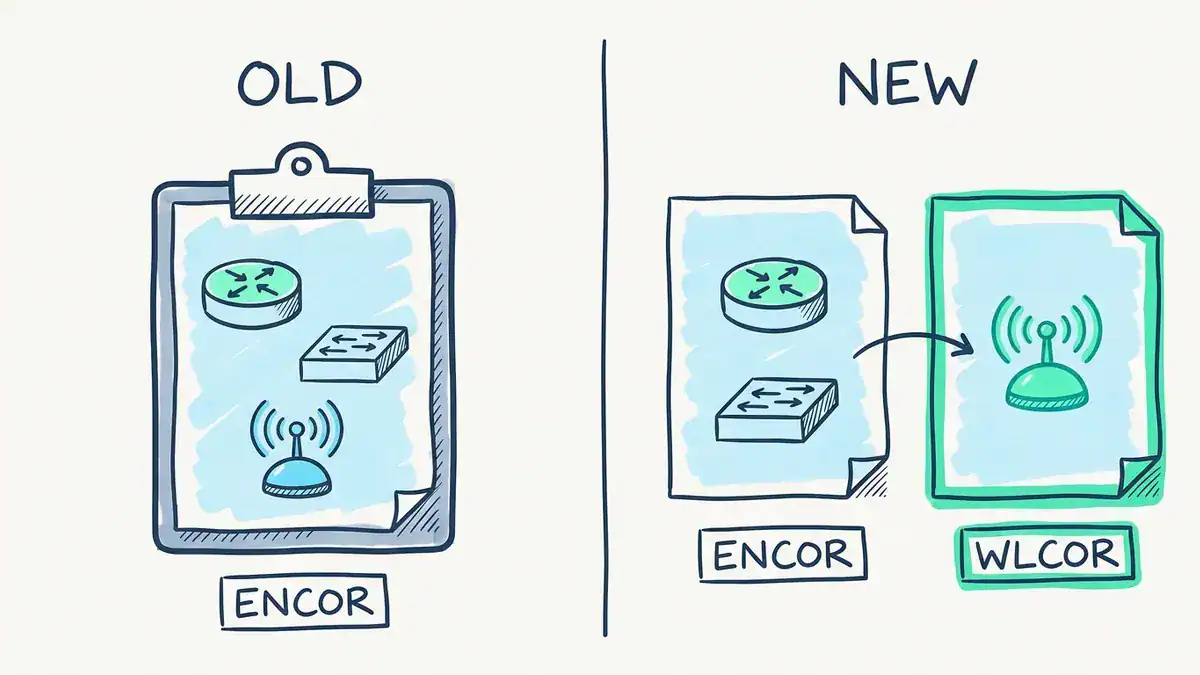
Before 2026-03-19, ENCOR 350-401 v1.1 included wireless. From v1.2, wireless lives in the CCNP Wireless core exam, 350-101 WLCOR.
Will ENCOR change again in 2027? As of 2026-11-22, Cisco hasn’t announced an ENCOR v1.3 or v2.0. Cisco usually announces exam changes months ahead, and the ENCOR exam page always shows the current version. Check it the week you book. One change that is confirmed for 2027 sits one level down: the new CCNA 200-301 v2.0 starts on 2027-02-03, which matters if you’re still on the CCNA step.
CCNP ENCOR 350-401 exam topics
ENCOR is the CCNP exam that decides most attempts, and it holds most of the CCNP exam topics people worry about. It’s broad on purpose. Here are the official CCNP ENCOR exam topics for v1.2, with Cisco’s weights:
| Domain | Weight | What’s in it |
|---|---|---|
| 1.0 Architecture | 15% | 2-tier, 3-tier and fabric design, FHRP and SSO, Catalyst SD-WAN and SD-Access planes, reading QoS configs |
| 2.0 Virtualization | 10% | Hypervisors, VRF, GRE and IPsec tunnels, LISP, VXLAN |
| 3.0 Infrastructure | 30% | Trunks, EtherChannel, RSTP and MST, EIGRP vs OSPF concepts, OSPFv2/v3 multi-area, eBGP, PBR, NTP and PTP, NAT/PAT, HSRP and VRRP, multicast |
| 4.0 Network Assurance | 10% | Debugs, SNMP, syslog, Flexible NetFlow, SPAN/RSPAN/ERSPAN, IP SLA, Catalyst Center, NETCONF and RESTCONF |
| 5.0 Security | 20% | AAA, ACLs, CoPP, REST API security, threat defence, endpoint security, NGFW, TrustSec and MACsec |
| 6.0 Automation and Artificial Intelligence | 15% | Python, JSON, YANG, Catalyst Center and SD-WAN Manager APIs, REST response codes, EEM applets, agent vs agentless tools |
Source: Cisco’s ENCOR v1.2 exam topics PDF, read 2026-11-22.
Infrastructure is 30% on its own. That’s where your lab hours should go first.
Look at how much of it is “configure and verify” rather than “describe.” OSPF, eBGP, NAT, FHRP, EtherChannel, NetFlow, IP SLA, SPAN and AAA all carry hands-on verbs. You won’t pass those by reading. If routing is your weak spot, our guide to route redistribution between OSPF, EIGRP and BGP shows the kind of config-level detail ENCOR expects. The architecture domain also asks how SD-WAN works, which our SD-WAN beginner’s guide explains.
What Cisco doesn’t publish: the number of questions or the passing score. Any site that quotes an exact count or a fixed score as fact is guessing. Cisco only says results are pass or fail.
Which CCNP concentration should you pick?
Your CCNP concentration is the part you get to choose. Pick the one closest to your actual job, because you’ll study faster when you can test ideas at work.
| Concentration | Pick it if you… |
|---|---|
| 300-410 ENARSI | Live in routing: OSPF, EIGRP, BGP, redistribution, VPN, troubleshooting. A common first pick |
| 300-415 ENSDWI | Run or plan a Cisco Catalyst SD-WAN deployment |
| 300-420 ENSLD | Design networks more than you configure them |
| 300-435 ENAUTO | Script with Python and APIs, or want to move toward automation |
| 300-440 ENCC | Connect branches and campuses to public cloud |
| 300-445 ENNA | Own monitoring, telemetry and network assurance tools (English only) |
CCNP ENARSI is a common pick for one simple reason: it builds directly on ENCOR’s biggest domain. The routing you learn for ENCOR’s Infrastructure section carries straight into ENARSI’s troubleshooting labs. Booking ENARSI soon after ENCOR, while the material is still fresh, is a sensible move.
ENAUTO is the smart second look. It also counts toward CCNP Automation, so one exam can sit under two professional tracks if you add AUTOCOR later. If that’s your direction, the CCNA Automation Workbook covers the Python, REST, NETCONF and YANG basics that ENCOR domain 6 and ENAUTO both build on.
Honestly, there’s no wrong concentration. They cost the same and they earn the same CCNP Enterprise. Pick for your job, not for the hype.
CCNP certification cost
Cisco’s CCNP certification cost is $700 in exam fees for CCNP Enterprise: $400 for ENCOR plus $300 for the concentration. Those are US list prices. Local prices and taxes vary by country.
What pushes the real total higher:
- Retakes. A failed exam costs the full fee again.
- CCNP training. Official Cisco courses and third-party courses are optional, and prices vary widely.
- Lab gear. A free EVE-NG install on your own PC covers almost every ENCOR lab. You don’t need racks of hardware. Our guide to installing EVE-NG walks through it.
- Practice material. A CCNP practice exam and a workbook, if you use them.
Want to compare against the levels around it? The CCIE vs CCNP guide covers the CCIE lab fee, and our CCNA exam cost guide breaks down the step before.
CCNA vs CCNP: how big is the jump?
What is CCNA and CCNP certification, side by side? The CCNA proves you can run a small to mid-size network. The CCNP proves you can run and fix a large enterprise one. Here’s the CCNP vs CCNA certification comparison in one table:
| CCNA | CCNP Enterprise | |
|---|---|---|
| Level | Associate | Professional |
| Exams | One (200-301) | Two (ENCOR + one concentration) |
| Exam fees (USD) | $300 | $700 |
| Routing depth | Single-area OSPF basics | Multi-area OSPFv2/v3, eBGP, redistribution (ENARSI) |
| New topic areas | Mostly fundamentals | SD-WAN, SD-Access, VXLAN, LISP, multicast, Catalyst Center, EEM |
| Validity | 3 years | 3 years |
| Renewal by credits | 30 CE credits | 80 CE credits |
The biggest shift in the CCNA vs CCNP gap isn’t the number of topics. It’s the verbs. CCNA mostly asks you to identify and describe. ENCOR asks you to configure, verify and troubleshoot.
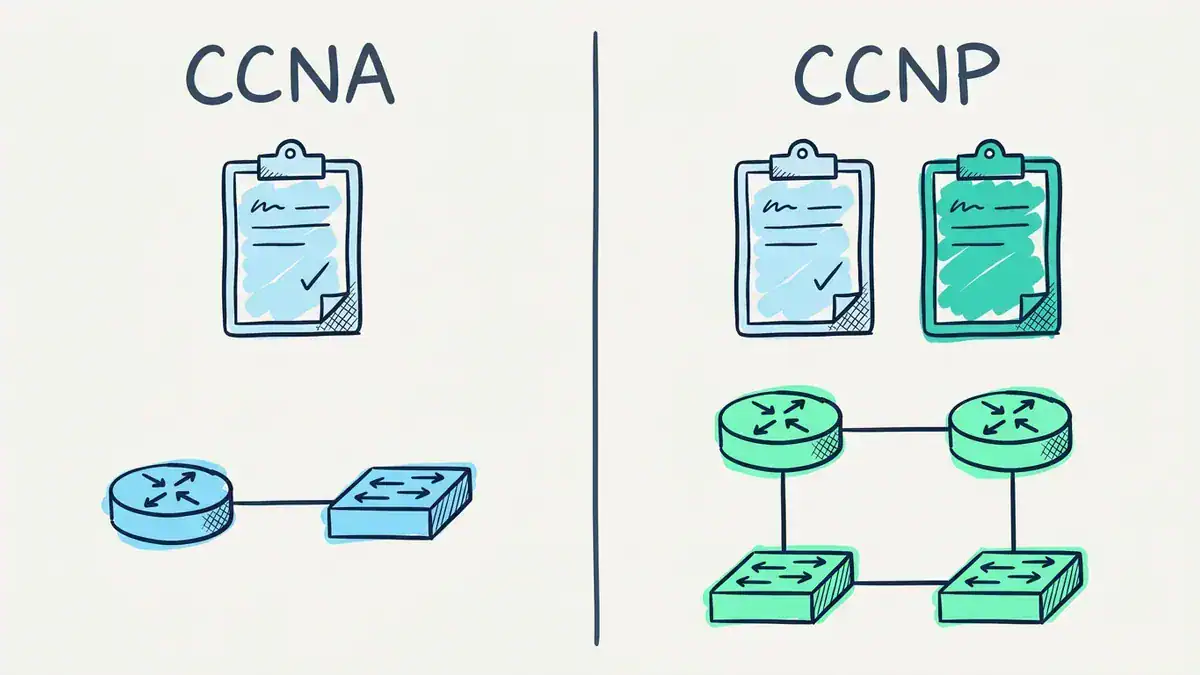
CCNA is one exam (200-301) on a small network. CCNP Enterprise is two exams (350-401 plus a 300-series concentration) on a larger, layered enterprise network.
Going from CCNA to CCNP in 2027
If you’re on the CCNA to CCNP road right now, note the date above: CCNA v2.0 starts on 2027-02-03. Our CCNA certification guide explains what moves between versions.
Here’s a realistic move. Say you passed the CCNA last autumn and you’re doing helpdesk or junior network work. Give yourself two or three months of daily labs on the topics the CCNA only touched: multi-area OSPF, eBGP, EtherChannel troubleshooting, NAT and HSRP. Then start ENCOR study proper. That bridge period is where a lot of failed first attempts could have been saved.
Still building CCNA skills? The CCNA Workbook is 75 EVE-NG and Packet Tracer labs on the 200-301 blueprint.
How hard is CCNP, and how long does it take?
How hard is CCNP? Harder than the CCNA by a clear margin, and much easier than the CCIE lab. ENCOR’s breadth is the hard part. In one exam you jump from VXLAN to Python to MACsec to multicast.
How long does it take to get CCNP certification? Cisco doesn’t publish a study time, so these are our planning estimates, not statistics:
| Starting point | ENCOR | Concentration | Total |
|---|---|---|---|
| Fresh CCNA, little job experience | 4 to 6 months | 2 to 3 months | About 6 to 9 months |
| CCNA plus 2 to 3 years of network work | 3 to 4 months | 1 to 2 months | About 4 to 6 months |
| No CCNA, no network job | Start with the CCNA | Over a year |
The variable that matters most isn’t talent. It’s lab hours per week.
Picture two engineers who start ENCOR on the same day. One reads the official cert guide cover to cover and books the exam when they finish it. The other reads one chapter, then rebuilds that chapter’s configs in EVE-NG before moving on. The second one usually finishes later on paper, but passes first. The ENCOR blueprint rewards people who’ve typed the commands.
A six-month CCNP study plan
Here’s how to get CCNP certification in about six months with 8 to 10 hours a week. It assumes a recent CCNA and treats this article as your CCNP study guide outline. Adjust the months to your own start point.
- Month 1: Infrastructure, Layer 2 and Layer 3. Trunks, EtherChannel, RSTP and MST, multi-area OSPFv2 and v3, eBGP between neighbours. Build every topic in a lab before you move on.
- Month 2: Infrastructure, IP services and multicast. NAT/PAT, HSRP and VRRP, NTP and PTP, PBR, then PIM, IGMP, SSM and MSDP. Multicast is new depth in v1.2, so don’t skip it.
- Month 3: Virtualization and architecture. VRF, GRE and IPsec tunnels, VXLAN and LISP concepts, SD-WAN and SD-Access planes, QoS configs.
- Month 4: Security and assurance. AAA, ACLs, CoPP, TrustSec and MACsec, then debugs, Flexible NetFlow, SPAN, IP SLA, NETCONF and RESTCONF.
- Month 5: Automation and AI. Python reading, JSON, YANG, REST response codes, Catalyst Center and SD-WAN Manager APIs, EEM applets. Then a full revision pass and a CCNP practice exam to find weak domains.
- Month 6: Book ENCOR, then the concentration. Sit ENCOR early in the month. Pass, and start your concentration the following week while the material’s fresh.
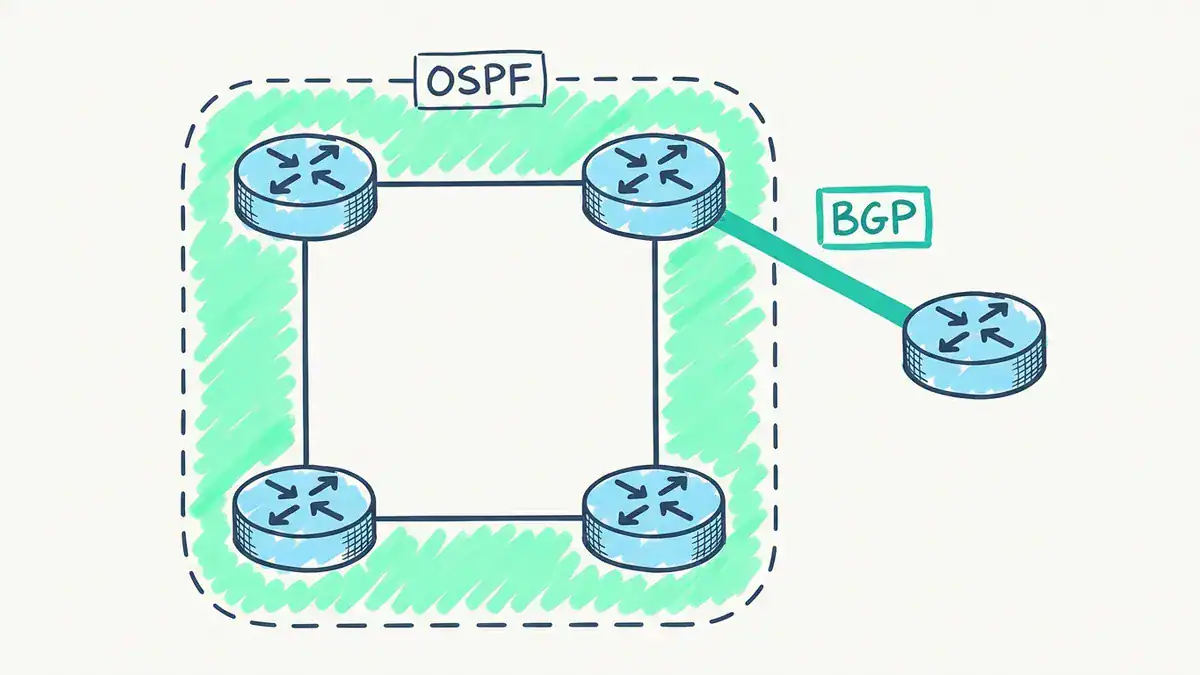
A starter CCNP lab: four routers running OSPF inside (split them into two areas for multi-area practice) and a fifth router as an external eBGP peer. It covers a big slice of ENCOR’s 30% Infrastructure domain.
Your CCNP lab
A CCNP lab doesn’t need hardware. A single PC running EVE-NG with virtual routers and switches covers nearly everything ENCOR asks you to configure. Our EVE-NG hardware requirements guide helps you size the PC. Our home lab setup guide shows how to build one in a weekend.
Want the labs already built? The CCIE Enterprise Workbook gives you 120 EVE-NG labs with tested configs for OSPF, BGP, DMVPN, SD-Access and SD-WAN, the same technology families ENCOR covers. It goes deeper than ENCOR needs, which is the point if CCIE is your next step. Grab the free sample from the workbook page.
Is CCNP worth it in 2027?
For most network engineers with a CCNA and a couple of years on the job, yes. It’s the certification that moves you from “can follow a change plan” to “writes the change plan.”
On pay, PayScale’s self-reported average for CCNP holders was $113K in the US, based on 1,412 people reporting and updated 2026-07-14 (PayScale/Salary)). Treat it as a rough guide, since it’s self-reported and mixes every track. For the full CCNP salary breakdown by track, see our guide to Cisco certifications that boost your salary.
And CCNP vs CCIE? The CCIE adds an eight-hour hands-on lab on top of a core exam, and for Enterprise that core exam is the same ENCOR you pass for CCNP. Our CCIE vs CCNP comparison covers when the jump makes sense, and the CCIE career path maps the road after it.
How to renew CCNP certification
How long does CCNP certification last? Three years from the date you earn it. Cisco doesn’t give extensions, so put the date in your calendar the day you pass.
How do I renew my CCNP certification? Cisco’s recertification policy gives three ways to recertify before the expiry date:
- Earn 80 Continuing Education (CE) credits for a professional-level certification, through approved Cisco training and events.
- Pass exams again. ENCOR and each concentration exam say they “can be used toward recertification.”
- Move up a level. Cisco counts advancing to the next certification level, such as a CCIE, as a way to recertify.
You can mix routes, but the exact exam-and-credit combinations change from time to time, so check Cisco’s recertification page before you plan your CCNP Enterprise recertify path.
Here’s how a renewal can go wrong. Picture an engineer who passed ENCOR and ENARSI in early 2024, got busy and forgot. By the time they check in 2027, the certificate has lapsed, and with no extensions on offer they’re back to two exams on the newer blueprint. A single re-pass of ENCOR in 2026 would’ve kept everything active.
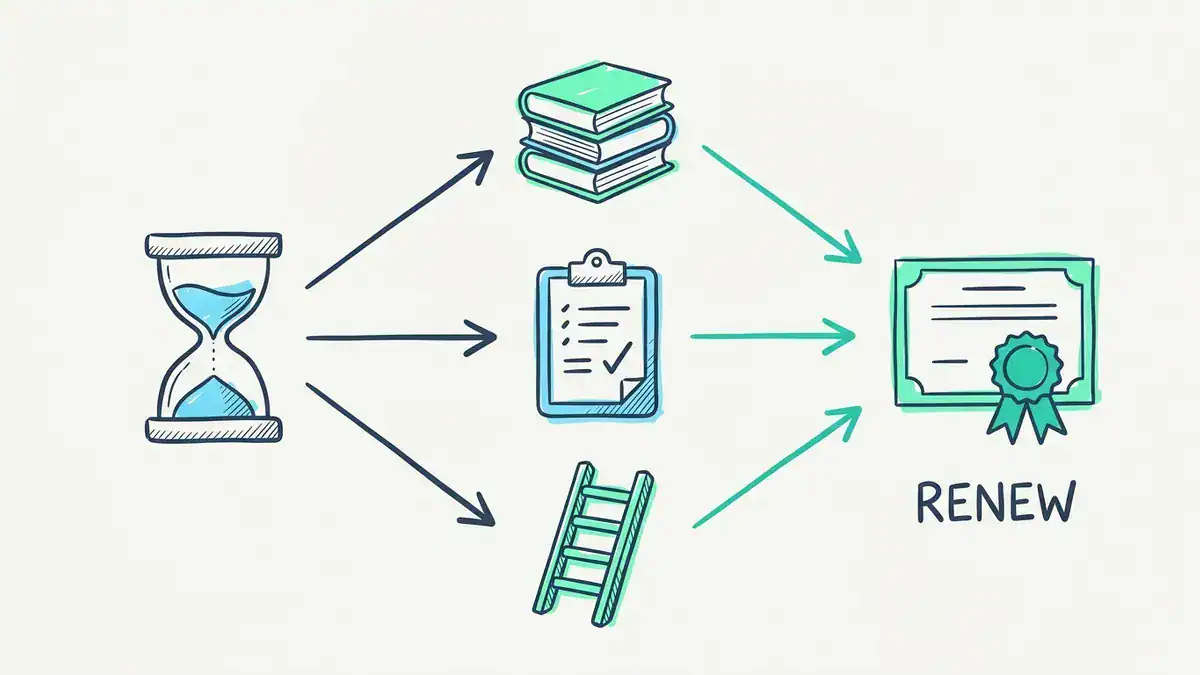
Three ways to renew before the three-year mark: 80 CE credits, passing an exam again, or earning a higher certification such as a CCIE.
Frequently asked questions
What is CCNP certification?
CCNP (Cisco Certified Network Professional) is Cisco’s professional-level certification, between CCNA and CCIE. Each of the eight CCNP tracks needs two exams: a core exam and one concentration exam. CCNP Enterprise, the track this guide covers, uses 350-401 ENCOR as its core.
Do I need a CCNA before CCNP?
No. Cisco lists no prerequisites for any CCNP Enterprise exam. In practice many candidates hold a CCNA first, because ENCOR assumes associate-level routing and switching skills.
How long does CCNP certification last?
Three years from the date you earn it. You renew with 80 Continuing Education credits, by passing exams again, or by earning a higher certification such as a CCIE. Cisco doesn’t offer extensions.
How much does the CCNP Enterprise exam cost?
$700 in Cisco’s US list prices: $400 for 350-401 ENCOR and $300 for the concentration exam. Retakes cost the full fee again, and local prices vary by country.
What changed in ENCOR 350-401 v1.2?
All wireless topics moved to the new CCNP Wireless core exam (350-101 WLCOR) on 2026-03-19. Multicast gained SSM, bidir and MSDP, and domain 6 became “Automation and Artificial Intelligence.” Cisco kept the domain weights the same.
How many questions are on the ENCOR exam, and what’s the passing score?
Cisco doesn’t publish either number. It only states that ENCOR is a 120-minute exam with a pass or fail result. Treat any exact question count or fixed score as unofficial.
Which CCNP concentration is easiest?
None is officially easier, and they all cost $300. ENARSI is a common pick because it builds on ENCOR’s 30% Infrastructure domain. The easiest one for you is usually the one closest to your daily job.
Does passing ENCOR count toward the CCIE?
Yes. Cisco says ENCOR meets the core exam requirement for CCIE Enterprise Infrastructure. Passing it also earns the Cisco Certified Specialist – Enterprise Core on its own.
Bottom line
The CCNP certification is still the clearest next step after the CCNA, as long as you study the 2027 version of it, not the 2024 one.
- CCNP Enterprise is two exams: ENCOR 350-401 v1.2 plus one of six concentrations, $700 in fees.
- Wireless left ENCOR on 2026-03-19. Skip old wireless chapters and spend that time on multicast, SD-Access and automation.
- Infrastructure is 30% of ENCOR. Lab hours there pay off more than anywhere else.
- Plan on about six months with a recent CCNA and 8 to 10 hours a week, by our estimate.
- Renew within three years: 80 CE credits, an exam re-pass or a CCIE.
Your next step is simple. Install EVE-NG, build a four-router OSPF lab this week, and start month one of the plan.
Ready to lab the technology for real? Download the free sample of the CCIE Enterprise Workbook and see how its EVE-NG labs line up with the ENCOR blueprint.