
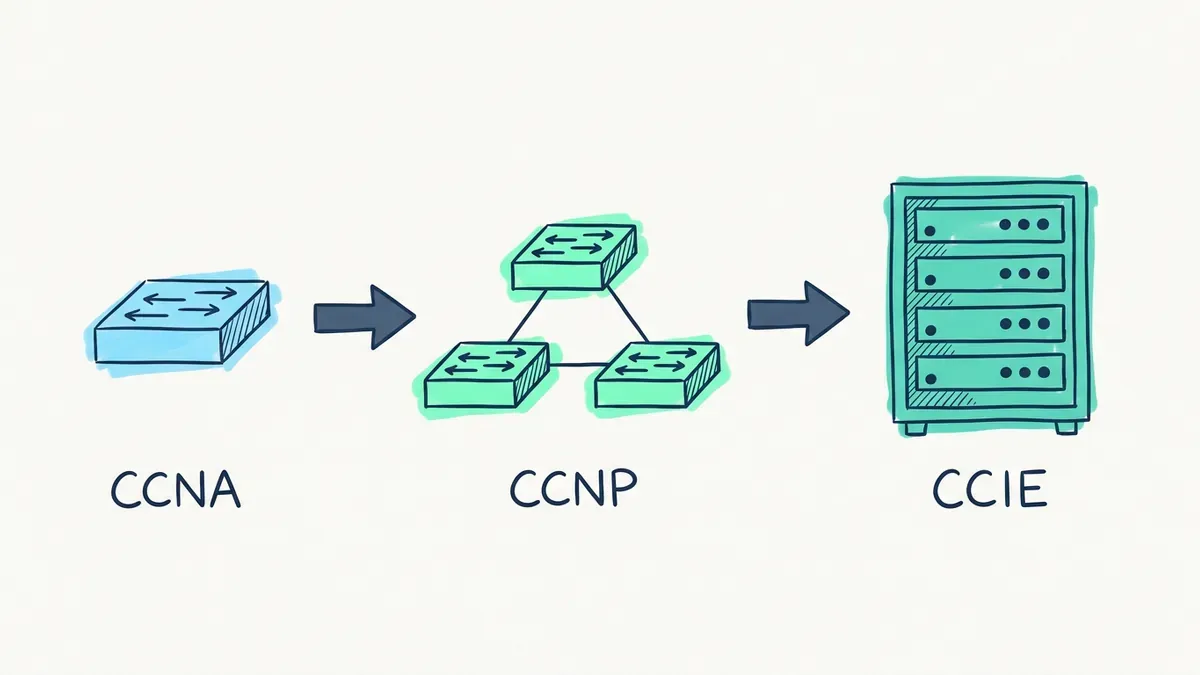
CCNP and CCIE are two steps on the same Cisco ladder. The CCNP is a core exam plus one concentration exam, and CCNP Enterprise lists $700 in total. The CCIE is a core exam plus an 8-hour hands-on lab, at $400 plus $1,600 per lab attempt. Take the CCNP first unless you already have years of hands-on work in one track. For Enterprise, the CCNP core exam (ENCOR) is also the CCIE core exam, so nothing you study for the CCNP is wasted.
On pay, PayScale’s self-reported averages in July 2026 were $113K for CCNP holders and $151K for CCIE holders, a gap near $38K. Sources disagree, so our pay guides show each one.
But here’s the thing. Salary isn’t the whole story. The CCIE vs CCNP decision depends on where you are in your career, how much time you can invest, and what kind of engineer you want to become. Some people are better off with a CCNP. Others need the CCIE to hit their goals.
So which one actually makes sense for you? Let’s break it down honestly, no fluff, no hype. Just the facts. Last checked 2026-11-08.
CCIE vs CCNP: The Quick Breakdown
Before we get into the details, here’s a quick side-by-side look at CCIE vs CCNP. This table covers the big differences at a glance.
| Category | CCNP (Enterprise shown) | CCIE (Enterprise Infrastructure shown) |
|---|---|---|
| Level | Professional | Expert |
| Exams | 1 core exam ($400, 120 minutes) + 1 concentration exam ($300, 90 minutes) | 1 core exam ($400, 120 minutes) + 8-hour lab ($1,600) |
| Fees at Cisco list price | $700 | $2,000 with one lab attempt, $1,600 for each retake |
| Prerequisites | None listed | None listed |
| Validity | 3 years, renew with Continuing Education credits or retake | 3 years, same options |
| Tracks | 8 | 7 |
| Typical experience (our view) | 3-5 years | 5+ years |
| Study time (our estimate) | 3-6 months | 1-2 years, varies widely |
| Pass rate | Cisco doesn’t publish one | Cisco doesn’t publish one |
Fees are Cisco list prices in US dollars for the Enterprise track, checked 2026-11-08. Other tracks may differ.
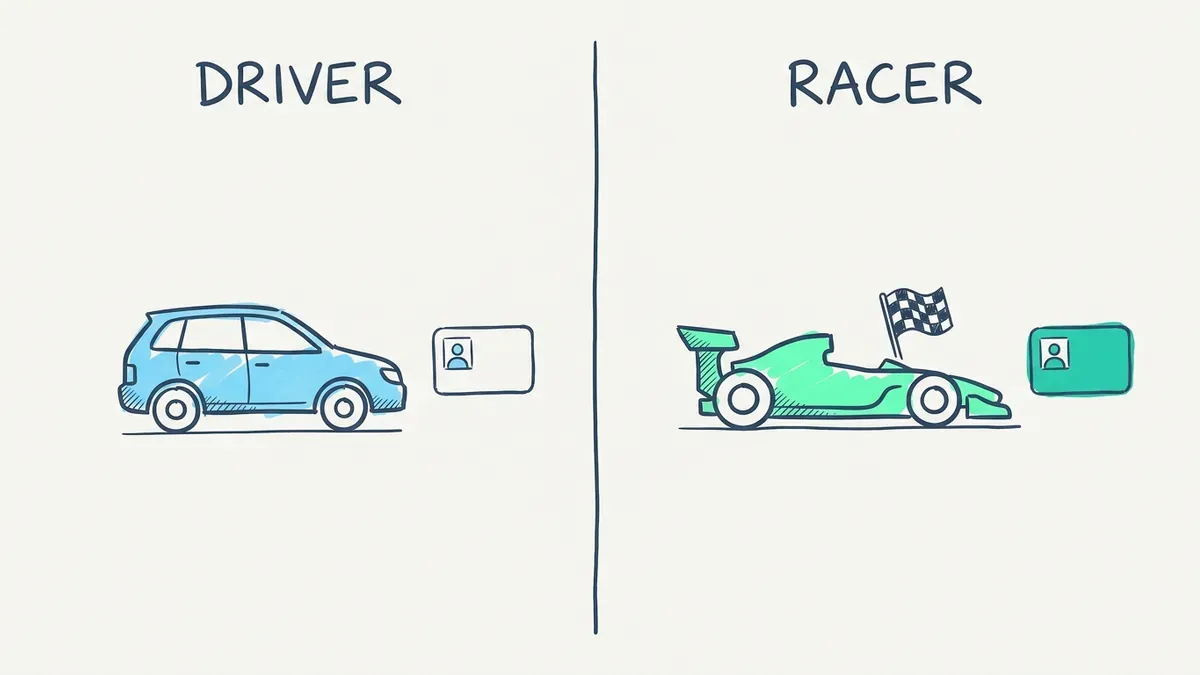
Think of it this way. CCNP is your driver’s licence, it proves you can do the job well. CCIE? That’s your racing licence. Different league entirely.
Now let’s dig deeper into each one.
What Is CCNP and Who Is It For?
CCNP stands for Cisco Certified Network Professional. It’s the mid-tier Cisco certification aimed at engineers with about 3-5 years of networking experience. You don’t technically need a CCNA to take the CCNP exams (Cisco lists no prerequisites), but most people have one. If you’re starting there, our CCNA exam cost guide shows what the first step costs.
The CCNP proves you can plan, build, and troubleshoot enterprise network solutions. Cisco lists CCNP in eight areas: Automation, Collaboration, Cybersecurity, Data Center, Enterprise, Security, Service Provider and Wireless. Check Cisco’s page for each area’s exams and fees. Each track requires a core exam plus one concentration exam of your choice. On the Enterprise track you pass one core exam (350-401 ENCOR, $400, 120 minutes) and one concentration exam of your choice ($300 and 90 minutes each): ENARSI, ENSDWI, ENSLD, ENAUTO, ENCC or ENNA. ENSDWI is the SD-WAN one.
And here’s something most people miss about the CCNP vs CCIE conversation. Passing the CCNP Enterprise core exam (350-401 ENCOR) also counts as your CCIE Enterprise Infrastructure core exam. On its own, ENCOR also earns the Cisco Certified Specialist – Enterprise Core certification. So if you’re thinking long-term, the CCNP is actually your first step toward the CCIE. Pretty smart move by Cisco.
The CCNP is ideal for network engineers, security analysts, and cloud infrastructure pros who want to validate their skills and move into senior roles. It’s respected globally and most hiring managers see it as a strong signal that you know your stuff. If your routing fundamentals need work before you tackle CCNP-level material, our EIGRP vs OSPF breakdown is a good place to firm those up.
What Is CCIE and Who Is It For?
The CCIE, Cisco Certified Internetwork Expert, is one of the most respected certifications in all of IT. Not just networking. All of IT. Cisco doesn’t publish a count of active CCIEs. Third-party estimates run from about 45,000 to 50,000 active and above 69,000 issued over the programme’s life (PyNet Labs, January 2025, not Cisco data). That exclusivity is part of what makes it so valuable.
Here’s what sets the CCIE apart from everything else. The lab exam. It’s an 8-hour, hands-on exam. Cisco says the Enterprise Infrastructure version tests your ability to plan, design, operate, and optimize dual-stack solutions. No shortcuts. You either know the technology inside and out, or you don’t.
Sound intimidating? It should be. That’s the point.
Cisco lists seven CCIE tracks: Automation, Collaboration, Data Center, Enterprise Infrastructure, Security, Service Provider and Wireless. If you’re weighing the Enterprise or Security tracks, our CCIE Enterprise Infrastructure Workbook and CCIE Security Workbook walk through real exam-style lab scenarios for each.
The CCIE is meant for senior engineers, network architects, and technical leaders who want to prove they’re among the best in the world. It’s not for everyone. But for those who earn it, the career impact is massive.
CCIE vs CCNP: Detailed Side-by-Side Comparison
Let’s get into the specifics. Understanding the CCIE vs CCNP differences across key areas will help you make a smarter decision.
How the CCIE vs CCNP Exam Structure Differs
This is where the biggest gap shows up in the CCNP vs CCIE written comparison. The CCNP requires two written exams, a core exam (120 minutes) and a concentration exam (90 minutes). Both are multiple choice and simulation-based. Challenging? Sure. But manageable with solid study habits.
The CCIE? Completely different animal. You first pass a core exam (the old “written”; on the Enterprise track it can be your CCNP core exam, ENCOR). Then comes the lab exam. Eight hours. Hands-on. You’re configuring, troubleshooting, and designing networks. There’s no guessing your way through a CCIE lab.
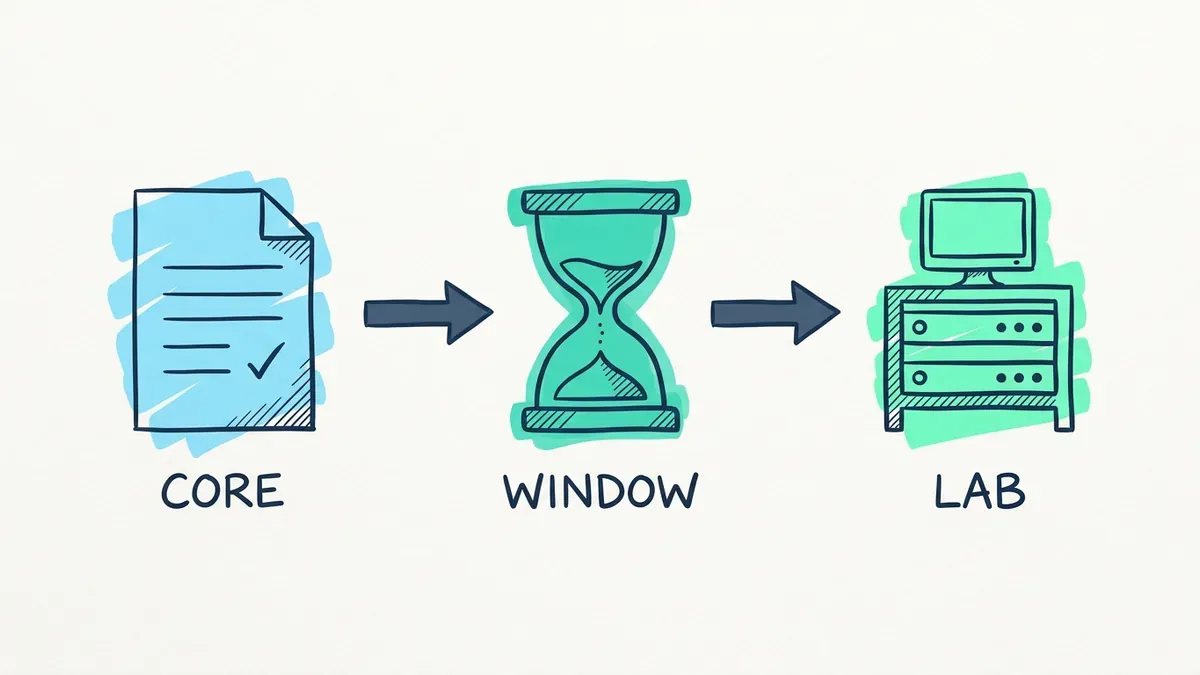
Passing the core exam starts a clock. It’s valid for three years, and you must finish the lab inside that window. Cisco sets no limit on lab attempts inside it, and you wait 30 days after a failed lab. Cisco’s exam policies page has the details.
Students who breeze through the CCNP written exams often hit a wall when they start CCIE lab prep. The jump in practical skill required is enormous. Building that muscle memory ahead of time, through a real home lab rather than just reading, is what closes the gap. Our home lab setup guide walks through building one in a weekend.
CCIE vs CCNP: Time and Cost Investment
Let’s talk numbers. Cisco’s list fees for CCNP Enterprise are $700 in total: $400 for the core exam and $300 for the concentration exam. Study time is our estimate: most people need 3-6 months of focused study. Add study materials and lab time on top. Those depend on what you buy.
The CCIE is a different story. Cisco’s list fees are $400 for the core exam and $1,600 for the lab, so $2,000 with one lab attempt. Yeah, per attempt: a retake is another $1,600. Cisco sets no study timeline. Our estimate is 6-12 months with structured training and 18-24 months with self-study, sometimes longer.
That’s why structured, scenario-based practice makes financial sense. Working through a real lab workbook before you sit the exam catches the gaps a single read-through never will, and it’s a lot cheaper than a second $1,600 lab attempt. Our CCIE exam cost guide breaks down every fee, from the core exam to travel.
CCNP vs CCIE Salary: What the Numbers Actually Show
This is the section everyone skips to. Fair enough. Let’s talk about the CCNP vs CCIE salary differences with real data.
- PayScale, CCNP: $113K average base, 1,405 survey responses (updated 2026-07-14)
- PayScale, CCIE: $151K average base, 201 profiles (updated 2026-07-03)
Self-reported averages, so treat them as a guide. Job title, city and years of experience all move the number too. Our full CCIE salary guide by track shows ZipRecruiter, PayScale and Glassdoor side by side, and our Cisco certification salary comparison covers CCNP pay by track.
But here’s something salary averages don’t show. Architect, consulting and principal roles often list the CCIE as preferred. Think principal network architect, consulting engineer, or technical director. Not every employer asks for it, so check the job posts you’re aiming at.
The Bureau of Labor Statistics projects computer network architect employment to grow 8% from 2025 to 2035, well ahead of the average for all occupations, with 2025 median pay at $134,050. Source: BLS Occupational Outlook Handbook. On pay, Pearson VUE’s 2025 report found 32% of certified professionals got a rise, and 56% of those within three months, so about 18% inside a quarter, by our arithmetic (32% x 56%). The return on investment is real, just slower than a single salary figure suggests.
CCNP vs CCIE Difficulty: How Hard Are We Talking?
Let’s be honest about the CCNP vs CCIE difficulty gap. It’s significant.
The CCNP exams are challenging. You need to know your protocols, configurations, and troubleshooting methodologies. But the format is familiar, multiple choice, drag and drop, simulations. If you’ve passed the CCNA, you know the drill. Study hard, practice labs, and you’ll get through it.
The CCIE lab? Whole different world. Imagine troubleshooting a broken multi-site network with BGP, OSPF, MPLS, DMVPN, and security policies, all under time pressure. Eight hours, hands-on, under time pressure. It’s like a live troubleshooting marathon.
Cisco doesn’t publish pass rates for any exam. Training vendors quote first-attempt CCIE rates anywhere from about 10% to 30%, always without naming a source, so plan for a retake. An 8-hour lab on top of a core exam tells you most of what you need to know about the CCNP vs CCIE difficulty difference.
Multiple CCNP vs CCIE: Does Stacking Certifications Beat One CCIE?
This is a question we hear constantly. Is earning multiple CCNP certifications across different tracks (Enterprise, Security, Data Center) better than pursuing a single CCIE? The multiple CCNP vs CCIE debate is more nuanced than most people think.
Here’s the honest answer. It depends on your career goal. That’s our view, not a Cisco ruling.
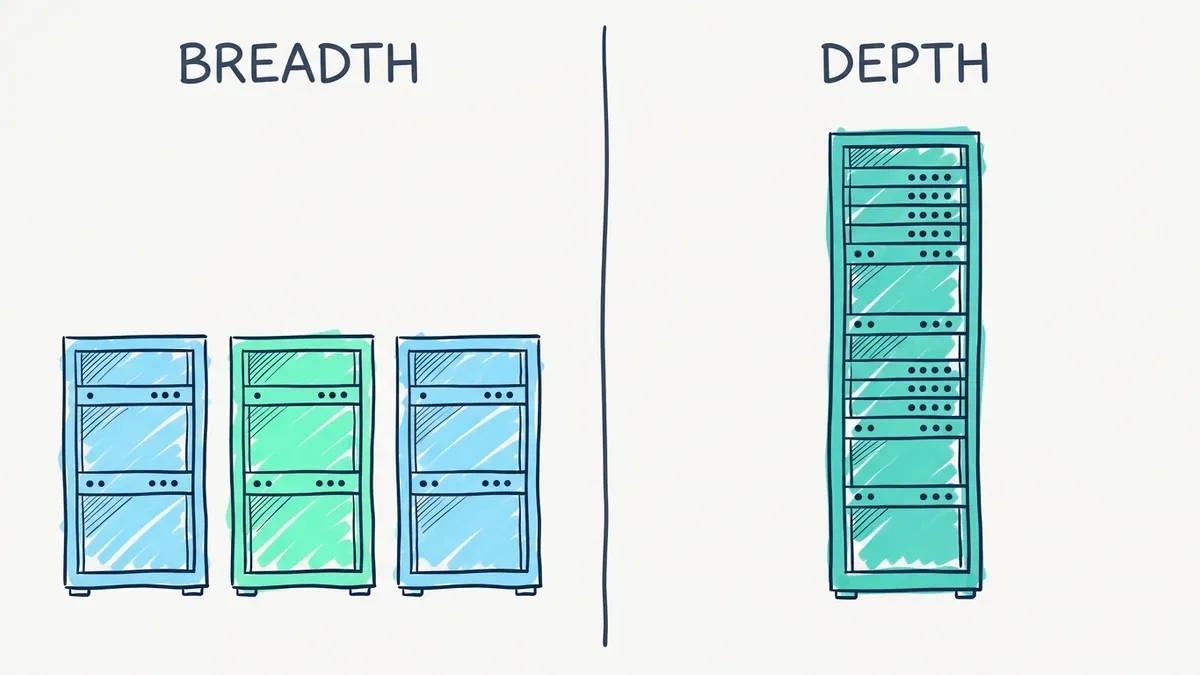
Multiple CCNPs make sense if: You want to be a versatile generalist. Some organizations value engineers who understand networking, security, AND data center technologies. If you’re at a smaller company or an MSP where you wear many hats, breadth matters more than depth.
A single CCIE makes sense if: You want to specialize and reach the top of your field. The CCIE signals world-class depth in one domain. It opens doors to consulting, architecture roles, and leadership positions that multiple CCNPs simply can’t match.
Think of it like martial arts. Stacking CCNPs is like earning belts in three different styles. Impressive? Sure. But a CCIE is like earning a black belt in one. Different kind of respect. Different kind of opportunity.
According to Skillsoft’s 2024 IT Skills and Salary Report (published by Global Knowledge), 97% of IT decision makers say certified staff add measurable value to their organisation.
CCIE vs CCNP: Which Path Should You Take?
So how do you actually decide? Here’s a practical guide based on career goals. Use this to figure out where the CCIE vs CCNP decision lands for your situation. If you’re going all the way, our CCIE career path roadmap maps every stage from zero to lab.
| Your Goal | Best Path | Why |
|---|---|---|
| Network Engineer | CCNP first, then CCIE | Build foundation, then specialise |
| Network Architect | CCIE (often preferred) | Architecture roles demand expert depth |
| Security Expert | CCNP Security, then CCIE Security | Security is a focused track. Our CCIE Security salary guide covers pay. |
| Automation Engineer | CCNP Automation, then consider CCIE Automation | Cisco’s current names for the automation track |
| Consulting/Freelance | CCIE (most clients expect it) | Clients often ask for expert-level proof |
| Career Changer (new to IT) | CCNA then CCNP | Build progressively, don’t skip levels |
Five questions before you book the CCIE lab
Answer yes or no.
- Can you troubleshoot an unfamiliar topology without a guide?
- Do you already work in one track?
- Can you give it about 10 hours a week for months?
- Could you pay for a retake ($1,600) without stress?
- Is your core exam fresh enough to finish inside the three-year window?
Two or more “no” answers means the CCNP route, or a few more months of hands-on work, is the better next step. The 10 hours is a planning number, not a statistic.
Bottom line? If you’re early in your career, start with the CCNP. Build real-world experience. Get comfortable with design and troubleshooting at scale. Then, when you’re ready to make the jump, the CCIE becomes your career accelerator.
If you’re already a senior engineer with 5+ years and you know your track, go straight for the CCIE. Whichever stage you’re at, our CCNA Workbook and CCNA Automation Workbook cover the foundation, and the CCIE Enterprise and Security workbooks linked above cover the expert-level lab scenarios once you’re ready for them.
Is CCIE harder than CCNP?
Yes. The CCNP is two exams. The CCIE is a core exam plus an 8-hour hands-on lab. Cisco doesn’t publish pass rates, and the figures training vendors quote carry no source, so we don’t repeat one. Budget for a lab retake.
How much more does a CCIE make than a CCNP?
PayScale’s self-reported averages in July 2026 were $151K for CCIE holders and $113K for CCNP holders, a gap near $38K. Other sources differ because titles, cities and experience differ. Our CCIE salary guide shows each source side by side.
Do I need CCNP before CCIE?
No. Cisco lists no prerequisites for the CCIE core or lab exams. For Enterprise, the CCNP core exam ENCOR (350-401) is also the CCIE Enterprise Infrastructure core exam, so most people take the CCNP route and hold a credential along the way.
Is it better to get multiple CCNPs or one CCIE?
It depends on the job. Several CCNPs show breadth, which suits generalist and managed-service roles. One CCIE shows depth, which suits architect and consulting roles. That’s our opinion, not a Cisco rule.
What’s the CCIE vs CCNP exam structure difference?
The CCNP is a core exam plus one concentration exam. The CCIE is a core exam plus an 8-hour hands-on lab. Pass the core exam and the three-year clock starts: you must finish the lab inside that window, with a 30-day wait after each failed attempt.
Is the CCNP still worth it in 2026?
For most mid-career network and security engineers, yes. It’s Cisco’s professional-level credential and its core exam counts toward the CCIE. It matters less if your job never touches Cisco gear. That’s our view, so check the job posts you’re aiming at.
How many CCIEs are there?
Cisco doesn’t publish a count of active CCIEs. Third-party estimates run from about 45,000 to 50,000 active and above 69,000 issued over the programme’s life (PyNet Labs, January 2025, not Cisco data).
Is CCNA or CCNP harder?
The CCNP. The CCNA is one exam. The CCNP is a core exam plus a concentration exam, with deeper scenarios and an expectation of real job experience.
The Bottom Line on CCIE vs CCNP
The CCIE vs CCNP decision isn’t about which cert is better. Both are valuable. Both advance careers. The real question is which one matches where you are right now and where you want to go.
If you’re building your career, the CCNP is your next smart move. If you’re ready to break into the top tier of networking professionals, the CCIE will get you there. And for many people, the best path is CCNP first, then CCIE.
Whatever you decide, don’t go it alone with just theory. Structured, hands-on lab practice is what separates people who pass on attempt one from people who need three tries. Our CCIE Enterprise Infrastructure Workbook and CCIE Security Workbook are built around exactly that kind of guided, scenario-based practice.