
The CCIE career path is one of the most searched topics in networking, and for good reason. Getting from zero to passing that 8-hour lab exam is a serious commitment. But it doesn’t have to be confusing.
Short answer? The CCIE career path takes most people 3-5 years from scratch, moving through CCNA, then CCNP, then CCIE. With a structured study plan you can cut that to about 2-3 years. Self-study only? Expect the longer end.
That’s the quick version. Now let’s break down every stage of the CCIE career path so you know exactly what to expect, what it costs, and what it pays.
What Does the CCIE Career Path Actually Look Like?
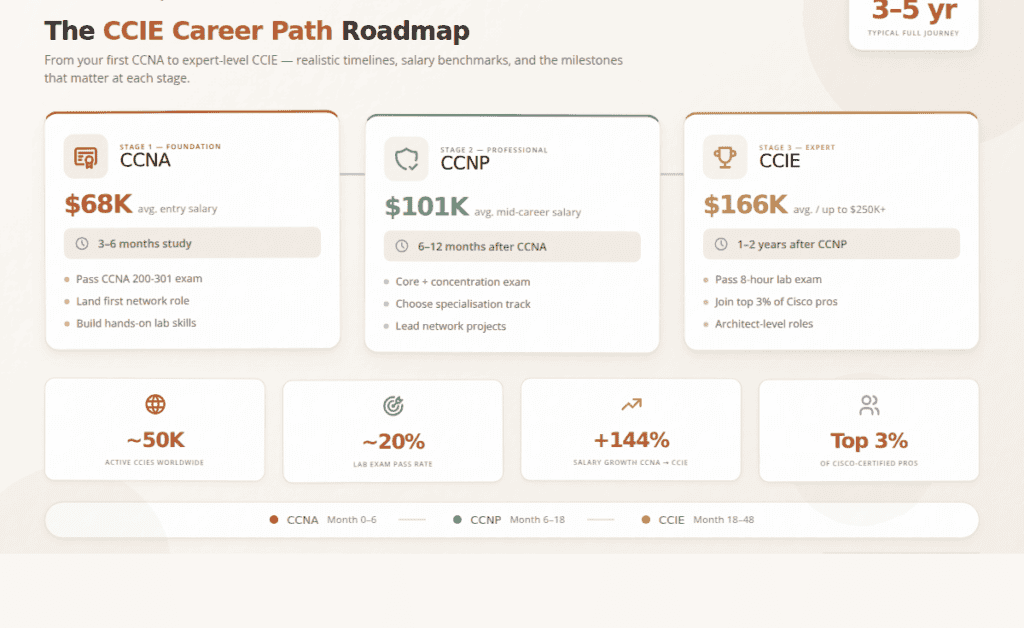
The CCIE career path has three clear stages. Think of it like climbing a mountain, you don’t start at the summit. Each stage builds on the last, and skipping stages is how people fail.
Here’s the roadmap at a glance:
| Stage | Certification | Timeline | Avg Salary |
|---|---|---|---|
| 1 – Foundation | CCNA | 3-6 months | $68K entry |
| 2 – Professional | CCNP | 6-12 months after CCNA | $101K mid-career |
| 3 – Expert | CCIE | 1-2 years after CCNP | $166K avg, up to $250K+ |
Each stage isn’t just about passing exams. It’s about building real skills that compound over time. And honestly, the people who rush through Stage 1 usually struggle hard at Stage 3.
Stage 1: Starting Your CCIE Career Path at Zero
Starting from zero means you’ve got little to no networking experience. Maybe you’re in helpdesk, maybe you’re switching careers entirely. Either way, the CCIE career path begins with the same step for everyone: CCNA.
Building Your CCIE Career Path Foundation
The Cisco CCNA certification is your entry ticket. It covers routing, switching, basic security, wireless, and automation fundamentals. Think of CCNA as your driver’s licence, it proves you understand the rules of the road.
Most people finish CCNA in 3-6 months of focused study. If you’re working full-time, expect closer to 6 months. And don’t skip the hands-on labs. Reading about networking and actually configuring a router are two completely different things. If you’re deciding between CCNA and CompTIA Network+ as your starting point, we’ve broken down which one to pick first.
Get a solid study plan, stick to it, and build the habit of daily lab practice. Even 30 minutes a day adds up fast over 6 months. The CCIE career path rewards consistency more than intensity.
What jobs open up after CCNA? Network technician, junior network administrator, NOC analyst. These roles typically pay between $50K and $80K depending on your location. Not bad for 6 months of effort.
Network Engineer Career Progression
Here’s something most career guides won’t tell you. Don’t stay at CCNA level for more than a year. The network engineer career market moves fast, and if you’re sitting on a CCNA for 3 years without progressing, employers notice.
Your goal during Stage 1 is simple: get certified, land a hands-on role, and start studying for CCNP within 6 months of getting hired. The real-world experience you gain at work will make CCNP study way easier.
The network engineer career is evolving fast. Automation, cloud, and security are becoming table stakes. AI-assisted tooling is already changing what network engineers are expected to know, so starting your CCIE career path early gives you a head start while these skills are still considered advanced.
Stage 2: The CCNP Bridge
Most people think CCNP is where the CCIE career path really starts. And they’re right. CCNP is where you go from “I know networking” to “I actually understand networking.”
The CCNP level is also where you pick your specialisation. And this decision matters because it sets the direction for your CCIE track.
Picking Your CCNP Specialisation
Cisco offers several CCNP tracks: Enterprise, Security, Data Center, Service Provider, and Collaboration. For the CCIE career path, the most popular and highest-paying tracks are Enterprise, Security, and Data Center.
Here’s the honest breakdown:
| CCNP Track | Job Demand | Difficulty | CCNP Salary |
|---|---|---|---|
| Enterprise | Very High | Moderate | $145K |
| Security | Very High | High | $168K |
| Data Center | High | High | $155K |
| Automation | Growing Fast | Moderate-High | $150K |
Pick based on what you enjoy, not just salary numbers. You’ll be spending hundreds of hours studying this stuff. Passion matters. The CCIE career path is long enough, you don’t want to be miserable through it.
Enterprise is the most versatile. Security has the highest demand. Data Center pays well in specific markets. And Automation? That’s where the future is heading. Your study plan should factor in not just the exam, but the career you want 5 years from now.
CCIE Career Path Timeline: Realistic Expectations
Let’s be real about timelines. The path from CCNA to CCNP takes most people 6-12 months. That’s with consistent study, 10-15 hours a week minimum.
During this stage, you should be working in a network engineer role. The Bureau of Labor Statistics’ latest projections (2025-2035) show employment for network and computer systems administrators declining about 4%, not growing. That’s not a knock on networking, it’s a sign the generalist admin role is shrinking while demand shifts hard toward specialists who can design, secure and automate networks. Source: BLS Occupational Outlook Handbook
That’s exactly why the CCIE career path exists. Specialisation is where the money is.
During CCNP study, start getting comfortable with hands-on labs. The CCIE lab exam will test your ability to configure complex scenarios from scratch. Building that muscle memory at the CCNP level makes the jump to CCIE much smoother. The CCNP qualifying exams test deeper theory, while your day job builds the practical sense. Combine both, and you’re set up for the expert-level stage.
Stage 3: The CCIE Career Path Gets Real
This is it. Stage 3 is where everything changes. The difficulty jumps significantly, the study hours double, and the stakes are higher than ever. But so are the rewards.
Cisco doesn’t publish a live count of active CCIEs, but roughly 69,000 CCIE certifications have been issued worldwide since the program began, and industry estimates put the number still active today at around 45,000-50,000. Compare that to millions of CCNA holders, and you’ll understand why CCIEs command the salaries they do.
Choosing Your CCIE Career Path Track
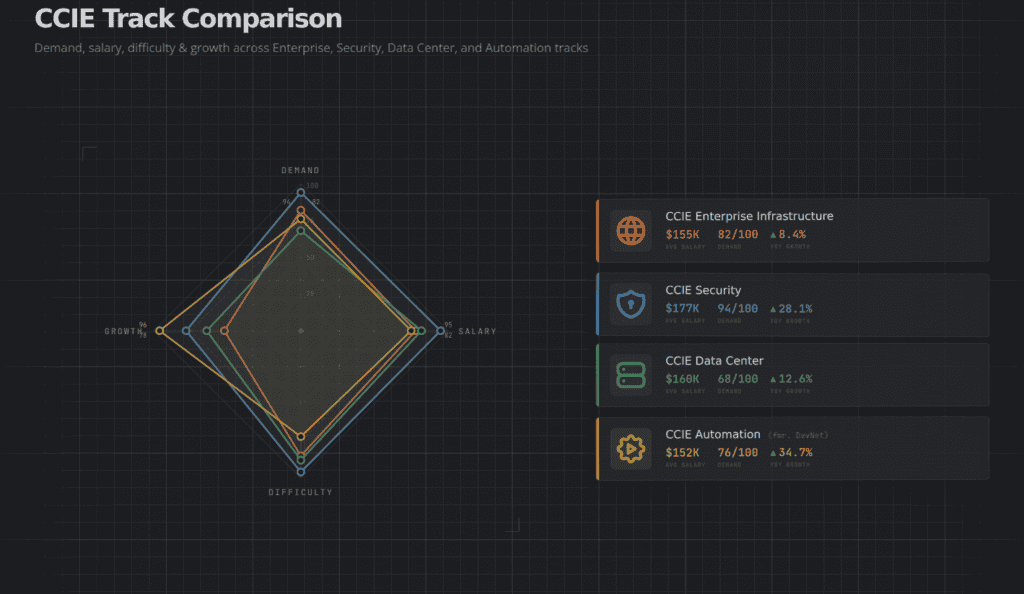
Your CCIE track should align with your CCNP specialisation. Switching tracks at this stage means starting over on a lot of material. Not ideal.
Here’s what each track covers:
CCIE Enterprise covers SD-WAN, SD-Access, and advanced routing and switching. It’s the broadest track and the most popular worldwide. If you’re a generalist who wants maximum flexibility, this is your pick. Our CCIE Enterprise Infrastructure Workbook walks through the exam topics hands-on.
CCIE Security focuses on firewalls, VPNs, identity services, and threat defence. Security professionals are in massive demand right now, and the salary ceiling is pretty much the highest of any CCIE track. The CCIE Security Workbook covers the lab topics in depth.
CCIE Data Center digs into ACI, NX-OS, MDS, and UCS. Data center engineers who hold this cert are basically unicorns in the job market. Hard to find. Well paid.
And if automation is your thing, CCIE Automation covers network programmability, APIs, and DevNet. This track is growing the fastest. The industry is moving toward automation, and early movers have a huge advantage on the network engineer career ladder. The CCNA Automation Workbook is a solid place to start building those fundamentals before you go deep on the CCIE-level material.
No matter which track you choose, the CCIE career path structure is the same.
What Each CCIE Track Covers
Regardless of your track, every CCIE certification follows the same format: a qualifying exam (written) and the lab exam. The qualifying exam tests theory. The lab exam tests you.
The lab is 8 hours of hands-on configuration and troubleshooting. No multiple choice. No guessing. You either know it or you don’t. That’s what makes CCIE the gold standard of the network engineer career.
Surviving the CCIE Lab Exam
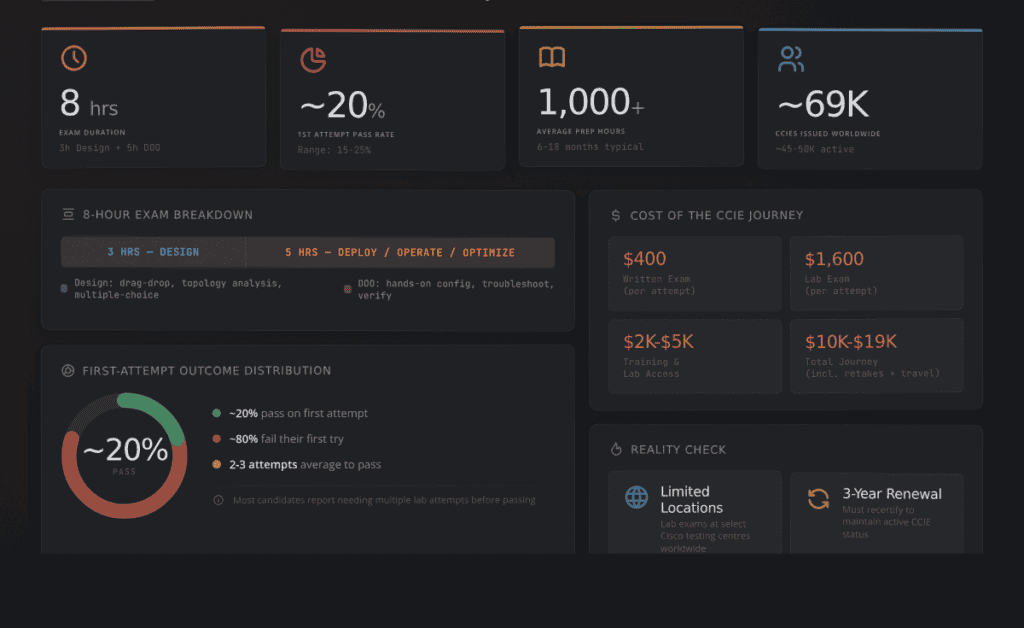
The CCIE lab exam is where most people on this path hit a wall. The pass rate sits around 20-25% on the first attempt. It’s brutal.
Here’s the thing. The lab exam isn’t really about what you know. It’s about what you can do under extreme pressure with a ticking clock. Think of it like cooking a 5-course meal in a professional kitchen, knowing recipes isn’t enough. You need muscle memory.
That’s why hands-on labs aren’t optional. They’re everything. You need at least 500 hours of lab practice before attempting the exam. Some people need more, and a home lab you control end to end makes that practice sustainable. We’ve put together a full guide to building a CCNA-ready home lab in a weekend, and a breakdown of which home lab setup fits your certification track if you’re not sure where to start.
Study groups matter too. The CCIE career path is long and isolating if you do it alone. Find a community. Having someone to troubleshoot with makes a massive difference.
Your study plan should include regular timed practice sessions. Start with 2-hour blocks and gradually work up to full 8-hour simulated lab exams. This builds the endurance you’ll need on exam day. The CCIE lab exam doesn’t care if you’re tired at hour six, you still need to perform.
One more thing about this stage: don’t underestimate the qualifying exam. Many candidates treat it as a formality. It’s not. The written exam covers deep theory that supports your lab skills. Fail it, and you can’t even attempt the lab.
How CCIE Certification Changes Your Market Value
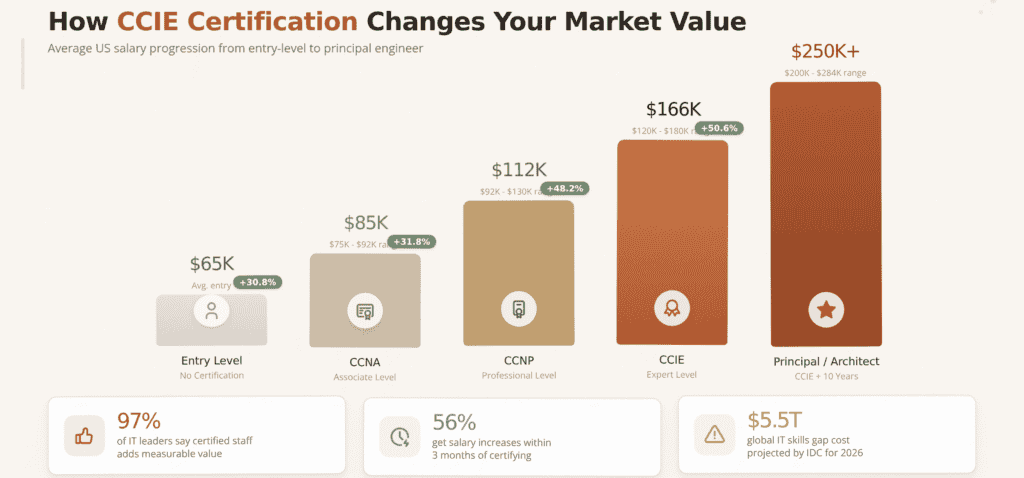
Let’s talk money. Because honestly, that’s a big part of why you’re looking at the CCIE career path in the first place.
The average CCIE salary sits around $166K a year, typically in the $120K-$180K range. Principal and architect-level engineers with CCIE plus a decade of experience can clear $250K+. According to PayScale data, CCIE holders consistently rank among the highest-paid IT professionals worldwide.
| Career Stage | Certification Level | Avg Salary (USD) |
|---|---|---|
| Entry Level | No certification | $65K |
| CCNA | Associate Level | $85K |
| CCNP | Professional Level | $112K |
| CCIE | Expert Level | $166K ($120K-$180K) |
| Principal / Architect | CCIE + 10 Years | $250K+ ($200K-$284K) |
But salary is just part of the story. CCIE certification changes how people look at you in the industry. You go from “network engineer” to “the expert we call when nothing else works.” Job security, negotiation power, consulting opportunities, they all shift dramatically.
In Skillsoft’s IT Skills and Salary Report, 97% of IT decision makers said certified staff add value to their organisation. On pay, Pearson VUE’s 2025 report found 32% of certified professionals got a pay rise, and 56% of those saw it within three months of certifying.
What about the network engineer career outlook overall? Robert Half’s 2025 technology talent research found 93% of tech leaders say their teams lack the staff or skills needed to deliver on priority initiatives, and IDC puts the cost of IT skills gaps at $5.5 trillion by 2026 based on a survey of 811 enterprise IT leaders in the US and Canada. Demand for expert-level certification holders keeps climbing, and CCIE holders sit at the top of that curve.
Job roles that open up with CCIE certification include Network Architect, Senior Security Engineer, Infrastructure Lead, and Technical Consulting Engineer. Many CCIEs also move into pre-sales roles at major vendors, where deep technical knowledge and Cisco certification carry serious weight.
Is the CCIE Career Path Worth It in 2026?
This is the question everyone asks. And the honest answer? It depends on you.
The CCIE career path is worth it if you’re genuinely passionate about networking technology, you’re willing to put in 2-3 years of serious effort, and you want to be in the top 1% of network engineers. The career advancement opportunities are massive, and the certification opens doors that no amount of experience alone can match.
It’s probably not worth it if you’re only chasing the salary. People who study purely for money tend to burn out around the CCNP stage. You need to actually enjoy the work.
The people who succeed on the CCIE career path tend to share three traits: they practice consistently, not just before exams, they ask questions when stuck instead of wasting a week, and they treat each certification as a step, not the finish line.
The CCIE career path isn’t for everyone. But for those who commit, it’s one of the most rewarding things you’ll ever do.
So what’s the best way to start? Map out your personal timeline. Identify which CCIE track matches your interests. Build a home lab you can practice on daily. The difference between a 2-year journey and a 5-year struggle often comes down to the quality of your practice and your support system.
How long does the full CCIE career path take?
From zero to CCIE, expect 3-5 years with self-study. With a structured plan and consistent lab practice, many people complete the CCIE career path in 2-3 years. It depends on your starting point, study hours, and how you structure your training.
What certifications do I need before CCIE?
You need to pass CCNA first, then CCNP in your chosen track. Cisco doesn’t technically require CCNP to attempt CCIE, but skipping it is a bad idea. The CCNP material is tested in the CCIE lab exam. Skipping stages almost always ends in failure.
How much does the CCIE career path cost in total?
Budget between $15,000 and $30,000 total for exam fees, study materials, training, and lab access. The CCIE lab exam alone costs around $1,600, plus $400 for the written qualifying exam. A solid study plan with structured, hands-on practice will save you money in the long run compared to multiple failed exam attempts.
Which CCIE track has the highest salary?
CCIE Security consistently pays the highest, with averages around $168K and top earners exceeding $220K. But all CCIE tracks pay well above industry averages.
Can I start the CCIE career path with no IT experience?
Absolutely. Many successful CCIEs started from zero. The CCIE career path is designed as a progression, CCNA teaches you the basics, CCNP builds depth, and CCIE proves mastery. What matters most is consistency and having a structured study plan.
Bottom Line
The CCIE career path isn’t short. It isn’t easy. But it’s one of the most clearly defined paths to a $160K+ salary in IT. From zero to CCNA to CCNP to CCIE, each step builds on the last, and each certification unlocks better opportunities.
Here’s what matters most: don’t skip stages, invest in hands-on labs, and build a study system you can actually stick to. Self-study works for some people. Structured, hands-on training works for most. The CCIE certification is the most respected expert-level certification in networking, earning it changes everything.
Ready to start building the lab skills the exam actually tests? The CCIE Enterprise Infrastructure Workbook and CCIE Security Workbook walk through real exam-style scenarios you can practice against, and if you’re still at Stage 1, the CCNA Workbook builds the foundation everything else depends on.