48% of Canadian IT and technology hiring managers plan to increase headcount in 2026. And they’re not looking for degrees first. They want certifications. That single stat from Robert Half Canada’s 2026 research tells you where IT certification jobs in Canada are heading this year. Source: Robert Half Canada, 2026
So which certifications actually get you hired? Short answer: cybersecurity certs (CISSP, Security+), cloud credentials (AWS Solutions Architect, Azure Administrator), and networking certifications (CCNA, CCNP, CCIE) top the list. IT certification jobs in Canada pay between $55,000 CAD at entry level and well over $200,000 CAD for expert-level roles like CCIE Security or AWS Security Specialty. Certified IT professionals in Canada consistently out-earn non-certified peers in the same roles.
But the numbers only tell part of the story. The cert you choose, the city you’re in, and how you stack your credentials all matter. A lot. This guide breaks down the IT certification jobs in Canada that employers are actually hiring for right now, with real salary data, city-by-city demand, and the fastest paths to getting hired.
Whether you’re a newcomer targeting your first IT certification jobs in Canada or a mid-career professional looking to level up, the playbook is the same: pick the right cert, get hands-on experience, and position yourself where the demand is highest. Tech roles in Canada are growing roughly 1.77 times faster than the rest of the job market, and that gap isn’t closing anytime soon. Source: CompTIA State of the Tech Workforce Canada 2026
What IT Certification Jobs in Canada Pay the Most?
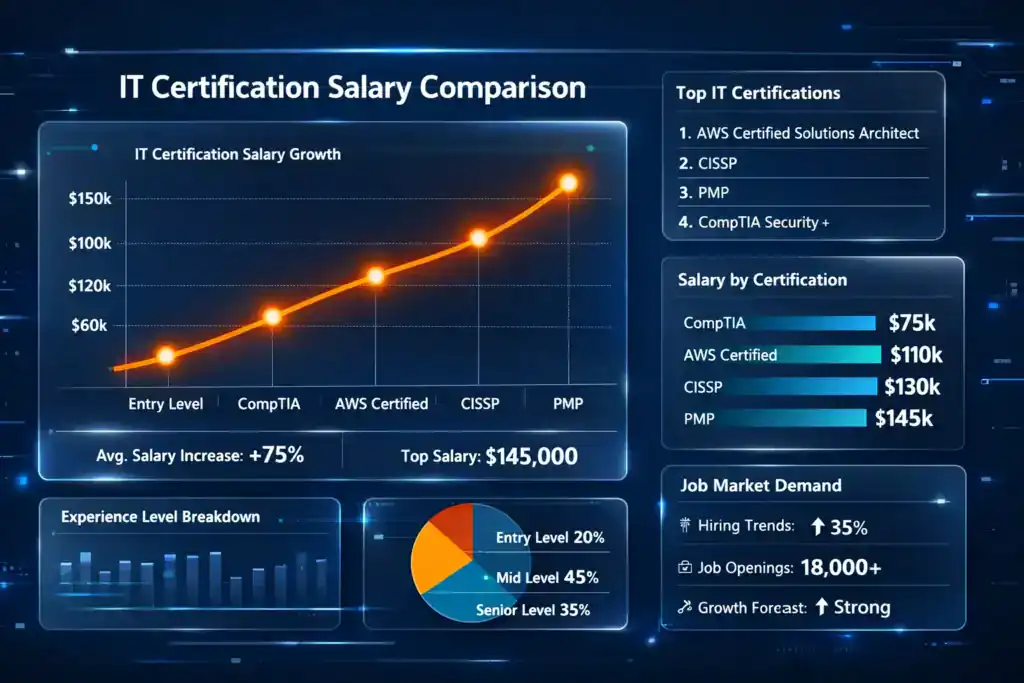
Money talks. So let’s start there. IT certification jobs in Canada span a massive salary range, and your cert choice is the biggest lever you’ve got. Here’s what certified IT professionals typically earn across the country in 2026:
| Certification | Entry Level (CAD) | Mid-Career (CAD) | Senior (CAD) |
|---|---|---|---|
| CCIE (all tracks) | $130,000 | $175,000 | $220,000+ |
| CCIE Security | $140,000 | $185,000 | $230,000+ |
| AWS Solutions Architect | $105,000 | $137,000 | $175,000+ |
| Azure Solutions Architect | $100,000 | $142,000 | $180,000+ |
| CCNP (Enterprise/Security) | $98,000 | $119,000 | $165,000+ |
| CISSP | $95,000 | $120,000 | $155,000+ |
| Fortinet NSE4 | $80,000 | $105,000 | $140,000+ |
| DevOps (various certs) | $90,000 | $130,000 | $170,000+ |
| CCNA | $60,000 | $85,000 | $120,000+ |
| CompTIA Security+ | $55,000 | $75,000 | $100,000+ |
Figures above are typical ranges pulled from current job-posting and salary-survey data (September 2026); actual pay varies by region, employer and experience.
Look at that gap between CCNA and CCIE. That’s not just a certification difference. It’s a career-tier jump. And for IT certification jobs in Canada, the expert-level certs consistently command the highest salaries, especially in Toronto and Vancouver.
Here’s something worth knowing: only a fraction of the roughly 69,000 CCIE certifications issued worldwide stay active at any given time, since the credential has to be renewed every three years. That scarcity is a real part of why CCIE pay holds up. Source: industry CCIE population estimates, 2026
Also worth mentioning: remote work has changed the salary picture for IT certification jobs in Canada. Professionals in smaller cities can now access Toronto-level salaries by working remotely for GTA-based companies. That said, on-site and hybrid roles still pay a premium in most cases.
So which cert gives you the best return? For entry-level IT certification jobs in Canada, CCNA offers the fastest path to a paycheque. For maximum earning potential, CCIE Security is hard to beat. And for the broadest job market access, AWS Solutions Architect opens doors across almost every industry.
Which IT Certification Jobs in Canada Are Growing Fastest?

Three areas are absolutely exploding for IT certification jobs in Canada right now: cybersecurity, cloud infrastructure, and DevOps automation.
Cybersecurity leads the pack. And it’s not even close. Quebec’s Bill 25 on personal information protection forced every organisation in the province to strengthen security teams. Ontario is following similar patterns. The result: cybersecurity job postings in Canada have grown at a double-digit clip, and certified professionals are getting snapped up fast once they hit the market.
Cloud adoption is the second biggest driver. Canadian businesses are moving fast on AWS and Azure. Cloud certification salaries keep climbing as demand outpaces supply. According to Randstad Canada, cloud architects and engineers rank among the most in-demand IT roles for 2026. If you hold an AWS Solutions Architect or Azure Solutions Architect certification, you’re looking at a starting salary above $100K CAD.
DevOps and automation round out the top three. Companies don’t just want engineers who can configure networks anymore. They want people who can automate them. That’s why Cisco’s DevNet track and automation certifications have gained real traction.
Sound familiar? If you’ve been watching the Canadian IT job market, none of this is surprising. But here’s the part most people miss: it’s the combination of certs that gets you hired fastest.
For example, a network engineer with CCNP plus an AWS certification is far more valuable than someone with just one of those credentials. Why? Because IT certification jobs in Canada increasingly require hybrid skills. Your network doesn’t end at the office firewall anymore. It extends into AWS, Azure, and multi-cloud environments.
Best Certifications for IT Certification Jobs in Canada by Category
Not all certifications are equal. The best one for you depends on which career path you’re targeting. Let’s break down the IT certification jobs in Canada by category so you can see exactly where to invest your time.
Networking IT Certification Jobs in Canada

Networking is the backbone of IT. Always has been. And in Canada, certified network engineers are still in high demand, especially for hybrid cloud environments where on-prem and cloud systems need to talk to each other. If you want stable, well-paying IT certification jobs in Canada, networking is a proven path.
The Cisco certification path is still the gold standard here. Start with CCNA to prove you understand routing, switching, and basic security. CCNA-certified professionals in Canada earn around $60,000-$120,000 CAD depending on experience. Not bad for an entry-level cert. For a comparison against the other common entry-level path, see the CCNA vs Network+ breakdown.
From there, CCNP Enterprise takes you to the professional level. And then there’s CCIE. Different league entirely.
Think of it this way. CCNA is your driver’s licence. CCIE is your pilot’s licence. The CCIE Enterprise and CCIE Data Center tracks are where senior IT certification jobs in Canada live. Robert Half Canada lists CCNP and CCIE as preferred credentials for senior network architect positions, one of the top-paying IT roles in the country.
Also worth noting: Cisco SD-WAN, Cisco ACI, and VMware NSX skills are increasingly showing up in Canadian job postings. Enterprise networking isn’t just routers and switches anymore.
If you’re aiming for networking IT certification jobs in Canada, practical experience matters as much as the cert itself. The CCNA Workbook gives you 60+ hands-on labs against real topology, which is what separates candidates who pass technical interviews from those who don’t.
Security IT Certification Jobs in Canada
Cybersecurity jobs in Canada are growing faster than any other IT segment. Certified IT professionals with security credentials are commanding premium salaries. If there’s one area where IT certification jobs in Canada are practically guaranteed, it’s security.
Where should you start? CompTIA Security+ is the entry point. It’s now the baseline requirement for most system admin and junior security roles across the country. In Quebec, it’s practically non-negotiable, with average salaries around $55,000-$75,000 CAD for entry-level positions.
For mid-career professionals, the CCIE Security certification puts you in elite territory. We’re talking $140,000-$230,000+ CAD. Pass rates on the first attempt are reportedly low, commonly cited in the 20-30% range. Yeah, it’s brutal. But that difficulty is exactly what makes it valuable.
Beyond Cisco, specialised security tools are huge for IT certification jobs in Canada. Fortinet NSE4 knowledge matters because FortiGate firewalls are everywhere in Canadian enterprises. SIEM and extended detection tools like Wazuh prove you can handle the tooling Canadian SOC teams actually use daily. The Wazuh SIEM Home Lab guide walks through setting that up hands-on.
Hiring managers filling security-focused IT certification jobs in Canada don’t want someone with just one cert. They want a security professional who can work across platforms.
Cloud IT Certification Jobs in Canada
Cloud certification salaries in Canada are hard to ignore. AWS and Azure dominate the Canadian market, and demand for certified cloud professionals keeps climbing. Cloud-focused IT certification jobs in Canada are among the most accessible for remote workers too.
AWS track: the AWS Cloud Practitioner is your starting point. It’s foundational, but it proves you understand cloud concepts. The real money starts with AWS Solutions Architect. In Canada, AWS-certified architects pull in $105,000-$175,000+ CAD. Montreal’s startup ecosystem especially values AWS credentials.
Azure track: Microsoft Azure dominates in Canadian financial institutions and government. The Azure Administrator cert is your entry point, and Azure Solutions Architect is where the bigger salaries kick in. The AZ-104 Study Guide covers the exam path and the labs that actually matter. Quebec-based employers particularly value Azure because of its strong presence in the province’s financial sector.
Here’s the thing. If you’re targeting IT certification jobs in Canada specifically, holding both an AWS and an Azure cert gives you a real edge. Most Canadian enterprises run multi-cloud environments. Being locked into just one platform limits your options.
Cloud IT certification jobs in Canada also offer strong remote work flexibility. Many cloud architect and cloud engineer roles are fully remote, which means you can live in Calgary and work for a Toronto-based fintech. That salary arbitrage is real.
DevOps and Automation Certification Jobs

Automation isn’t optional anymore. Every major Canadian employer expects IT professionals to write scripts, manage CI/CD pipelines, and automate repetitive tasks. That’s made DevOps skills one of the fastest-growing categories for IT certification jobs in Canada.
DevOps-focused IT certification jobs in Canada earn between $90,000 and $170,000+ CAD, covering the full pipeline: containerisation, infrastructure as code, monitoring, and deployment automation. The DevOps Workbook covers 95 labs across Git, CI/CD, Docker, Kubernetes, Terraform and cloud DevOps.
On the networking side, Cisco’s automation track is gaining ground fast. Start with CCNA Automation to learn network programmability. The CCNA Automation Workbook covers Python, REST APIs, YANG, NETCONF and Ansible against simulated devices.
Big difference between someone who can configure a network and someone who can automate it. Canadian employers know that, and they pay accordingly.
On the infrastructure side, don’t overlook virtualization certs. VMware vSphere and VMware NSX skills are still relevant for IT certification jobs in Canada, especially in enterprise environments running private cloud. Proxmox VE is gaining traction too, particularly among organisations looking for alternatives to traditional hypervisors since Broadcom’s licensing changes.
Entry-Level IT Certification Jobs in Canada: Where to Start in 2026
Don’t have years of experience? Good news. Canada’s IT talent gap means employers are hiring certified juniors faster than ever.
Here’s the entry-level roadmap:
Step 1, foundation cert (0-6 months): CompTIA A+ covers hardware, OS, and troubleshooting. It’s the standard first cert for helpdesk and IT support roles. Entry salary: $45K-$60K CAD. Not exciting, but it’s your foot in the door.
Step 2, specialise (6-12 months): Pick one track and go deep, not wide.
| Track | Cert | Entry Salary |
|---|---|---|
| Networking | CCNA | $62K-$78K CAD |
| Security | CompTIA Security+ | $65K-$80K CAD |
| Cloud | AWS Cloud Practitioner | $58K-$75K CAD |
| Linux/DevOps | RHCSA | $60K-$78K CAD |
What Canadian employers actually look for in junior hires:
- A cert that proves you can do the work, not just a diploma
- Lab hours, can you configure a switch, spin up an EC2 instance, or read a firewall log?
- Willingness to learn on the job
Common mistake: stacking too many certs before your first job. One solid cert plus real lab experience gets you hired faster than four paper certs with no hands-on proof.
Why Canadian Employers Prefer Certified IT Professionals
Here’s what hiring managers won’t say on LinkedIn but absolutely think during interviews: degrees tell them you can learn. Certifications tell them you can do the job. That mindset is what makes IT certification jobs in Canada so accessible for people with the right credentials.
The shift toward skills-first hiring is real in Canada. Nearly 7 in 10 (69%) of Canadian tech leaders say upskilling current staff is necessary to hit their 2026 priorities, and 95% say their teams currently lack the staff and skills needed for top priorities. Source: Robert Half Canada 2026 Tech Priorities report That’s a real skills gap, and certifications are how employers verify you’ve got what it takes.
The salary premium is real too. Certified IT professionals in Canada tend to out-earn non-certified peers by a meaningful margin, commonly cited in the 15-25% range across recruitment-firm salary surveys. On a $100K salary, that’s real money over a career of pursuing IT certification jobs in Canada.
And it’s not just about salary. Certification tends to translate into a pay bump fairly quickly for a lot of people, sometimes within months of getting certified, which is a fast return on the time invested.
And here’s something else most career guides skip. Canadian employers value certification recency. A CCNA you earned last year beats a CCIE from 2015 that’s lapsed. Keep your certs current. For IT certification jobs in Canada, showing that you’re actively maintaining and building skills signals commitment to employers.
How Do You Land IT Certification Jobs in Canada as a Newcomer?
If you just landed in Canada, or you’re planning to make the move, this section is for you. IT certification jobs in Canada are genuinely accessible for newcomers, but you need a strategy.
Think of certifications as your work permit for the IT industry. Canadian employers may not recognise your degree from another country, but they absolutely recognise Cisco, AWS, and Microsoft certifications. These are global standards, and they’re the fastest way into IT certification jobs in Canada for international professionals.
Here’s a realistic path for career changers and new immigrants:
Step 1: Start with a foundational cert. CCNA for networking, Security+ for cybersecurity, or AWS Cloud Practitioner for cloud. These get your foot in the door for entry-level IT certification jobs in Canada.
Step 2: Build Canadian work experience. Even contract roles and short-term projects count. Toronto tech jobs are especially open to newcomers with certifications.
Step 3: Stack a second cert. Move from CCNA to CCNP, or from Cloud Practitioner to Solutions Architect. Each additional cert bumps your salary range and opens more doors.
Step 4: Specialise. Once you’ve got 2-3 years of Canadian experience, go deep in one area. Security, cloud, or automation are the highest-demand specialties for IT certification jobs in Canada at the mid-career and senior levels.
Real, hands-on lab time helps newcomers more than most people expect. Being able to actually configure a switch, stand up a VPC, or read a firewall log in an interview is what separates candidates who pass technical screens from those who don’t, regardless of where you learned it.
Top Canadian Cities for IT Certification Jobs

Where you live in Canada significantly impacts your IT certification job prospects. Not all cities are equal. And for IT certification jobs in Canada, geography still plays a major role in both salary and opportunity volume.
| City | Top Demand Areas | Key Employers | Salary Premium |
|---|---|---|---|
| Toronto | Cloud, Security, DevOps | Banks, Telecom, Big Tech | Highest in Canada |
| Vancouver | Cloud, AI/ML, Networking | Tech startups, Gaming | High (but high cost of living) |
| Montreal | AI, Security, AWS | Startups, Finance, Gov | Moderate (best cost-of-living ratio) |
| Calgary | Cloud, DevOps, Security | Energy, Finance | Growing fast |
| Ottawa | Security (gov clearance) | Government, Defence | Stable, security premium |
Toronto is Canada’s biggest tech hub. Period. IT certification jobs in Canada are most abundant here. Banks like RBC, TD, and BMO are constantly hiring certified network engineers, security analysts, and cloud architects. If you hold a CCIE or senior AWS certification, Toronto is where the top salaries are.
Montreal is the sleeper pick. Lower cost of living than Toronto, a booming startup ecosystem (especially AI), and strong government demand. Quebec’s privacy regulations (Bill 25) have created extra demand for security-certified professionals. If you’re bilingual, even better.
Ottawa is unique because of government and defence contracts. Security clearance plus a CISSP or CCIE Security cert? That combination is valuable for IT certification jobs in the capital.
Calgary is the dark horse. The energy sector’s digital transformation is driving strong demand for cloud and DevOps professionals. Lower competition than Toronto means certified professionals often get hired faster.
No matter which city you choose, the pattern is the same: certified professionals get hired faster, earn more, and have better career mobility than non-certified peers. The only variable is which certifications are most valued in each market.
Can You Get IT Certification Jobs in Canada Remotely?
Yes. Remote IT certification jobs in Canada are growing, and certified professionals have a clear edge.
Here’s what the remote market looks like right now:
Which certs open remote doors:
- AWS Solutions Architect and Azure Administrator are the top two certs for remote cloud roles. Fully distributed teams are the norm in cloud.
- CISSP and CISM holders work remotely for SOC-as-a-service firms across Ontario and BC.
- Cisco CCNP-level engineers often work remotely managing enterprise networks via VPN and SD-WAN platforms.
Salary for remote IT certification jobs in Canada:
| Role | Cert | Remote Salary (CAD) |
|---|---|---|
| Cloud Architect | AWS/Azure | $110K-$160K |
| Security Analyst | CISSP | $95K-$140K |
| Network Engineer | CCNP | $90K-$120K |
| DevOps Engineer | CKA/Terraform | $100K-$135K |
Ontario and BC post the most remote IT roles, with Alberta close behind. Quebec has strong French-language remote demand.
One thing to know: many Canadian employers post hybrid roles as remote. Ask during screening whether “remote” means fully distributed or three days in-office. It saves everyone time.
Why is it difficult to get an IT job in 2026?
Two reasons: credential inflation and AI-adjacent role shifts. Entry-level roles that didn’t require certs three years ago now do. And many junior IT jobs are evolving toward cloud-first and DevOps skill sets. The fix is straightforward: certify for the roles that are actually hiring, not the ones that were hiring in 2022.
How much do IT certification jobs in Canada pay in 2026?
Salaries for IT certification jobs in Canada range from about $55,000 CAD for entry-level Security+ holders to over $230,000 CAD for CCIE Security certified professionals. The typical range for certified IT professionals sits around $90,000-$120,000 CAD at the mid-career level. Toronto and Vancouver offer the highest salaries, while Montreal provides the best salary-to-cost-of-living ratio.
Can I get IT certification jobs in Canada without a degree?
Yes. The Canadian tech industry is shifting toward skills-first hiring. Multiple recruitment firms report that employers prioritise certifications and hands-on experience over formal degrees for IT certification jobs in Canada. A CCNA or AWS certification with practical lab experience is often enough to land entry-level roles. That said, stacking multiple certifications accelerates your career progression significantly.
Which Canadian city has the most IT certification jobs?
Toronto has the highest volume of IT certification jobs in Canada, followed by Vancouver, Montreal, Calgary, and Ottawa. Toronto dominates in banking and enterprise IT. Montreal leads in AI and startups. Ottawa offers strong government security roles. Calgary is growing fast in cloud and DevOps positions.
Which IT certification is in-demand in Canada?
The most in-demand IT certifications in Canada right now are CCNA and CCNP for networking roles, AWS Solutions Architect and Microsoft Azure Administrator for cloud, and CISSP or CompTIA Security+ for cybersecurity. Canadian employers list these certs in job requirements more than any others, particularly in Ontario, BC, and Alberta.
Are IT jobs in Canada hard to get?
Not if you’re certified and have hands-on lab experience. Canada’s IT talent gap means employers are actively competing for qualified candidates. The challenge isn’t finding jobs, it’s meeting technical screening requirements. A relevant certification paired with real lab hours addresses that directly.
Is IT support a good career in Canada in 2026?
IT support is a solid starting point, not a destination. Entry salaries run $45K-$65K CAD in major cities. The real value is what it leads to: most network engineers, security analysts, and cloud architects started in IT support. With the right cert stack, you can move from helpdesk to a $100K+ role in 2-3 years.
Bottom Line: Your Next Move
IT certification jobs in Canada aren’t slowing down in 2026. If anything, the talent shortage is making certified professionals more valuable than ever. 48% of IT hiring managers are expanding their teams. 69% say they need to upskill existing staff. The demand is real.
Your fastest path? Pick a certification category (networking, security, cloud, or DevOps), earn a foundational cert, get some Canadian work experience, and keep stacking credentials. The data is clear: certified IT professionals in Canada consistently out-earn their non-certified peers.
Don’t overthink this. The best time to start pursuing IT certification jobs in Canada was a year ago. The second-best time is right now.
Put it into practice
- CCNA Workbook – the fastest entry-level path, 60+ hands-on labs.
- CCNA Automation Workbook – Python, REST APIs, NETCONF and Ansible for the automation-heavy roles.
- AWS Solutions Architect Workbook – for the cloud track.
- Azure Workbook – for the Microsoft cloud track.
- DevOps Workbook – 95 labs across the automation stack employers are asking for.
- FortiGate NSE4 Lab Workbook – for the security/firewall track.
- CCIE Security Workbook – for the top of the security career ladder.
- CCIE Enterprise Infrastructure Workbook – for the top of the networking career ladder.