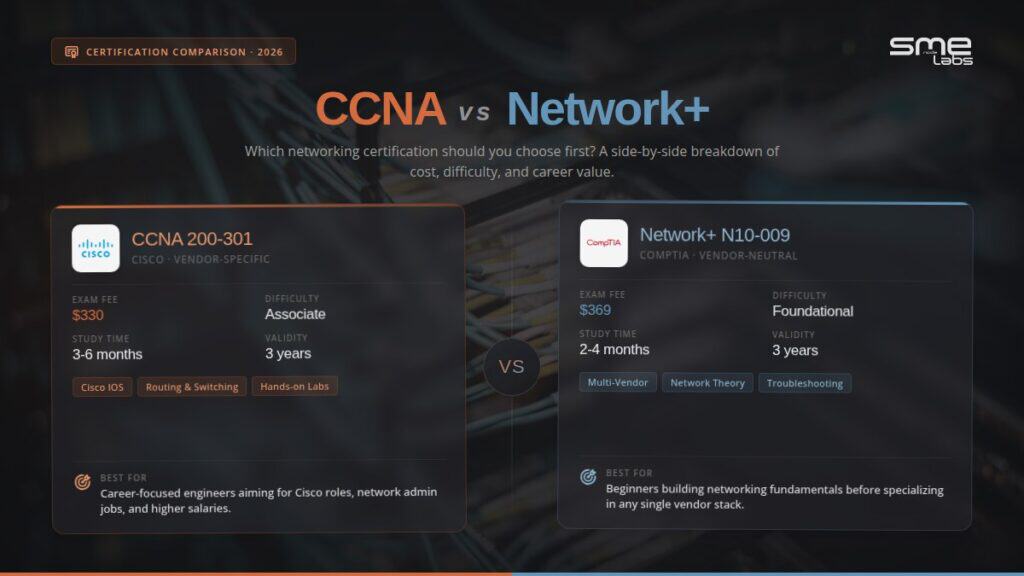
Short version? Pick Network+ if you’re brand new to IT and want a vendor-neutral foundation. Pick CCNA if you already have helpdesk experience or you’re aiming straight for a network engineer role with higher pay. That’s the call most hiring managers and study coaches make in 2026. To check where you actually stand, 20 free CCNA practice questions is a quick self-test.
Here’s the deal. Both certs cover networking basics like the OSI model, IP addressing, routing, and switching. But CCNA goes deeper into Cisco gear, hands-on configuration, and automation. Network+ stays vendor-neutral and broader.
So which one wins for you?
It depends on your starting point, your budget, and where you want your career to go. We’ll break it all down below: exam cost, difficulty, study time, salary numbers, and which cert hiring managers actually care about. Plus a few honest opinions you won’t find on Cisco’s marketing pages.
Quick Verdict Table
If you’re… Choose Why New to IT, no experience Network+ Easier on-ramp, vendor-neutral In helpdesk, want network engineer role CCNA Higher pay, more job listings Aiming for cybersecurity Network+ then Security+ Broader foundation Budget tight, want one cert CCNA Better ROI long-term Want both Network+ first, then CCNA Smoother learning curve
Bottom line. CCNA pays more. Network+ is easier to start. Most people don’t need both.
CCNA vs Network+: Quick Comparison Table
| Factor | CCNA (200-301) | CompTIA Network+ (N10-009) |
|---|---|---|
| Vendor | Cisco (single vendor) | Vendor-neutral |
| Exam cost (USD, 2026) | ~$300 | ~$390 |
| Number of questions | 100-120 | Up to 90 |
| Time | 120 minutes | 90 minutes |
| Passing score | 825 / 1000 | 720 / 900 |
| Difficulty | Moderate to hard | Moderate |
| Average study time | 3-6 months | 6-10 weeks |
| Average US salary | ~$85K-$112K | ~$65K-$80K |
| Validity | 3 years | 3 years |
| Hands-on labs required? | Yes (heavy) | Light |
| Recognised globally | Yes | Yes |
| Best for | Network engineering, SD-WAN, automation | Help desk, junior NOC, cybersecurity foundation |
Sources for cost and exam details: Cisco Learning Network and CompTIA Network+.
What is CCNA? (And Why It Still Matters)
CCNA stands for Cisco Certified Network Associate. It’s the entry-level cert from Cisco, the company that makes most of the world’s enterprise routers and switches. The current exam code is 200-301.
CCNA covers six domains:
- Network fundamentals (OSI model, IP, subnetting)
- Network access (VLANs, trunking, EtherChannel, wireless)
- IP connectivity (routing, OSPF, static routes)
- IP services (NAT, NTP, DHCP, SNMP, QoS)
- Security fundamentals (ACLs, port security, AAA)
- Automation and programmability (Python, Ansible, REST APIs)
Notice that last one. Cisco added automation to CCNA back in 2020 because networks aren’t configured by hand anymore. Modern network engineers script their changes. So CCNA in 2026 is not just about typing enable into a router. It expects you to understand how APIs and YAML configs work too.
You’ve probably heard CCNA called “the gold standard” for networking jobs. Honestly? That’s still mostly true. Most enterprise gear in North America runs on Cisco IOS, IOS-XE, or NX-OS. Even shops that use Aruba or Juniper still hire CCNA-certified folks because the underlying concepts transfer.
Big difference vs Network+: CCNA forces you into a virtual command line. You don’t get to pick “the answer” from a list. You have to type the right command on a Cisco router under timed pressure. No safety net. That’s why hiring managers trust it.
For hands-on practice, our CCNA lab workbook with EVE-NG ISO and Packet Tracer scenarios walks you through 75 graded labs that mirror the 200-301 exam blueprint. Every lab has tested IOS configs and topology files you can load into your home setup. Want the condensed version to revise from? The free CCNA 200-301 PDF is 27 pages with Packet Tracer commands.
What is CompTIA Network+? (And Where It Fits)
CompTIA Network+ is the vendor-neutral networking cert from CompTIA, the same group that makes A+ and Security+. The current version is N10-009, released in mid-2024 and still active in 2026.
Network+ covers five domains:
- Networking concepts (OSI, encapsulation, ports and protocols)
- Network implementation (cabling, switching, routing basics)
- Network operations (monitoring, documentation, disaster recovery)
- Network security (CIA triad, threats, hardening)
- Network troubleshooting (methodology, tools, common issues)
The big sell for Network+ is that it’s not tied to one vendor. You learn what a VLAN is conceptually, not how to configure one on a Cisco Catalyst 9300. So if your future job uses Aruba, Juniper, or MikroTik, the knowledge still applies.
Network+ also serves as a stepping stone to cybersecurity. If your end goal is SOC analyst or pentester, the path most coaches recommend is A+ → Network+ → Security+. The CCNA isn’t strictly needed for that route.
Our Security+ practice questions are mapped to the current SY0-701 objectives if that’s the direction you’re headed.
Want a vendor-neutral router alternative for hands-on labs? Take a look at our MikroTik MTCNA workbook with RouterOS v7 labs. It’s not Cisco, but it teaches the same routing and switching concepts on real hardware-style scenarios.
CCNA vs Network+: Difficulty (The Honest Truth)
People ask this all the time. Is CCNA harder than Network+? Yes. By a lot.
Network+ is mostly multiple-choice with a handful of drag-and-drop and performance-based questions. The performance-based questions are scenario-style: match this protocol to that port, drag this device to that diagram. You can use process of elimination on most of them.
CCNA is different. You’ll get simulator questions where you have to log into a virtual Cisco router and configure OSPF, troubleshoot a broken VLAN, or fix an ACL. If you don’t know the exact command syntax, you fail that question. Period. Interviews ask what you’ve configured. 50 CCNA interview questions with answers is the free prep.
Plus the CCNA exam runs a question forward-only. Once you submit, you can’t go back. Network+ lets you flag and review. Small thing, but it changes your test strategy.
| Difficulty signal | CCNA | Network+ |
|---|---|---|
| Hands-on simulators | Yes, multiple | Light, drag-and-drop |
| Forward-only exam | Yes | No (review allowed) |
| Pass rate (estimated) | ~70-75% | ~80-85% |
| Average study hours | 200-400 | 80-150 |
| Math (subnetting) | Heavy | Moderate |
The pass rates aren’t published officially by Cisco or CompTIA. Those numbers come from training providers and Reddit polls, so take them with a pinch of salt.
Just being honest here. Most people who fail CCNA underestimate the labs. They cram concepts but skip the CLI work. Don’t do that.
Cost Breakdown: Which Cert Is Cheaper?
Exam cost is only part of the story. Here’s what you actually pay.
CCNA total cost (typical):
- Exam voucher: ~$300 USD
- Study materials (book + course): $50-$200
- Practice labs (Packet Tracer is free; EVE-NG community is free): $0-$100
- Practice exams: $30-$80
- Total: $380-$680
Network+ total cost (typical):
- Exam voucher: ~$390 USD (or $369 with bundle discount)
- Study materials (Mike Meyers book + Professor Messer videos): $30-$100
- Practice exams: $30-$80
- Total: $450-$570
So Network+ exam is more expensive than CCNA. Surprised? Most people are.
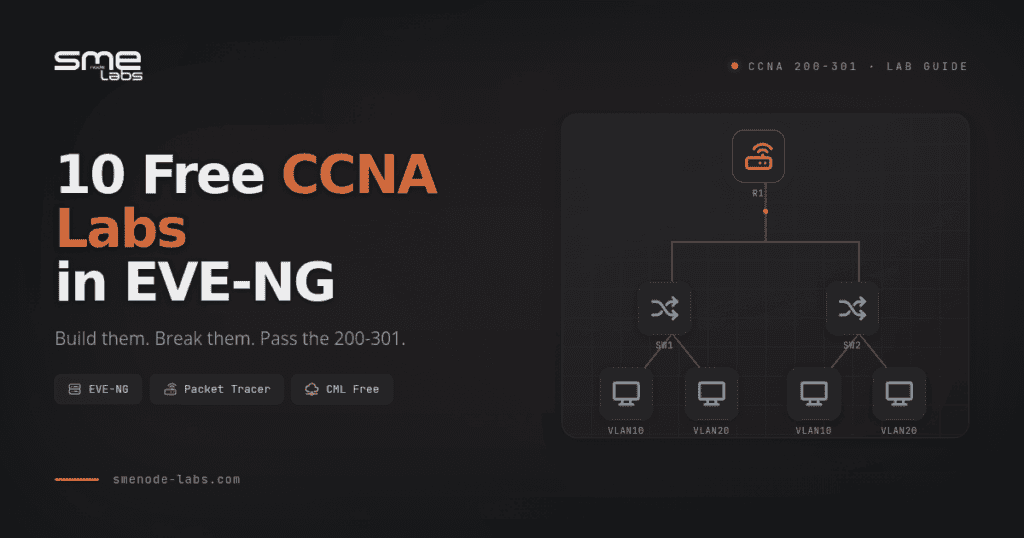
Then why do people say CCNA “costs more”? Because of the lab investment. To pass CCNA you need real hands-on time on Cisco gear or a strong simulator. That’s where the hidden cost lives. EVE-NG community edition is free, but you’ll spend a weekend setting it up if you’re new to it. An emulator with nothing in it teaches you nothing. Here are 10 free CCNA labs you can build in EVE-NG.
If you want a faster path, our CCNA lab workbook bundle includes a pre-configured EVE-NG ISO so you skip the setup pain.
Salary: Which Cert Pays More?
This is where CCNA pulls ahead. By a lot.
| Role | Avg US Salary (2026) | Source |
|---|---|---|
| CCNA-certified network admin | $85K-$112K | Glassdoor, PayScale aggregate |
| CCNA + 3 years experience | $110K-$140K | LinkedIn salary insights |
| Network+ certified junior tech | $55K-$75K | PayScale |
| Network+ + 2 years experience | $65K-$85K | PayScale |
| Help desk technician | $45K-$60K | BLS Computer Support Specialists |
| Network engineer (any cert) | $90K-$130K | BLS Network and Computer Systems Administrators |
Nationwide, CCNA-tagged jobs pay roughly 30% more than Network+-tagged jobs. That gap shows up because CCNA opens different doors. Network+ qualifies you for help desk and junior NOC roles. CCNA qualifies you for network admin and junior network engineer roles.
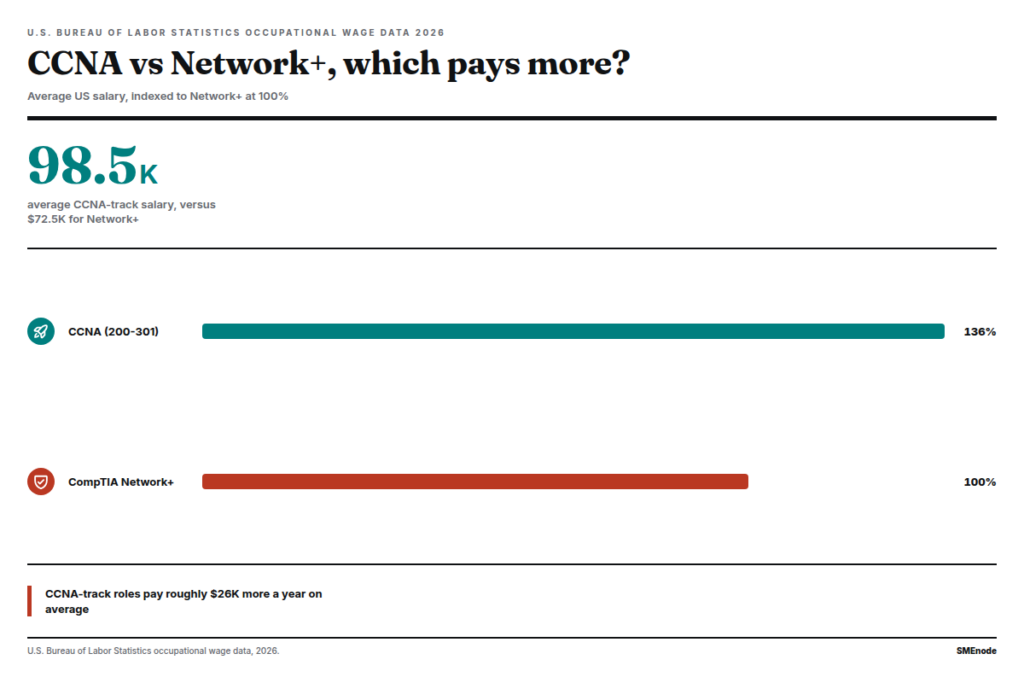
The cybersecurity market also matters. According to the Bureau of Labor Statistics, information security jobs are projected to grow 32% from 2022-2032, way above average. If that’s your goal, Network+ is the cheaper on-ramp.
Should I Take Network+ Before CCNA?
Honestly? Most people don’t need both.
The case for Network+ first:
- You’ve never touched a router or switch
- You’re not sure if networking is your career
- You want a quick win before committing to CCNA
- Your goal is cybersecurity (Net+ → Sec+ is a cleaner path)
The case for going straight to CCNA:
- You’ve worked help desk for 6+ months
- You can subnet without Googling it
- Your job market is hiring network engineers
- You want a stronger paycheque sooner
Here’s the thing. Network+ content is mostly a subset of CCNA content. So studying CCNA also covers most of Network+. If you study CCNA seriously and pass it, you could pass Network+ with a week of review. The reverse is not true.
Sound familiar? “I’ll do Network+ as a confidence-builder.” That’s fine if you have time and money. But if you’re job-hunting in 6 months, skip Network+ and grind CCNA. Hiring managers care about CCNA more.
CCNA vs Network+ for Cybersecurity: Which Helps More?
Different question, different answer.
For cybersecurity careers, Network+ is the more common starting point. Here’s why:
- The CompTIA stack (A+ → Net+ → Sec+ → CySA+) is the dominant cert path for SOC analysts.
- Many DoD 8570 / 8140 roles list Network+ and Security+ as approved baseline certs.
- Most security tools (firewalls, IDS, SIEM) need vendor-neutral networking knowledge.
That said. CCNA still helps if you want to specialise in network security, cloud security, or pentesting. Cisco’s CCNA Cybersecurity track (formerly CyberOps) is gaining traction.
For folks who want to defend Cisco networks specifically, our Cisco SAFE security architecture workbook and FortiGate NSE4 lab workbook cover the practical side that exam prep books skip.
Career Paths: Where Each Cert Takes You
CCNA opens doors to:
- Network administrator
- Junior network engineer
- NOC engineer (tier 2)
- Network security engineer (after Sec+)
- Cloud network engineer (after AWS or Azure cert)
- Eventually: CCNP, CCIE, network architect
Network+ opens doors to:
- Help desk technician
- Junior NOC analyst
- IT support specialist
- SOC analyst (after Security+)
- Eventually: CySA+, CASP+, security analyst, pentester
Look. There’s overlap. A Network+ holder can absolutely become a network engineer over time. A CCNA holder can pivot to security. Certs open doors but they don’t lock you in. Outside Cisco and CompTIA there is a third route: the Huawei workbook range covers HCIA Datacom.
Pretty much. The cert is the start, not the destination.
Study Strategy: How Long Does Each Take?
Network+ study plan (typical, 8 weeks):
- Week 1-2: OSI, TCP/IP, subnetting basics
- Week 3-4: Routing, switching, wireless
- Week 5-6: Network security, hardening
- Week 7: Troubleshooting methodology
- Week 8: Practice exams, review
CCNA study plan (typical, 4 months):
- Month 1: Network fundamentals, IP addressing, subnetting drills
- Month 2: Switching (VLANs, STP, EtherChannel), basic routing
- Month 3: OSPF, ACLs, NAT, IP services, security basics
- Month 4: Automation (Python, REST, Ansible), labs, practice exams
The biggest mistake on CCNA? Skipping subnetting drills. You need to subnet a /22 in 30 seconds without a calculator. The exam doesn’t give you scratch paper for hand-math, you get a digital whiteboard with a slow stylus. So practice in your head.
For CCNA candidates short on time, the CCNA automation workbook covers the DevNet-flavoured automation domain that most paper books gloss over. That domain is now ~10% of your exam score.
Renewal: How to Keep Your Cert Active
Both certs expire after 3 years. Renewal works differently.
CCNA renewal:
- Pass any Cisco Continuing Education exam, OR
- Earn 30 CE credits through approved Cisco activities, OR
- Pass a higher-level Cisco cert (CCNP, CCIE)
Network+ renewal:
- Earn 30 CEUs through CompTIA Continuing Education program
- Or pass a higher CompTIA cert (Sec+ doesn’t renew Net+, but CySA+ does)
- Or complete approved training, courses, or work experience
The CompTIA path is easier for working pros. The Cisco path forces you to keep your skills sharp by passing more exams.
So Which One Should You Pick?
Three quick checks:
- What’s your current job?
- No IT job → Network+
- Help desk → CCNA
- Network tech → CCNA (skip Net+)
- What’s your 12-month goal?
- Cybersecurity → Network+
- Network engineering → CCNA
- Cloud (AWS, Azure) → CCNA helps but isn’t required
- What’s your budget?
- Under $500 → Network+
- Over $500 + 4 months → CCNA
If you’re still on the fence, go CCNA. The salary jump justifies the extra effort. Worth it for most career paths.
Frequently Asked Questions
Is CCNA better than Network+?
For network engineering jobs and salary, yes. CCNA holders earn around 30% more than Network+ holders on average and have access to more job listings. Network+ is easier and broader, but CCNA carries more weight with hiring managers in networking-focused roles. For cybersecurity careers, Network+ is the more common entry point.
Should I take CompTIA Network+ or CCNA first?
Take Network+ first if you’re new to IT, want a vendor-neutral foundation, or are aiming for cybersecurity. Take CCNA first if you have any helpdesk experience, want to be a network engineer, or want a stronger paycheque sooner. Most professionals don’t need both, since CCNA covers most of what Network+ teaches.
Is CCNA changing in 2026?
The 200-301 exam blueprint has not changed for 2026. Cisco announced a renaming convention in late 2025 (for example CCNA Cybersecurity replacing CyberOps Associate), but the core CCNA exam topics for routing, switching, and automation remain the same. Always confirm at Cisco Learning Network before booking your exam.
What is the CCNA salary in 2026?
CCNA-certified network administrators in the US earn between $85,000 and $112,000 per year on average, according to PayScale and Glassdoor data. With 3+ years of experience, salaries climb to $110K-$140K. Senior network engineers with CCNA plus higher certs (CCNP, CCIE) earn $130K-$180K depending on location and specialisation.
Is CCNA going away?
No. Cisco renamed some Cisco Certified Specialist tracks in 2026 but the core CCNA cert is not going away. Cisco confirmed the certification is being expanded, not retired. The 200-301 exam remains the entry point to all Cisco certification tracks.
What is the fail rate for CCNA?
Cisco does not publish official pass rates. Community estimates from training providers and Reddit polls put the first-attempt CCNA pass rate at around 70-75%, compared to roughly 80-85% for Network+. Most failures come from underestimating the simulator questions and skipping hands-on lab time.
How long does it take to study for CCNA vs Network+?
Network+ takes most candidates 6-10 weeks of part-time study (around 80-150 total hours). CCNA takes most candidates 3-6 months (around 200-400 hours), mostly because of the hands-on lab requirement. If you already have Network+ knowledge, CCNA prep can drop to 2-3 months.
Can I skip Network+ and go straight to CCNA?
Yes, you can. CCNA has no prerequisites. If you can subnet, understand IP basics, and have any helpdesk or home-lab experience, going straight to CCNA saves time and money. The Network+ content is mostly a subset of CCNA content, so studying CCNA covers most of Network+ anyway.
Which cert do employers prefer, CCNA or Network+?
For dedicated networking roles (network admin, network engineer, NOC), employers prefer CCNA. For general IT support, helpdesk, and entry-level cybersecurity, Network+ is more commonly listed. Big enterprises that run Cisco gear (which is most of them) heavily favour CCNA-certified candidates.
Does CCNA expire?
Yes. CCNA is valid for 3 years from the date you pass the exam. You can renew by earning Cisco Continuing Education credits, passing a higher-level Cisco cert, or retaking the CCNA exam. Network+ also expires after 3 years and renews through CompTIA’s CEU program.
Bottom Line
CCNA pays more. Network+ is easier to start. For most readers serious about a networking career, CCNA is the better long-term bet. For absolute beginners or future security pros, Network+ is the smarter first move.
Just don’t waste years debating. Pick one, study hard, and pass it.
If you’ve decided on CCNA, our CCNA lab workbook with EVE-NG ISO and 75 hands-on labs is built specifically for the 200-301 exam. Every lab has tested IOS configs and topology files. No setup pain, no guesswork.
If you’re going the broader vendor-neutral route or aiming at cybersecurity later, our MikroTik MTCNA workbook gives you real-world routing and switching practice on a different platform. Same fundamentals, different vendor flavour.
Either way, study with hands-on labs. Reading alone won’t get you through.