You’ve probably heard that VMware is the only real option for enterprise virtualization. And honestly? That was true. Five years ago. But the proxmox vs vmware debate has completely changed since Broadcom’s acquisition shook up the industry. Today, the answer isn’t as simple as picking the bigger brand.
Short answer? If you want maximum job market value right now, learn VMware. If you want to future-proof your skills and save money, learn Proxmox. If you’re serious about your career, learn both. That’s the honest take on proxmox vs vmware in 2026.
But there’s more to it than that. The virtualization platform you choose to learn affects your salary, job options, and long-term career growth. So let’s break down proxmox vs vmware with real data, not marketing fluff.
Proxmox vs VMware: Quick Comparison Table
Before we dig into details, here’s the side-by-side view. This proxmox vs vmware snapshot gives you the key differences at a glance.
| Feature | Proxmox VE | VMware vSphere |
|---|---|---|
| License Cost | Free (open-source) | ~$135-$350/core/year (subscription, list) |
| Hypervisor | KVM + LXC | ESXi |
| Management UI | Web-based (free) | vCenter (paid license) |
| High Availability | Built-in (free) | Requires vSphere HA license |
| Live Migration | Yes (free) | Yes (vMotion, licensed) |
| Container Support | Native LXC | Via Tanzu (extra cost) |
| Enterprise Adoption | Growing fast | Market leader, share falling |
| Learning Curve | Moderate (Linux skills help) | Moderate to steep |
| Best For | Homelabs, SMBs, cost-conscious orgs | Large enterprises, legacy environments |
Pretty clear differences, right? But the numbers only tell part of the story. Let’s look at what actually matters for your career.
Choosing the Right Virtualization Platform for Your Goals
Here’s the thing. The best virtualization platform depends entirely on what you’re trying to do. Building a homelab to practice for certifications? Proxmox wins hands down. Aiming for a senior role at a Fortune 500 company? You’ll probably need VMware on your resume.
The proxmox vs vmware decision isn’t really about which platform is “better.” It’s about which one gets you where you want to go. And increasingly, the answer is both.
Think of it this way. VMware to server virtualization is like Cisco to networking. It’s the industry standard that everyone recognises. But just like how network engineers are now learning open-source tools alongside Cisco, virtualization pros are adding Proxmox to their skillset. That’s the real proxmox vs vmware story. Big difference in how employers see you.
Professionals who know both platforms tend to get more interview callbacks than single-platform specialists. That tracks with how hiring managers actually talk about the gap right now.
Proxmox vs VMware: Feature-by-Feature Breakdown
Let’s get specific. The proxmox vs vmware comparison really comes down to five key areas. Each one matters differently depending on your situation.
Proxmox vs VMware: Licensing and Cost
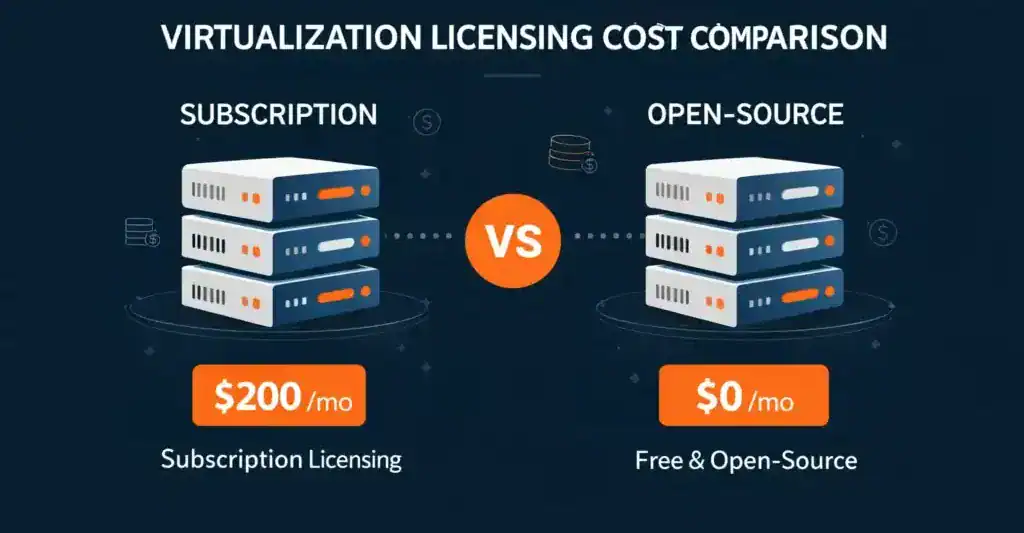
This is where things get interesting. Proxmox VE is completely free and open-source under the AGPL v3 licence. You can download it, install it on 100 servers, and never pay a dime. Optional enterprise support subscriptions start at around $110 per CPU per year.
VMware? That’s a different story. Since Broadcom took over, they’ve eliminated perpetual licences. Everything is subscription now, priced per core rather than per socket. Current list pricing for vSphere Foundation runs roughly $135-$350 per core annually, with most realised deals (after negotiation) landing between $100 and $280 per core. Deals also carry a 72-core minimum order, so even a modest 10-host deployment starts in the tens of thousands of dollars a year, not the low four figures it used to be. Source: VMware licensing cost trackers, September 2026
Sound expensive? It is. And that’s exactly why so many organisations are evaluating the proxmox vs vmware question for the first time.
Just being realistic here. Cost alone is pushing entire IT departments to reconsider their virtualization platform choices.
Why the Open-Source Hypervisor Movement Matters
Proxmox isn’t just a budget alternative. It’s part of a larger shift toward open-source hypervisor solutions across the industry. And this matters for your career more than you think.
Organisations like Wikimedia, the French government, and thousands of SMBs worldwide run production workloads on Proxmox. It’s built on KVM, the same kernel-based virtual machines that power AWS, Google Cloud, and most of the world’s cloud infrastructure. Not some fringe technology.
The open-source hypervisor approach also means you develop deeper Linux and infrastructure skills. Those skills transfer everywhere, whether you end up managing virtual machines on Proxmox, OpenStack, or even cloud-native environments.
Want the hands-on reps without the subscription bill? The What Is a Home Lab? guide walks through building a practice environment track by track, Proxmox included.
Proxmox vs VMware: Performance and Scalability
When comparing proxmox vs vmware on raw performance, the results might surprise you. Independent benchmarks generally show KVM (Proxmox’s hypervisor) landing close to ESXi for most workloads, often within single digits of overhead either way. Sometimes one edges ahead, sometimes the other.
Here’s the honest take. For most use cases, you won’t notice a meaningful performance difference between the two. Both handle live migration well. Both support high availability clustering. Both can manage hundreds of virtual machines per host.
Where VMware pulls ahead is in very large-scale enterprise deployments, think 1,000+ hosts managed through vCenter. VMware’s management tooling at that scale is still more mature. But how many of us are managing environments that big? Exactly.
For most proxmox vs vmware performance comparisons, the real-world difference is negligible. Both can saturate 10GbE and 25GbE links. Both handle NVMe storage with minimal overhead. What matters more is how well you configure the platform, not which platform you pick.
Management Interface and Ease of Use
Proxmox gives you a clean web-based UI right out of the box. No extra software needed. You open a browser, log in, and manage your entire IT infrastructure from one place. Creating virtual machines, managing storage, setting up networking, it’s all there.
VMware’s approach requires vCenter Server for centralised management, which is a separate licensed product. The vSphere Client is powerful, no question. But it comes with complexity. And cost.
For anyone building a homelab or running a small to mid-size data centre, Proxmox’s interface feels refreshingly simple. It doesn’t mean it’s less capable. It means the learning curve is gentler. And when you’re evaluating proxmox vs vmware from a total cost perspective, the free management tools tip the balance even further.
High Availability and Clustering
Both platforms support high availability, but the approach differs. Proxmox includes HA clustering for free. You need at least three nodes, a shared storage backend like Ceph (also included free), and you’re set. If a host fails, your virtual machines automatically restart on surviving nodes.
VMware offers vSphere HA, which works well but requires appropriate licensing. You’ll also want vSAN for hyper-converged storage, adding another licence. The technology is solid, proven in thousands of enterprises. But the cost stacks up fast.
Make sense so far? Good. Because when it comes to the proxmox vs vmware high availability comparison, both platforms deliver. The difference is the price tag.
Enterprise Virtualization: Where the Jobs Are
Let’s talk money and jobs. Because that’s why you’re actually reading this proxmox vs vmware comparison. Right?
VMware still leads the enterprise virtualization market by installed base, but that lead has narrowed fast since the Broadcom acquisition. Industry trackers put VMware’s current share somewhere in the 35-43% range, down from roughly 70% in 2024, largely because net-new deployments and SMB and edge workloads are shifting elsewhere. Source: market share tracking cited via Gartner, 2026
That still means more job listings, more demand, and generally higher salaries for VMware specialists in large, regulated environments, the ones hardest to migrate off VMware regardless of price.
| Role | Typical Salary Range (USD) | Experience Level |
|---|---|---|
| VMware Administrator | $95,000 – $130,000 | Mid-Level |
| VMware Engineer (VCP) | $120,000 – $160,000 | Senior |
| Proxmox Engineer | $85,000 – $125,000 | Mid-Level |
| Virtualization Architect | $140,000 – $190,000 | Senior/Lead |
| Multi-Platform Specialist | $130,000 – $170,000 | Senior |
Figures above are typical ranges from current job-posting and salary-survey data (September 2026); actual pay varies by region, employer and experience.
Notice the “Multi-Platform Specialist” row? Professionals who know both platforms tend to out-earn single-platform admins by a meaningful margin, and hybrid skills are consistently among the fastest-growing requirements in infrastructure job postings.
But here’s the thing most people miss. Enterprise virtualization is shifting fast. Broadcom’s pricing changes are pushing mid-market companies toward alternatives. That means Proxmox job postings are growing.
Proxmox job postings have grown noticeably since the Broadcom licensing changes took hold. VMware listings are still much larger in volume, but the trend is clear. Companies want people who understand the full proxmox vs vmware picture and can make informed recommendations about their data centre strategy.
What does this mean for you? If you only know VMware, you’re still very employable. No doubt. But if you know both, you become the person companies call when they’re evaluating whether to stay with VMware or migrate. That’s a high-value position to be in.
Proxmox vs VMware for Career Growth
If you’re looking at the proxmox vs vmware question purely from a career angle, here’s what the data says.
VMware certifications like VCP-DCV are still among the most recognised in IT infrastructure. They open doors at banks, hospitals, government agencies, and Fortune 500 companies. That’s just reality.
Proxmox, on the other hand, proves you understand Linux, KVM, Ceph, and open-source infrastructure at a fundamental level. These aren’t just Proxmox skills. They’re cloud skills, automation skills, and DevOps skills rolled into one.
Worth it to learn both? Absolutely.
Should You Learn Both?
Honestly? Yes. And here’s why.
Learning both Proxmox and VMware is like being bilingual. Each language opens different doors. VMware gets you into traditional enterprise environments. Proxmox proves you can work with open-source, Linux-based IT infrastructure. Together, they make you the person who can handle whatever a company throws at you.
Engineers who’ve worked hands-on with both platforms consistently report better job outcomes than single-platform specialists. They’re not just checking boxes. They understand server virtualization at a deeper level because they’ve seen two different approaches to the same problems.
Start with whichever matches your current job or homelab setup. Then add the other. Your resume will thank you.
So, Proxmox vs VMware, Which Should You Learn?
Let’s make this simple. The proxmox vs vmware decision comes down to three scenarios.
| Your Situation | Best Choice | Why |
|---|---|---|
| Enterprise career focus | Start with VMware | More job listings, higher immediate salary |
| Budget-conscious / Homelab | Start with Proxmox | Free, full-featured, builds Linux skills |
| Maximum career value | Learn both | Salary premium, future-proof |
The smart move in 2026? Don’t pick sides in the proxmox vs vmware debate. Learn both. The IT professionals earning the most aren’t VMware-only or Proxmox-only. They’re the ones who can walk into any data centre and get the job done, regardless of what virtualization platform is running.
Skilled-worker availability and the pace of technical change are the two biggest drivers of the current infrastructure skills gap, according to CompTIA’s 2026 State of the Tech Workforce report. Professionals who know multiple virtualization platforms are exactly who these companies are looking for. Source: CompTIA State of the Tech Workforce 2026
Bottom line on the proxmox vs vmware decision for career growth? The market rewards versatility. Companies don’t just want someone who can click through vSphere. They want someone who understands why certain workloads run better on one platform versus another. That kind of knowledge only comes from hands-on experience with both.
And here’s one more thing to consider. As more organisations adopt hybrid cloud and multi-cloud strategies, understanding both proprietary and open-source virtualization gives you a real advantage in cloud migration projects.
Frequently Asked Questions
Is Proxmox good enough for production environments? Yes. This is one of the most common questions in the proxmox vs vmware debate. Thousands of organisations run production workloads on Proxmox, including ISPs, universities, and government agencies. The KVM hypervisor underneath is the same technology powering AWS and Google Cloud. For small to mid-size deployments, Proxmox is absolutely production-ready.
Can I migrate from VMware to Proxmox? You can. Proxmox supports importing VMware virtual machines through OVF/OVA files and disk conversion tools. The process takes planning, but it’s doable. Many organisations are doing exactly this proxmox vs vmware migration after Broadcom’s licensing changes. The part most migration plans underestimate is backup and restore on the far side. The Veeam Backup Workbook covers that hands-on.
Which has better community support? Different strengths. VMware has more structured documentation and formal support channels. Proxmox has a very active open-source community, a detailed wiki, and responsive forums. For learning, both have plenty of resources available. When comparing proxmox vs vmware community resources, neither leaves you stranded.
Do I need Linux skills for Proxmox? Basic Linux command-line skills definitely help. Proxmox runs on Debian Linux, so understanding package management, file systems, and networking from the terminal makes your life easier. But the web interface handles most day-to-day tasks without touching the CLI.
How long does it take to learn each platform? For basic administration, about 2-4 weeks of focused study for either platform. Getting to an advanced level, high availability, automation, performance tuning, takes 3-6 months with consistent, hands-on practice.
Is the proxmox vs vmware debate relevant for cloud engineers? Absolutely. Understanding on-premises virtualization gives cloud engineers a real advantage when designing hybrid architectures. The proxmox vs vmware knowledge helps you understand what’s happening underneath cloud services like EC2 and Azure VMs. Plus, many companies still run hybrid environments where cloud and on-prem virtualization coexist.
Bottom Line
The proxmox vs vmware debate isn’t about choosing a winner. It’s about choosing what’s right for your career right now, and where the industry is heading. VMware still leads the enterprise market. Proxmox is gaining ground fast, especially with organisations watching their budgets.
If you’re serious about a career in server virtualization and IT infrastructure, learn both platforms. Start with whichever fits your current situation, then expand. The proxmox vs vmware skills combination puts you in a small, high-demand group of professionals who can adapt to any environment.
Put it into practice
- DevOps Workbook – 95 labs across Git, CI/CD, Docker, Kubernetes, Terraform and cloud DevOps, the automation layer that sits on top of whichever hypervisor you run.
- Veeam Backup Workbook – backup and restore across virtualization platforms, the part most migration plans underestimate.
Related reading on SMEnode Labs
- What Is a Home Lab? The 2026 Guide for IT Cert Students, Track by Track – build the practice environment this comparison assumes you have.
- Home Lab Setup for Network Engineers: Build a CCNA Lab in a Weekend – a full weekend build if you’re starting from bare metal.