
$166,000. That’s the average salary for CCIE holders in 2026. CCNP holders? Around $145K. That $20K gap is why the CCIE vs CCNP debate keeps every networking pro up at night.
But here’s the thing. Salary isn’t the whole story. The CCIE vs CCNP decision depends on where you are in your career, how much time you can invest, and what kind of engineer you want to become. Some people are better off with a CCNP. Others need the CCIE to hit their goals.
So which one actually makes sense for you? Let’s break it down honestly, no fluff, no hype. Just the facts.
CCIE vs CCNP: The Quick Breakdown
Before we get into the details, here’s a quick side-by-side look at CCIE vs CCNP. This table covers the big differences at a glance.
| Category | CCNP | CCIE |
|---|---|---|
| Level | Professional | Expert |
| Target Audience | Mid-level engineers (3-5 yrs) | Senior/Expert engineers (5-7+ yrs) |
| Exam Format | Core exam + 1 concentration | Written qualifying + 8-hour lab |
| Avg. Salary (USD) | $144,000 – $168,000 | $166,000 – $220,000+ |
| Time to Earn | 3-6 months | 6-24 months |
| Total Cost | $600 – $1,200 | $1,600 – $5,000+ |
| Pass Rate | ~50-60% first attempt | ~25-30% first attempt |
| Global Holders | Hundreds of thousands | ~69,000 issued (~45-50K active) |
Think of it this way. CCNP is your driver’s license, it proves you can do the job well. CCIE? That’s your racing license. Different league entirely.
Now let’s dig deeper into each one.
What Is CCNP and Who Is It For?
CCNP stands for Cisco Certified Network Professional. It’s the mid-tier Cisco certification aimed at engineers with about 3-5 years of networking experience. You don’t technically need a CCNA to take the CCNP exams, but most people have one.
The CCNP proves you can plan, build, and troubleshoot enterprise network solutions. It comes in several tracks: Enterprise, Security, Data Center, Collaboration, and Service Provider. Each track requires a core exam plus one concentration exam of your choice.
And here’s something most people miss about the CCNP vs CCIE conversation. Passing the CCNP Enterprise core exam (350-401 ENCOR) also counts as your CCIE Enterprise Infrastructure qualifying exam. So if you’re thinking long-term, the CCNP is actually your first step toward the CCIE. Pretty smart move by Cisco.
The CCNP is ideal for network engineers, security analysts, and cloud infrastructure pros who want to validate their skills and move into senior roles. It’s respected globally and most hiring managers see it as a strong signal that you know your stuff. If your routing fundamentals need work before you tackle CCNP-level material, our EIGRP vs OSPF breakdown is a good place to firm those up.
What Is CCIE and Who Is It For?
The CCIE, Cisco Certified Internetwork Expert, is one of the most respected certifications in all of IT. Not just networking. All of IT. Cisco doesn’t publish a live count of active CCIEs, but roughly 69,000 have been issued worldwide since the program began, with industry estimates putting the number still active today at around 45,000-50,000. That exclusivity is part of what makes it so valuable.
Here’s what sets the CCIE apart from everything else. The lab exam. It’s an 8-hour, hands-on practical test where you design, deploy, operate, and troubleshoot complex network scenarios in real time. No multiple choice. No shortcuts. You either know the technology inside and out, or you don’t.
Sound intimidating? It should be. That’s the point.
The CCIE is available in six tracks: Enterprise Infrastructure, Enterprise Wireless, Security, Data Center, Service Provider, and Collaboration. If you’re weighing the Enterprise or Security tracks, our CCIE Enterprise Infrastructure Workbook and CCIE Security Workbook walk through real exam-style lab scenarios for each.
The CCIE is meant for senior engineers, network architects, and technical leaders who want to prove they’re among the best in the world. It’s not for everyone. But for those who earn it, the career impact is massive.
CCIE vs CCNP: Detailed Side-by-Side Comparison
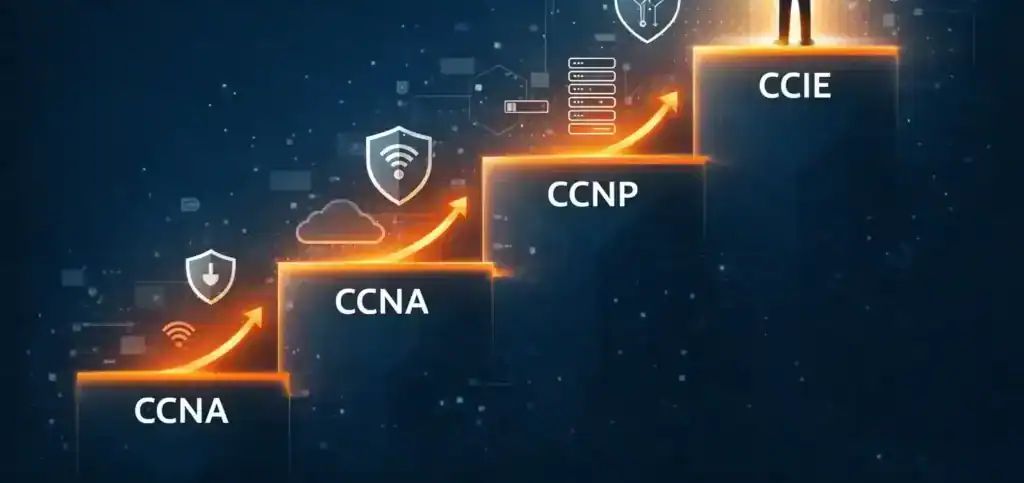
Let’s get into the specifics. Understanding the CCIE vs CCNP differences across key areas will help you make a smarter decision.
How the CCIE vs CCNP Exam Structure Differs
This is where the biggest gap shows up in the CCNP vs CCIE written comparison. The CCNP requires two written exams, a core exam (120 minutes) and a concentration exam (90 minutes). Both are multiple choice and simulation-based. Challenging? Sure. But manageable with solid study habits.
The CCIE? Completely different animal. You first pass a qualifying written exam (which can be your CCNP core exam). Then comes the lab exam. Eight hours. Hands-on. You’re configuring, troubleshooting, and designing networks on actual equipment. There’s no guessing your way through a CCIE lab.
Students who breeze through the CCNP written exams often hit a wall when they start CCIE lab prep. The jump in practical skill required is enormous. Building that muscle memory ahead of time, through a real home lab rather than just reading, is what closes the gap. Our home lab setup guide walks through building one in a weekend.
CCIE vs CCNP: Time and Cost Investment
Let’s talk numbers. The CCNP typically takes 3-6 months of focused study. Exam fees run about $600-$1,200 total (core plus concentration). Add study materials and you’re looking at maybe $1,500-$2,500 all in.
The CCIE is a different story. Most people spend 6-12 months preparing with structured training. Self-study? You’re looking at 18-24 months, sometimes longer. The qualifying exam costs around $450, and the lab exam runs $1,600 per attempt. Yeah, per attempt. With an average pass rate of 25-30%, many candidates take the lab 2-3 times. Do the math.
That’s why structured, scenario-based practice makes financial sense. Working through a real lab workbook before you sit the exam catches the gaps a single read-through never will, and it’s a lot cheaper than a second $1,600 lab attempt.
CCNP vs CCIE Salary: What the Numbers Actually Show
This is the section everyone skips to. Fair enough. Let’s talk about the CCNP vs CCIE salary differences with real data.
| Career Stage | CCNP Salary | CCIE Salary | Difference |
|---|---|---|---|
| Entry (0-3 yrs w/ cert) | $85K – $110K | $120K – $145K | +$35K – $40K |
| Mid-Level (3-7 yrs) | $120K – $155K | $150K – $185K | +$25K – $35K |
| Senior (7+ yrs) | $145K – $175K | $175K – $220K+ | +$30K – $50K+ |
A few things stand out here. The CCIE vs CCNP salary gap is biggest at the senior level, around $30K-$50K+ per year. Over a 10-year career, that’s $300K-$500K in extra earnings. Kind of puts the training investment in perspective, right?
But here’s something the salary tables don’t show. CCIE holders often get access to roles that CCNP holders simply don’t qualify for. Think principal network architect, consulting engineer, or technical director positions. These roles regularly pay north of $200K and they almost always require a CCIE or equivalent expert-level credential.
The Bureau of Labor Statistics projects computer network architect employment to grow 8% from 2025 to 2035, well ahead of the average for all occupations, with 2025 median pay at $134,050. Source: BLS Occupational Outlook Handbook. On pay, Pearson VUE’s 2025 report found 32% of certified professionals got a rise, and 56% of those within three months, so about 18% inside a quarter. The return on investment is real, just slower than the headline numbers suggest.
CCNP vs CCIE Difficulty: How Hard Are We Talking?
Let’s be honest about the CCNP vs CCIE difficulty gap. It’s significant.
The CCNP exams are challenging. You need to know your protocols, configurations, and troubleshooting methodologies. But the format is familiar, multiple choice, drag and drop, simulations. If you’ve passed the CCNA, you know the drill. Study hard, practice labs, and you’ll get through it. Most people with solid preparation pass within 1-2 attempts.
The CCIE lab? Whole different world. Imagine troubleshooting a broken multi-site network with BGP, OSPF, MPLS, DMVPN, and security policies, all under time pressure. No notes. No internet. Just you and the equipment for 8 hours. It’s like a live troubleshooting marathon.
Only about 25-30% of candidates pass the CCIE lab on their first try. That stat alone tells you everything about the CCNP vs CCIE difficulty difference.
Multiple CCNP vs CCIE: Does Stacking Certifications Beat One CCIE?
This is a question we hear constantly. Is earning multiple CCNP certifications across different tracks (Enterprise, Security, Data Center) better than pursuing a single CCIE? The multiple CCNP vs CCIE debate is more nuanced than most people think.
Here’s the honest answer. It depends on your career goal.
Multiple CCNPs make sense if: You want to be a versatile generalist. Some organizations value engineers who understand networking, security, AND data center technologies. If you’re at a smaller company or an MSP where you wear many hats, breadth matters more than depth.
A single CCIE makes sense if: You want to specialize and reach the top of your field. The CCIE signals world-class depth in one domain. It opens doors to consulting, architecture roles, and leadership positions that multiple CCNPs simply can’t match.
Think of it like martial arts. Stacking CCNPs is like earning belts in three different styles. Impressive? Sure. But a CCIE is like earning a black belt in one. Different kind of respect. Different kind of opportunity.
According to Skillsoft’s IT Skills and Salary Report, 97% of IT decision makers say certified staff add measurable value to their organisation. But when hiring for senior roles, the CCIE consistently ranks as the most sought-after credential in networking.
CCIE vs CCNP: Which Path Should You Take?
So how do you actually decide? Here’s a practical guide based on career goals. Use this to figure out where the CCIE vs CCNP decision lands for your situation.
| Your Goal | Best Path | Why |
|---|---|---|
| Network Engineer | CCNP first, then CCIE | Build foundation, then specialise |
| Network Architect | CCIE (required at most firms) | Architecture roles demand expert depth |
| Security Expert | CCNP Security, then CCIE Security | Security is high-demand, high-pay |
| Automation Engineer | CCNP + DevNet, consider CCIE | Automation skills + deep networking |
| Consulting/Freelance | CCIE (non-negotiable) | Clients pay premium for CCIE experts |
| Career Changer (new to IT) | CCNA then CCNP | Build progressively, don’t skip levels |
Bottom line? If you’re early in your career, start with the CCNP. Build real-world experience. Get comfortable with design and troubleshooting at scale. Then, when you’re ready to make the jump, the CCIE becomes your career accelerator.
If you’re already a senior engineer with 5+ years and you know your track, go straight for the CCIE. Whichever stage you’re at, our CCNA Workbook and CCNA Automation Workbook cover the foundation, and the CCIE Enterprise and Security workbooks linked above cover the expert-level lab scenarios once you’re ready for them.
Is CCIE harder than CCNP?
Yes, significantly. The CCIE vs CCNP difficulty gap is massive. CCNP exams are written tests with about a 50-60% pass rate. The CCIE lab is an 8-hour practical exam with only a 25-30% first-attempt pass rate. The CCIE requires deep, hands-on expertise that goes far beyond what the CCNP tests.
How much more does a CCIE make than a CCNP?
On average, the CCNP vs CCIE salary gap ranges from $25K-$50K per year depending on experience level and location. Entry-level CCIE holders earn around $120K-$145K, while senior CCIEs regularly clear $200K+. Over a full career, this adds up to hundreds of thousands in extra earnings.
Do I need CCNP before CCIE?
Not technically. Cisco doesn’t require the CCNP to attempt the CCIE, but the CCNP core exam (ENCOR 350-401) serves as the CCIE Enterprise Infrastructure qualifying exam. So most people earn their CCNP on the way to the CCIE. It’s the natural progression and gives you a credential even if the CCIE lab takes longer than expected.
Is it better to get multiple CCNPs or one CCIE?
It depends on your career goal. Multiple CCNPs show breadth across domains, which is great for generalist roles. But a single CCIE carries more weight for specialised, senior, and consulting positions. In terms of salary and career ceiling, one CCIE typically outperforms two or three CCNPs. The multiple CCNP vs CCIE debate really comes down to depth versus breadth.
What’s the CCIE vs CCNP exam structure difference?
The CCNP requires two written exams (core + concentration), typically completed in 3-6 months. The CCIE requires a qualifying written exam plus an 8-hour hands-on lab exam. The CCNP vs CCIE written portion is somewhat similar, but the CCIE lab is what makes it uniquely challenging. There’s nothing else like it in the industry.
The Bottom Line on CCIE vs CCNP
The CCIE vs CCNP decision isn’t about which cert is better. Both are valuable. Both advance careers. The real question is which one matches where you are right now and where you want to go.
If you’re building your career, the CCNP is your next smart move. If you’re ready to break into the top tier of networking professionals, the CCIE will get you there. And for many people, the best path is CCNP first, then CCIE.
Whatever you decide, don’t go it alone with just theory. Structured, hands-on lab practice is what separates people who pass on attempt one from people who need three tries. Our CCIE Enterprise Infrastructure Workbook and CCIE Security Workbook are built around exactly that kind of guided, scenario-based practice.