
This free AZ-104 practice test PDF has 25 exam-style scenario questions with answers and explanations, covering compute, storage, networking, identity and governance, and monitoring. AZ-104 is Microsoft’s Azure Administrator Associate exam. You get 100 minutes, and a score of 700 or more passes. The questions are original practice scenarios, not real exam questions. Drop your email and the PDF lands in your inbox.
AZ-104 Practice Test: What the Exam Measures
Microsoft’s AZ-104 study guide lists five skill areas, as of April 17, 2026:
| AZ-104 skill area | Weight | Scenarios in this practice test |
|---|---|---|
| Manage Azure identities and governance | 20-25% | RBAC roles and scopes, Azure Policy |
| Implement and manage storage | 15-20% | Replication: LRS, ZRS, GRS, RA-GRS |
| Deploy and manage Azure compute resources | 20-25% | Availability sets, scale sets, disks |
| Implement and manage virtual networking | 15-20% | NSGs, load balancing, Azure Bastion |
| Monitor and maintain Azure resources | 10-15% | Azure Monitor, Azure Backup, Site Recovery |
The PDF also has scenarios on Azure Firewall, WAF, Site-to-Site VPN and Reserved Instances. Those aren’t listed as skills in Microsoft’s current outline, so treat them as extra reading. The PDF has nothing on Microsoft Entra users and groups, ARM or Bicep templates, containers, App Service, VNet peering or SAS tokens, so it can’t be your only practice. The AZ-104 Study Guide 2026 covers the full list.
AZ-104 Exam Cost, Format and Retakes
You schedule through Pearson VUE, and the exam is proctored. Microsoft prices it by country or region, so check your own price on the exam page before you book. If you fail, you can retake it 24 hours after the first attempt, and later waits vary under Microsoft’s retake policy.
Once you pass, renewal costs nothing. Microsoft renews the certification every 12 months through a free online assessment. Microsoft also offers a free Practice Assessment and an exam sandbox, and the practice assessment needs a sign-in.
AZ-104 Exam Questions on Compute: Availability Sets vs Scale Sets
Scenario: 20 VMs run a web app in one region. The app must stay up during planned maintenance and hardware failures, with minimal admin effort and low cost. Answer: an availability set.
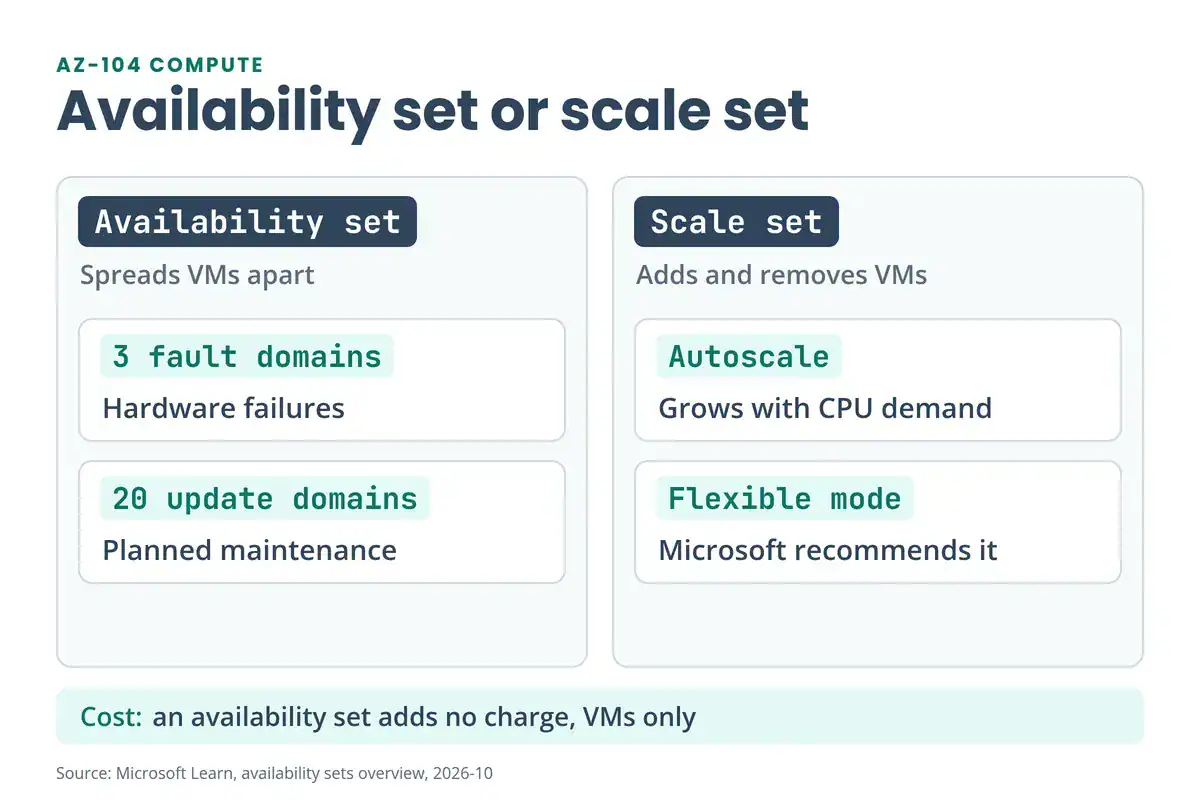
Per Microsoft’s availability set docs, an availability set spreads VMs across up to 3 fault domains and 20 update domains, and there’s no extra cost beyond the VMs. The same docs note that availability sets give less resilience than availability zones. They also recommend Virtual Machine Scale Sets in flexible orchestration mode for high availability with the widest range of features. If the scenario adds automatic scaling on CPU usage, the answer becomes a scale set.
AZ-104 Microsoft Azure Administrator Storage Scenarios: GRS vs RA-GRS
Scenario: financial data sits on LRS. It must survive a full region outage. Answer: GRS, or RA-GRS if the secondary must be readable.

| Option | Where the copies live | Secondary readable? |
|---|---|---|
| LRS | One datacenter | No secondary |
| ZRS | Three or more zones, same region | No secondary |
| GRS | Primary region, plus a second region | Only after failover |
| RA-GRS | Same as GRS | Always |
Per Microsoft’s storage redundancy docs, RA-GRS data is always available to read, not just during an outage. The PDF’s scenario says recovery must be automatic, but with GRS you choose to fail over, and account failover is needed to restore writes. Replication to the secondary is asynchronous, so recent writes can be lost. Expect exam wording like “ZRS protects against a zone failure, GRS against a region failure.”
AZ-104 Exam Questions and Answers: Network Security and Access
| Requirement | Answer | Why |
|---|---|---|
| Control traffic between subnets | Network Security Groups | Filter by source, destination, port and protocol |
| Admins reach VMs with no public IP | Azure Bastion | Browser-based access without exposing the VM |
| Central filtering and logging for a network | Azure Firewall | One place for rules and logs |
| Block SQL injection | Web Application Firewall | Built for OWASP-type attacks |
| Spread web traffic across VMs in a region | Load Balancer | Regional distribution |
The load balancer scenario is ambiguous as written: Application Gateway also distributes web traffic inside a region. On the real exam, extra detail picks the service, such as layer 7 routing or WAF, which points to Application Gateway.
AZ-104 Practice Test: Identity, RBAC and Azure Policy
- Assign permissions by role: RBAC, at the scope you choose.
- Developers who manage VMs only: the Virtual Machine Contributor role, not Contributor or Owner.
- Permissions across a whole subscription: assign at subscription scope.
- Allow only certain VM sizes, automatically: Azure Policy. RBAC controls who can act, and Policy controls what can be deployed.
Azure Monitor and Azure Backup for the AZ-104 Exam
Scenario: alert when VM CPU passes 80%, send an email, keep history. Answer: Azure Monitor.

The PDF says metrics are stored in a Log Analytics workspace. Microsoft’s data platform docs are more precise: metrics go to a time-series database that suits alerting, logs go to a Log Analytics workspace that suits root-cause queries, and some sources write to both. The alert rule and email come from an alert rule with an action group.
Scenario: daily backups, long retention, protection against accidental deletion. Answer: Azure Backup in a Recovery Services vault, with soft delete.

Per Microsoft’s soft delete docs, deleted backup data is kept for 14 days by default at no extra cost, and you can extend that up to 180 days. Replicating VMs to another region for disaster recovery is Azure Site Recovery, not Azure Backup.
AZ-104 Hybrid, Cost and Disk Scenarios
- Encrypted, low-cost, quick link to a datacenter: Site-to-Site VPN, which needs a VPN Gateway in Azure. ExpressRoute costs more and takes longer.
- VMs running 3 years with no downtime allowed: Reserved Instances. Spot VMs can be evicted.
- High IOPS, low latency, steady performance: Premium SSD.
What’s Inside the AZ-104 Practice Test PDF
- 25 questions in 13 scenarios, each starting with a company environment and requirements
- The answer and a short explanation for every question
- Compute, storage, networking, identity, and monitor and backup scenarios
The question numbers in the PDF are uneven: the first three scenarios each restart at Question 1, and Scenario 4 jumps to Question 10.
Who It’s For
- Beginners who want to see how scenario questions are worded
- Candidates who finished a study guide and want a quick self-check
- Anyone who wants hands-on practice next to the questions

No questions yet. Ask the first one.