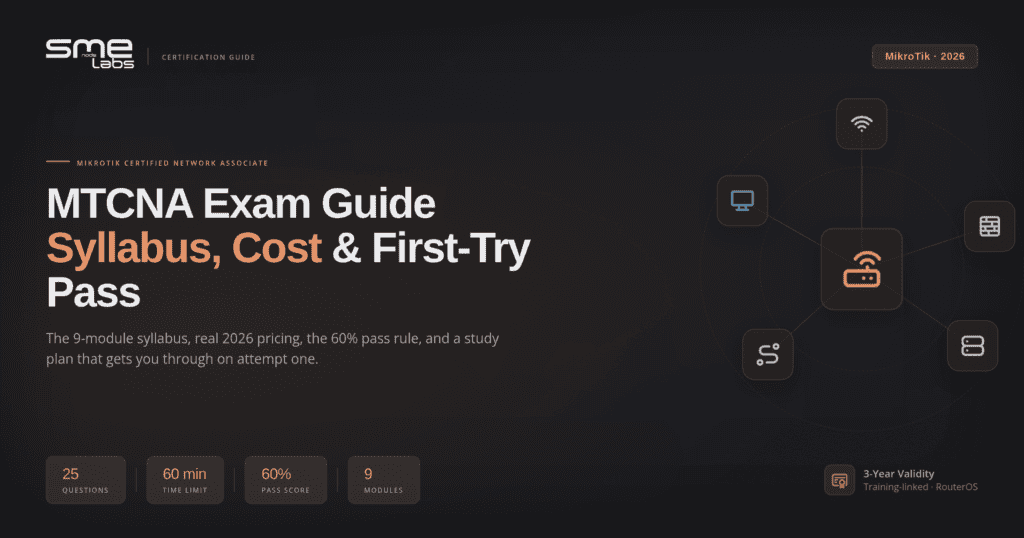
Only 60%. That’s the score you need to pass the MTCNA exam, and yet plenty of smart people still walk out of that 60-minute test having missed it by two or three questions. If VLANs are still fuzzy, start at what a VLAN is and work up.
Frustrating, right?
Here’s the thing. The MikroTik Certified Network Associate exam isn’t hard because the material is deep. It’s hard because it’s specific. RouterOS does things its own way, and the test checks whether you actually clicked through Winbox or just watched someone else do it. The other non-Cisco track worth knowing is the Huawei HCIA Datacom Workbook.
You’ve probably already booked a training session, or you’re about to. So you want two things: to know exactly what’s on the exam, and to pass it the first time. This guide covers both. We’ll break down the full syllabus, the real 2026 cost, the passing rules most people miss, and a study plan that works. Want a free lab to practise on? The Cisco SD-Access virtual lab PDF is a 24-slide walkthrough.
By the end, you’ll know whether the mtcna exam is worth your time, and how to walk in ready.
New to RouterOS? Grab our MTCNA Exam Workbook before you book your training. It maps every practice question to the official syllabus, so you know what to drill first.
What Is the MTCNA Exam, Exactly?
The MTCNA is the entry-level MikroTik certification. It proves you can configure a RouterOS device to do real work: routing, firewalls, DHCP, wireless, and basic traffic shaping.
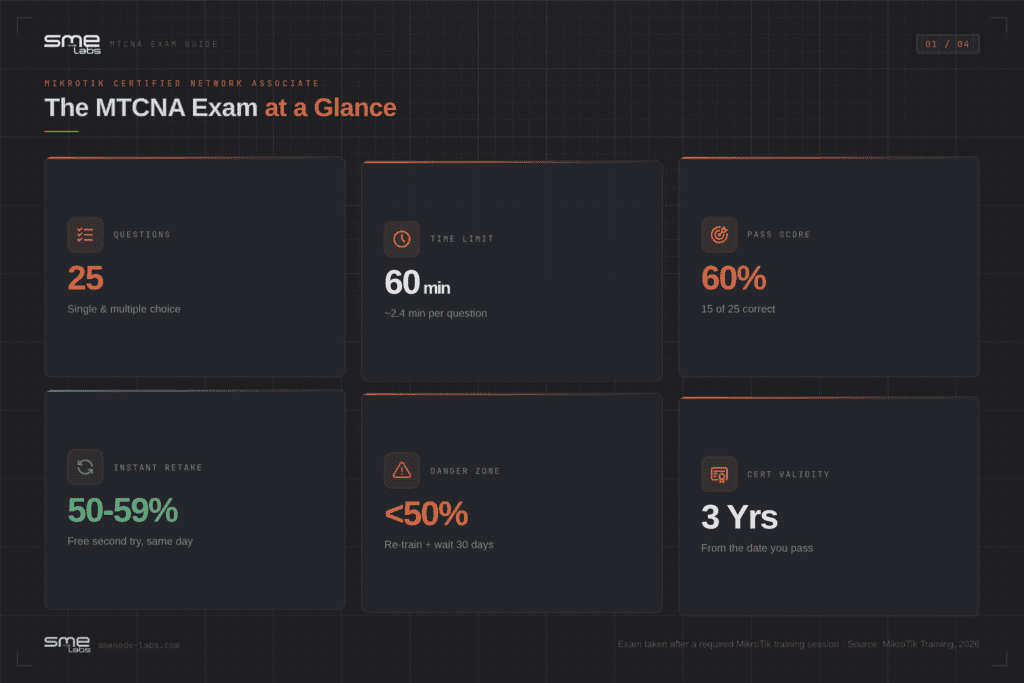
Here’s the format, straight from MikroTik. The official exam runs 25 questions in 60 minutes, single or multiple choice. You need 60% to pass. That’s it.
But there’s a catch most people don’t hear about until it’s too late.
You can’t just book the exam. A training session has to happen first. You attend an MTCNA course run by a MikroTik Certified Trainer, and the exam sits at the end of it. No standalone sittings. No walking in cold.
Now, the second-chance rule. This one’s actually generous.
- Score 60% or higher: you pass. Done.
- Score 50% to 59%: you get a free retake, right away.
- Score below 50%: you have to re-attend the training and wait at least 30 days.
So the danger zone is under 50%. Land there and you’re paying and waiting all over again. Land in the 50s and you get another shot the same day.
The certificate is valid for 3 years from the date you pass. After that it expires, though most people move up to MTCRE or another track long before then. For backup and DR labs, see the Veeam Backup Workbook.
How Much Does the MTCNA Exam Cost in 2026?
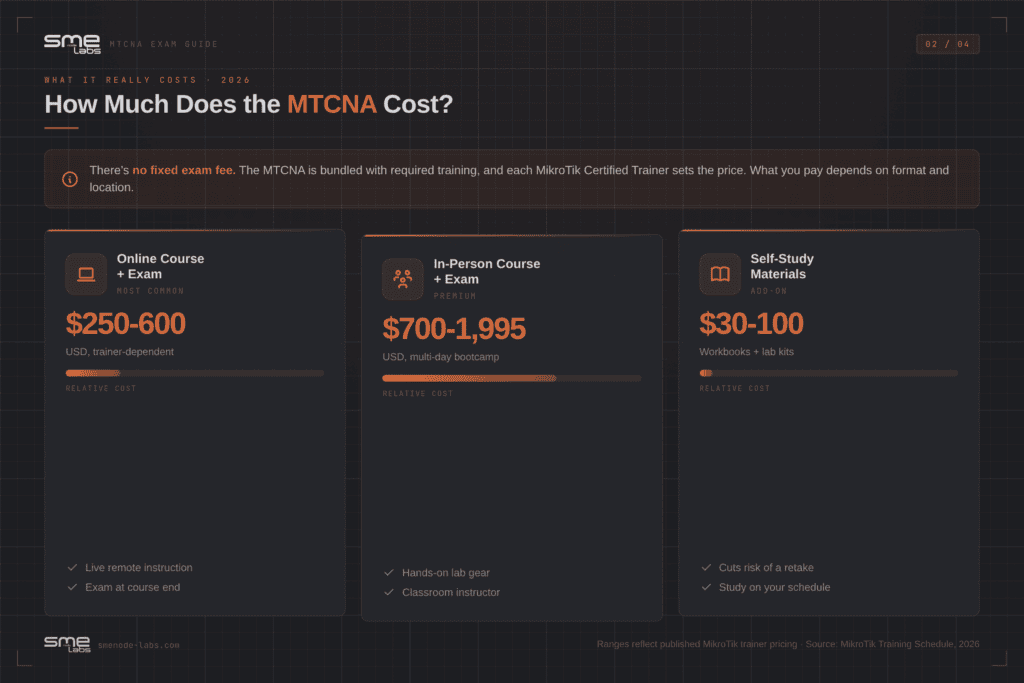
Short answer: there’s no fixed price. The exam itself is bundled into the training, and each MikroTik Certified Trainer sets their own rate.
That surprises people. There’s no central checkout on mikrotik.com where you pay a flat fee like you would for a CompTIA test.
So what does it actually run?
Prices swing hard depending on the trainer and the country. Across the current MikroTik training schedule, we’ve seen MTCNA courses priced anywhere from around $250 on the low end to nearly $2,000 for premium in-person bootcamps in North America. Online sessions tend to sit lower. In-person, multi-day classes cost more.
For a sense of real listings: Baltic Networks runs the course at $995, Microcom lists it at $1,995, and UK-based LinITX prices it around £780 (about $985 USD), all current as of this update.
Here’s a rough breakdown of what your money buys:
| What’s included | Typical range (2026) |
|---|---|
| Online MTCNA course + exam | $250 – $600 |
| In-person MTCNA course + exam | $700 – $1,995 |
| Self-study materials (workbooks, labs) | $30 – $100 |
That last row matters more than it looks. The course fee is fixed, but your pass rate isn’t. Spend $50 on solid practice material and you cut the odds of paying for a second course entirely.
Think of it like buying insurance on the bigger purchase.
Studying on a budget? Our RouterOS Lab Kit gives you hands-on config drills without a physical router. Cheaper than a failed retake, and honestly more useful than re-reading slides.
The MTCNA Syllabus: What’s Actually on the Exam?

MikroTik splits the mtcna syllabus into nine modules. Every question maps to one of them. Know these cold and you know the exam.
Let’s go through them.
Module 1: Introduction and RouterOS Basics
Logging in, Winbox, WebFig, the CLI. How RouterOS and RouterBOARD fit together. Basic navigation. Sounds trivial. It isn’t. A chunk of the easy points live here, and people lose them by never touching the actual interface.
Module 2: DHCP
Setting up a DHCP server and a DHCP client. Leases, pools, and how a router hands out addresses. Straightforward if you’ve done it once. A guessing game if you haven’t.
Module 3: Bridging
Connecting interfaces at layer 2. When to bridge, when not to. This trips up folks who only think in routing terms.
Module 4: Routing
Static routes, the routing table, default gateways. Core networking, RouterOS-flavoured. If your TCP/IP is shaky, patch it before class.
Module 5: Wireless
Access points, station mode, security, and basic wireless config. MikroTik gear is huge in wireless ISP setups, so expect real weight here.
Module 6: Firewall
Filter rules, NAT, address lists, connection tracking. This is where the exam gets interesting. NAT alone confuses a lot of first-timers.
Module 7: QoS
Simple queues and basic traffic shaping. How to limit bandwidth per client. Short module, but it shows up.
Module 8: Tunnels
PPP, PPPoE, and basic tunnelling. Common in ISP and remote-access work.
Module 9: Miscellaneous
The catch-all. Tools, monitoring, upgrades, small utilities. Easy points if you skimmed the manual, missed points if you didn’t.
One prerequisite runs under all of this: TCP/IP and subnetting. MikroTik assumes you already have it. If binary math and CIDR notation make you nervous, fix that first. Our subnetting guide walks through it without the headache.
Is MTCNA Worth It? Let’s Talk Jobs and Salary
Fair question. You’re spending money and a weekend. What do you get back?
Depends entirely on where you work.
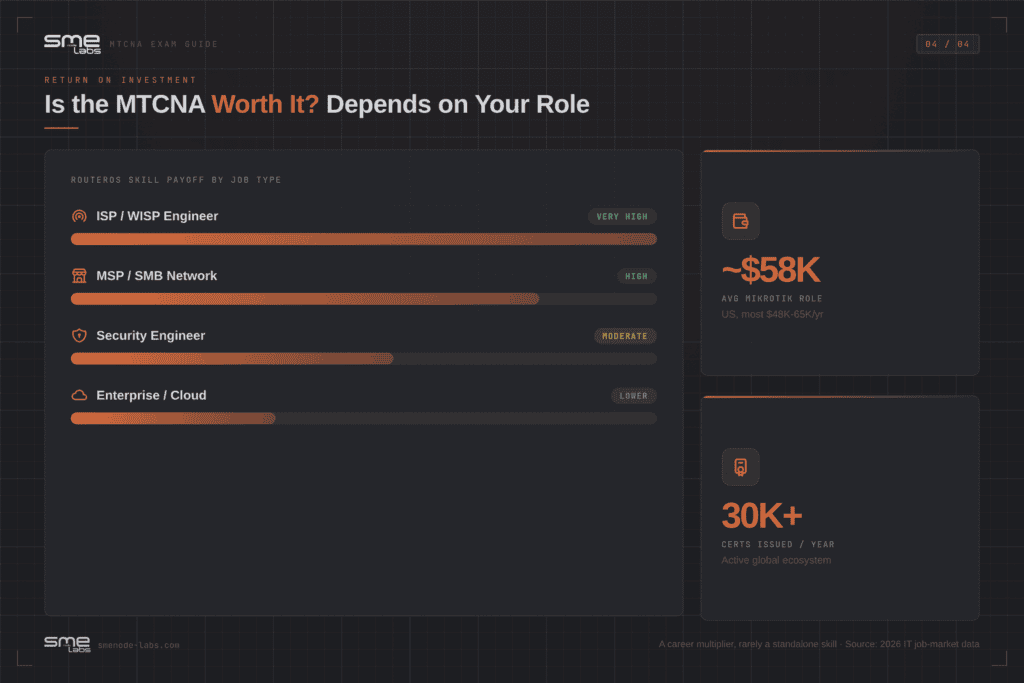
Over 30,000 MikroTik certificates get issued every year, so the ecosystem is alive and hiring. But the value isn’t spread evenly across every IT job.
Here’s the honest picture:
- ISP and WISP engineers: highest payoff. RouterOS is the platform they live in daily. The cert pays for itself fast.
- MSP and small-business network folks: strong payoff. Firewall, VPN, and routing skills transfer straight to client work.
- Security engineers: moderate. Firewall and layer-7 filtering knowledge helps.
- Pure enterprise or cloud engineers: lower direct payoff, unless you touch edge or branch sites.
On salary, be realistic. MikroTik-tagged roles in the US average roughly $58K a year, with most landing between $48K and $65K. Specialists who stack MikroTik with Linux or Cisco push much higher.
That last point is the real lesson. MikroTik is rarely the only skill on a job posting. It shows up next to Cisco, Juniper, or Linux. So think of MTCNA as a multiplier, not a finish line.
Let me give you a real-shaped example.
Here’s where MTCNA earns its keep. Small WISP operators who’ve been configuring MikroTik by copying forum posts take it mostly to look credible on bids. Municipal and contract work often specifies a certified RouterOS tech, and that single line in a tender is what the cert buys you. It doesn’t teach you everything. It proves what you already half-knew, and on a bid sheet that’s enough.
That’s the pattern. For the right person, the mikrotik certification opens doors that a resume line alone can’t.
How Do You Pass the MTCNA on Your First Try?
Now the part you came for. Passing isn’t about cramming. It’s about hands-on repetition and knowing where the traps are.
Here’s a study plan that works.
Start Hands-On, Not With Slides
The single biggest predictor of passing? Time inside RouterOS. Not reading about it. Doing it.
Get access to a router. A cheap hAP costs under $60, or spin up CHR (Cloud Hosted Router) free on a VM. Then build things. A DHCP server. A firewall rule. A simple queue. Break them. Fix them.
The single biggest predictor of a first-try pass is hands-on Winbox time. Watching hours of video without ever opening Winbox yourself is the classic way to fail this one. A weekend building and breaking configs on a cheap router changes the result more than another video course will. Same brain. Different method.
Drill the Firewall and NAT Modules Hard
If the exam has a graveyard, it’s the firewall section. NAT, filter chains, connection states. These questions are worded to catch people who memorized instead of understood.
Spend extra time here. Set up masquerade NAT. Then explain out loud why each rule exists. If you can teach it, you know it.
Memorize the Defaults
RouterOS has default behaviours the exam loves to test. Default routes, default firewall, default services. Know what a fresh RouterBOARD does out of the box, and a handful of questions become free points.
Practice Under Time Pressure
25 questions, 60 minutes. That’s just over two minutes each. Feels generous until a scenario question makes you think.
Take timed practice tests. Get used to the clock. Our MTCNA Exam Workbook includes timed question sets built to match the real pacing.
Don’t Ignore the Boring Modules
QoS and Miscellaneous feel like afterthoughts. They aren’t. Those “easy” modules hold points you can’t afford to leave behind when the pass line is 60%. Every question counts equally.
Common MTCNA Mistakes That Sink First-Timers
A few patterns show up again and again. Avoid these.
Studying theory, skipping labs. The exam tests doing, not reciting. If you’ve never configured it, you’ll guess.
Weak subnetting going in. MikroTik won’t teach you IP fundamentals. Show up shaky and you’ll drown in Module 4.
Rushing the firewall section. Slow down. Read every scenario twice. NAT questions punish speed-readers.
Assuming it’s like the CCNA. It overlaps, but RouterOS has its own logic. Cisco muscle memory can actively mislead you here.
Landing under 50%. The costliest mistake. Score 49% and you’re re-attending training and waiting a month. Aim for a comfortable margin, not a squeaker.
Frequently Asked Questions
How many questions are on the MTCNA exam?
25 single or multiple-choice questions, with 60 minutes to finish.
What’s the MTCNA passing score?
60%. Score 50 to 59% and you get an immediate free retake. Below 50% means re-attending training and waiting 30 days.
How much does the MTCNA cost in 2026?
There’s no fixed exam fee. It’s bundled with required training, which runs roughly $250 to $2,000 depending on the trainer and whether it’s online or in person.
How long is the MTCNA certificate valid?
3 years from the date you pass. Most people renew or move up to MTCRE before it expires.
Do I need experience before taking the MTCNA?
No formal experience, but you need solid TCP/IP and subnetting knowledge. RouterOS hands-on time helps a lot.
Can I take the MTCNA exam online?
The exam follows a training session set by a Certified Trainer. Some trainers offer online delivery, but the exam is tied to that course, not a standalone online booking.
Is MTCNA Harder or Easier Than CCNA?
Narrower, not necessarily easier. MTCNA covers one vendor’s OS in 25 questions over 60 minutes. CCNA covers multi-vendor networking plus security, automation, and wireless across 100 to 120 questions in 120 minutes, with Cisco’s passing bar estimated around 825 out of 1,000 (Cisco has never published the exact number). MTCNA is the faster, cheaper credential to earn. CCNA carries more industry recognition and a steeper study curve.
Bottom Line
The MTCNA is very passable when you prepare the right way. Here’s what to remember:
- Format: 25 questions, 60 minutes, 60% to pass. Under 50% is the danger zone.
- Cost: no flat fee, bundled with training, roughly $250 to $2,000.
- Syllabus: nine modules, with firewall and wireless carrying real weight.
- Value: highest for ISP, WISP, and MSP roles. A multiplier when stacked with other skills.
- Passing: hands-on practice beats video every time. Build, break, fix, repeat.
The people who pass first try aren’t smarter. They just spent their hours inside RouterOS instead of watching someone else use it.
Ready to walk in prepared? Start with the MTCNA Exam Workbook, drill the firewall module until it’s boring, and book your training with confidence.
You’ve got this.