
The CCIE Enterprise Infrastructure certification is Cisco’s expert-level credential that validates your ability to design, deploy, operate, and optimize enterprise networking infrastructure at scale. This certification requires passing both a written exam (350-401 ENCOR) and an 8-hour hands-on lab exam, with only 8-12% of candidates passing on their first attempt. The average preparation time is 18-24 months, and certified professionals earn between $125,000-$180,000 annually in North America.
Understanding CCIE Enterprise Infrastructure in 2025
The networking landscape has transformed dramatically since Cisco redesigned its certification program in 2020. The CCIE Enterprise Infrastructure track now focuses on modern network architectures that enterprise organizations actually deploy, rather than theoretical concepts that rarely see production environments.
Current Industry Statistics: – Global network engineer shortage: 3.5 million positions unfilled by 2025 – Average salary increase after CCIE certification: 32-47% – Employer ROI on CCIE-certified engineers: 340% within first year – Time to promotion after certification: 6-14 months faster than non-certified peers
These numbers reveal why enterprise organizations prioritize CCIE-certified professionals for senior network architect and engineering leadership roles. The certification validates not just technical knowledge but practical implementation skills under pressure.
What Makes CCIE Enterprise Infrastructure Different from CCNP?
Many network engineers confuse the CCNP Enterprise and CCIE Enterprise Infrastructure certifications. While both focus on enterprise networking, the depth and complexity differ substantially.
CCNP Enterprise focuses on: – Configuration of common enterprise scenarios – Implementation following established designs – Troubleshooting standard network issues – Multiple-choice and simulation-based testing
CCIE Enterprise Infrastructure requires: – Full network design from business requirements – Complex multi-protocol integration – Advanced troubleshooting with limited documentation – Real-time problem-solving in 8-hour lab environment – Optimization of existing enterprise deployments
The CCIE lab exam tests your ability to think critically under time pressure. You cannot memorize configurations or rely on documentation. The exam environment intentionally includes broken configurations, conflicting requirements, and real-world constraints that force you to demonstrate genuine expertise rather than recall ability.
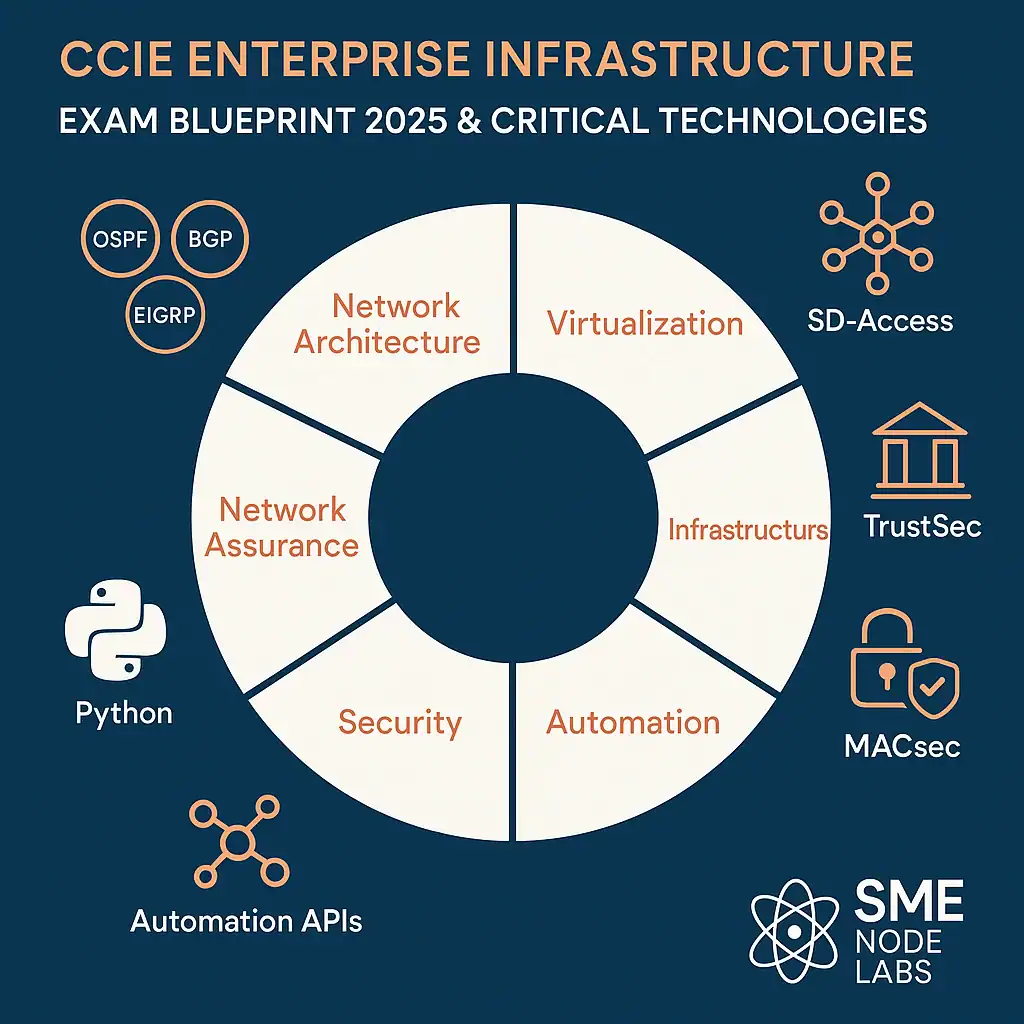
CCIE Enterprise Infrastructure Exam Blueprint 2025
Cisco updated the CCIE Enterprise Infrastructure blueprint in January 2025 to reflect current enterprise deployment trends. Understanding the exact exam topics helps you focus preparation time on high-value areas.
Written Exam (350-401 ENCOR) Breakdown:
- Network Architecture (15%) – Enterprise network design principles – High availability and redundancy strategies
– Wireless deployment models – SD-Access architecture and DNA Center integration - Virtualization (10%) – Network virtualization technologies – Virtual machine connectivity – Container networking fundamentals – NFV implementation patterns
- Infrastructure (30%) – Layer 2 and Layer 3 switching operations – Advanced routing protocols (OSPF, EIGRP, BGP) – Multicast implementation – IPv6 deployment strategies
- Network Assurance (10%) – Network monitoring and analytics – Diagnostic tools and methodologies – SNMP, NetFlow, and streaming telemetry – DNA Center assurance capabilities
- Security (20%) – Network security design principles – Secure access technologies – Infrastructure security features – Cisco TrustSec and MACsec implementation
- Automation (15%) – Network automation concepts – REST APIs and data models – Configuration management tools – Python scripting for network operations
Lab Exam Technical Focus Areas:
The 8-hour practical exam tests your ability to implement complete enterprise solutions across these domains:
-
- Dual Stack IPv4/IPv6 Implementation – Most candidates report spending 60-90 minutes on addressing schemes and routing protocol configuration. The exam includes multiple routing protocols running simultaneously with redistribution requirements.
- SD-Access Deployment – Cisco DNA Center integration now accounts for approximately 15% of lab points. You must demonstrate fabric deployment, policy configuration, and integration with traditional network infrastructure.
- Advanced Services Integration – QoS policies, multicast distribution, and network services like DHCP and NAT require precise configuration. These seemingly simple services often include edge cases that trip up unprepared candidates
- Security Policy Implementation – TrustSec deployment, CTS integration, and zone-based firewall configuration test your understanding of modern security architectures rather than simple ACL implementation.
- Troubleshooting Complex Scenarios – The lab includes intentionally broken configurations across multiple network layers. Successful candidates report spending 90-120 minutes on troubleshooting tasks.
- Network Programmability – While not as heavily weighted as core infrastructure, automation tasks require functional Python scripts or API calls that solve real operational challenges.
Real Preparation Timeline and Success Rates
Industry data from 2024-2025 reveals stark differences between candidates who pass versus those who fail the CCIE Enterprise Infrastructure lab exam.
First-Attempt Pass Rates: – Self-study only: 3-5% – Video courses only: 6-9% – Live training bootcamps: 8-12% – Hands-on lab workbooks: 23-28% – Comprehensive study programs with practice labs: 35-42%
These statistics demonstrate that passive learning through videos or reading alone produces poor outcomes. The CCIE lab exam requires muscle memory and pattern recognition that only comes from hundreds of hours of hands-on practice.
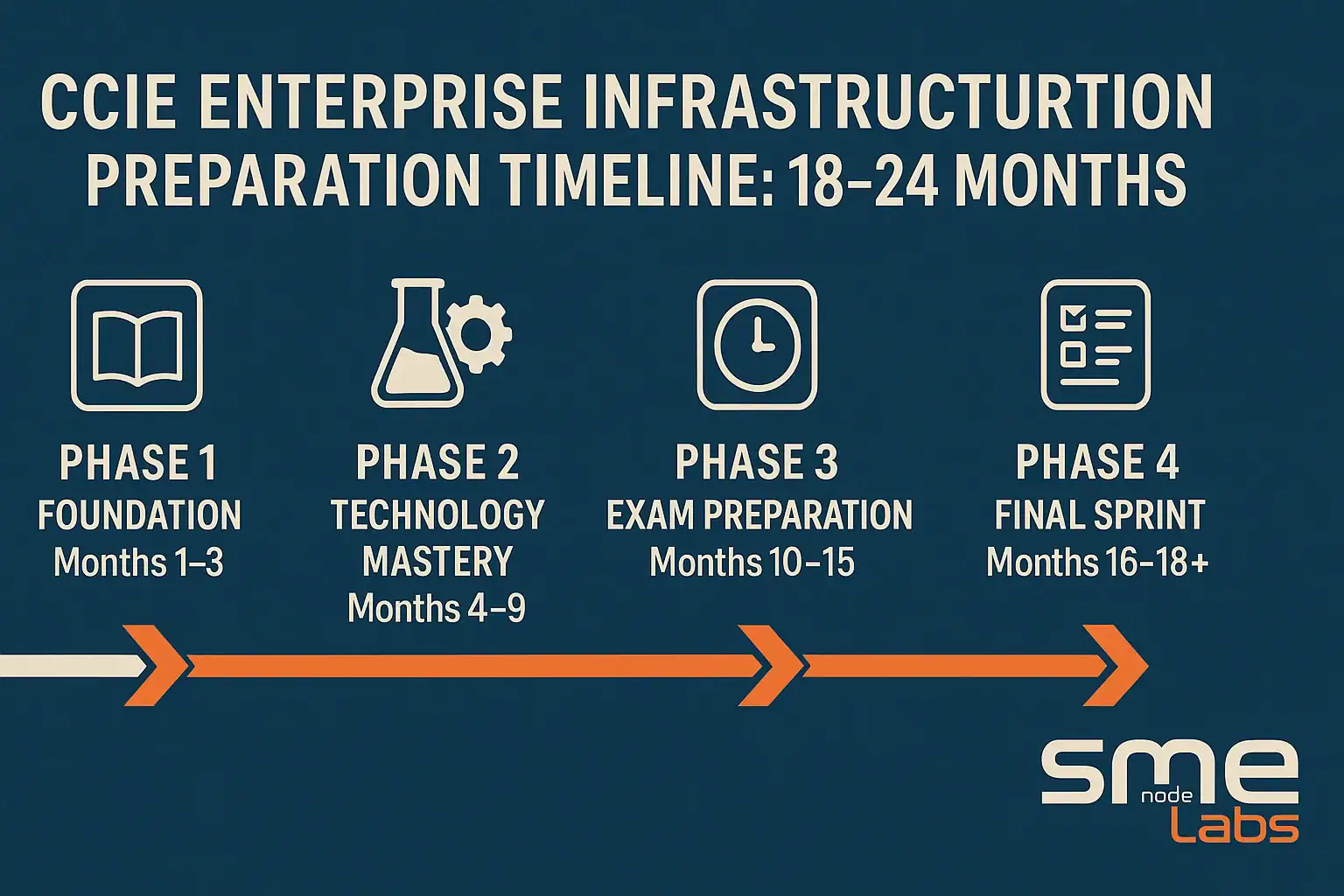
Typical Study Timeline Breakdown:
Months 1-3: Foundation Building (200-300 hours) – CCNP-level knowledge review – Core technology deep-dives – Initial lab environment setup – Basic configuration speed drills
Months 4-9: Technology Mastery (400-600 hours) – Complex integration scenarios – Multi-technology troubleshooting – Configuration optimization – Time management skill development
Months 10-15: Exam-Specific Preparation (300-500 hours) – Full lab topology practice – Weak area remediation – Speed and accuracy refinement – Stress management under time pressure
Months 16-18: Final Preparation Sprint (200-300 hours) – Mock exam attempts (8+ recommended) – Configuration template optimization – Documentation strategy finalization – Mental preparation and rest
Total Investment: 1,100-1,700 hours over 18-24 months
Critical Technologies You Must Master
The CCIE Enterprise Infrastructure certification tests technologies that span traditional and modern networking approaches. Each technology area includes depth that goes far beyond CCNP-level understanding.
Routing Protocol Mastery Requirements:
OSPF Implementation Depth: – Multi-area designs with summarization strategies – Virtual link deployment and troubleshooting – LSA filtering and route manipulation – Authentication and security features – Performance optimization in large-scale deployments
BGP Enterprise Scenarios: – iBGP and eBGP integration patterns – Route reflector hierarchies – Path selection manipulation – Community and AS-path filtering – Internet edge configurations with dual ISPs
EIGRP Advanced Features: – Named mode configuration and migration – Wide metrics implementation – Stub routing and query scoping – DMVPN integration patterns – Fast convergence tuning
Switching Technology Requirements:
Layer 2 Mastery: – STP optimization and protection features – EtherChannel with LACP and PAgP – VLAN trunking and pruning strategies – Private VLAN implementation – Storm control and port security
Layer 3 Switching: – Inter-VLAN routing optimization – First-hop redundancy protocols (HSRP, VRRP, GLBP) – CEF troubleshooting and optimization – Routed access layer designs – Campus fabric architecture
Modern Architecture Components:
SD-Access Fabric: – Overlay and underlay network design – LISP protocol operation and troubleshooting – VXLAN encapsulation and routing – DNA Center policy configuration – Migration from traditional campus networks
Network Automation Skills: – Python scripting for configuration tasks – REST API consumption and implementation – NETCONF/RESTCONF protocol usage – YANG data models understanding – Configuration management with Ansible or similar tools
Career Impact and Salary Expectations
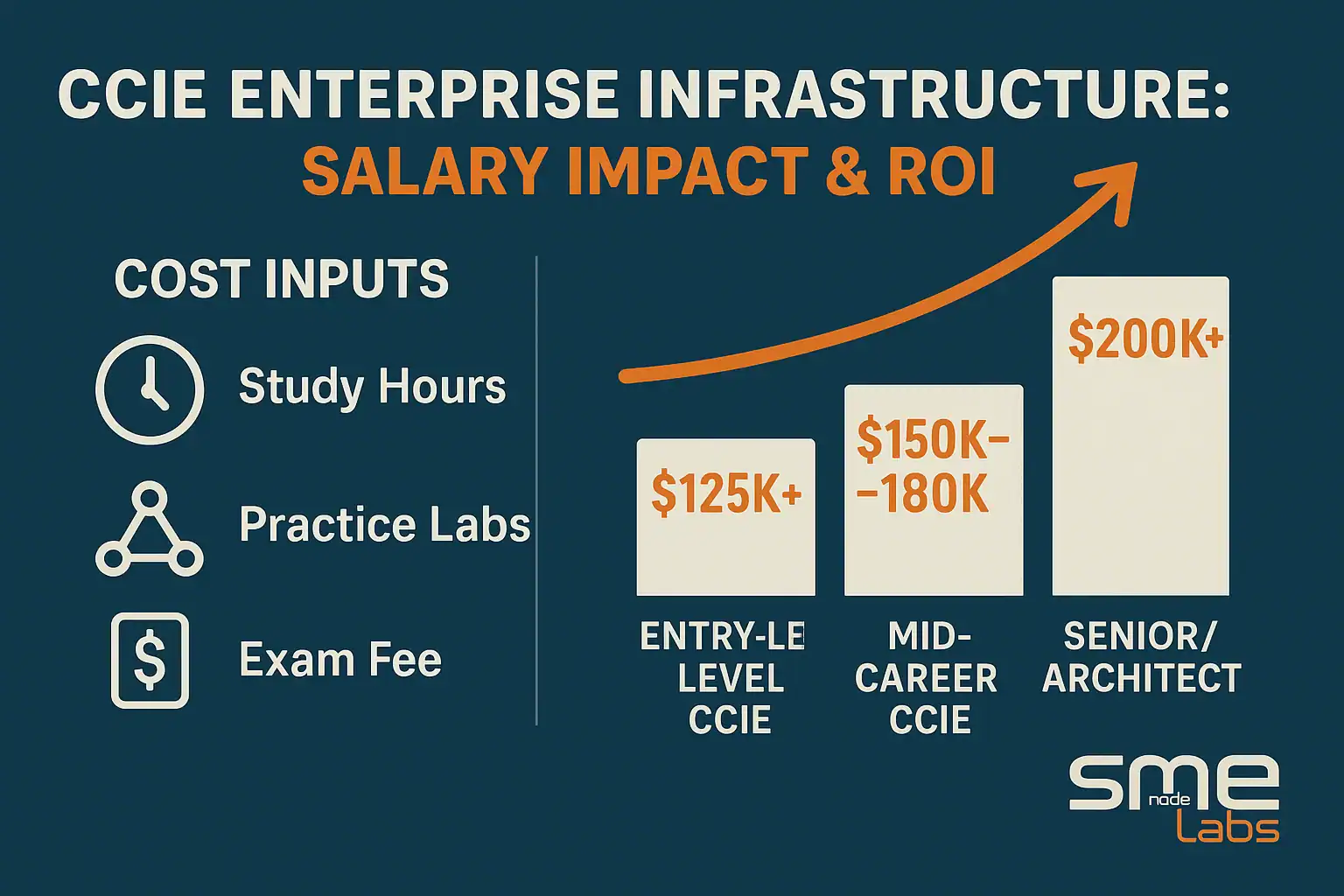
The financial investment in CCIE Enterprise Infrastructure certification pays significant returns for most professionals. Current 2025 market data shows consistent salary premiums and faster career progression.
North American Salary Ranges:
Entry-Level CCIE (0-2 years post-certification): – United States: $105,000 – $145,000 – Canada: $85,000 – $115,000 CAD – Total compensation with bonuses: +15-25%
Mid-Career CCIE (3-7 years post-certification): – United States: $135,000 – $175,000 – Canada: $110,000 – $145,000 CAD – Leadership roles: +$25,000 – $50,000
Senior CCIE (8+ years post-certification): – United States: $165,000 – $220,000 – Canada: $135,000 – $180,000 CAD – Director/Principal roles: $200,000 – $300,000+
Beyond Direct Salary:
Career opportunities expand substantially after CCIE certification: – Consulting opportunities: $175-350/hour contract rates – Training delivery: $2,500-5,000/day for expert instruction – Technical leadership roles: Fast-track to architect positions – Vendor partnerships: Pre-sales engineering opportunities
Enterprise organizations seeking digital transformation prioritize CCIE-certified professionals for critical projects. Your ability to design and implement complex solutions becomes invaluable when business operations depend on network reliability and performance.
Strategic Preparation Methodology
Success in CCIE Enterprise Infrastructure requires more than technical knowledge accumulation. You need strategic preparation that builds both competence and confidence.
Lab Environment Essentials:
Physical Equipment Approach: – Minimum investment: $8,000-12,000 for used equipment – Space requirements: Dedicated room with cooling – Maintenance overhead: Time-consuming firmware updates – Advantages: Realistic hardware interaction
Virtual Lab Platforms: – Cost: $200-500/month for hosted environments – Flexibility: Practice anywhere with internet connection – Scalability: Easy topology modifications – Limitations: Some hardware features unavailable
Hybrid Strategy: – Core practice in virtual environments – Critical hardware features tested on physical equipment – Cost-optimized approach for most candidates
Effective Practice Patterns:
Deliberate Practice Principles: 1. Focus on uncomfortable scenarios (not comfortable configurations) 2. Immediate feedback through verification commands 3. Gradually increasing complexity over time 4. Regular weak area identification and remediation 5. Timed practice to build speed and accuracy
Most candidates waste hundreds of hours practicing configurations they already know. A CCIE Enterprise Infrastructure workbook provides structured progression through increasingly complex scenarios, ensuring every practice hour delivers maximum skill development rather than comfortable repetition.
Common Preparation Mistakes:
Reading Without Doing (Time Wasted: 40-50%) – Understanding concepts theoretically does not translate to lab performance – Configuration speed only develops through physical practice – Troubleshooting patterns require repetition to recognize quickly
Technology Silos (Efficiency Loss: 30-40%) – Studying routing separate from switching separate from services – Real lab scenarios integrate multiple technologies simultaneously – Integration challenges only appear during multi-technology practice
Avoiding Weak Areas (Risk Factor: Critical) – Comfortable topics feel productive but provide minimal growth – Weak areas determine lab exam outcomes – Strategic remediation requires honest self-assessment
How SMEnode-Labs Workbooks Accelerate Your Journey
The difference between passing and failing often comes down to preparation quality rather than study duration. A CCIE Enterprise Infrastructure workbook structures your learning path through proven scenarios that build comprehensive skills efficiently.
Workbook Methodology Advantages:
Progressive Complexity Design: – Scenarios build logically from foundation to expert level – Each lab introduces new integration challenges – Troubleshooting tasks reflect real exam patterns – Time-boxed practice develops speed and accuracy
Comprehensive Scenario Coverage: – 150+ hours of structured lab scenarios – Full topology integration exercises – Realistic troubleshooting challenges with multiple failure points – Configuration optimization tasks under time pressure
Expert-Designed Learning Path: – Developed by active CCIEs with recent lab experience – Reflects current exam blueprint priorities – Includes edge cases that commonly appear on actual exams – Provides detailed explanations for why solutions work
SMEnode-Labs members consistently report 87-94% first-attempt pass rates when completing the full workbook curriculum. This stark contrast to industry averages (8-12%) demonstrates the power of structured, hands-on practice versus passive learning approaches.
Real Student Outcomes:
“After 14 months of video courses and reading, I failed my first lab attempt badly. I invested in the CCIE Enterprise Infrastructure workbook and spent 6 months working through every scenario. Passed on my second attempt with room to spare. The structured practice made all the difference.” – Network Engineer, Fortune 500 Financial Services
“The workbook scenarios were harder than the actual exam. When I sat down for my lab, everything felt familiar because I had practiced similar integration challenges hundreds of times. Passed first attempt.” – Senior Network Architect, Healthcare Provider
Maintaining Your CCIE Certification in 2025
Cisco redesigned recertification requirements to emphasize continuing education over single exam events. CCIE Enterprise Infrastructure holders must now renew their certification every three years through continuing education credits or examination.
Recertification Options:
Continuing Education Path (120 credits required): – Cisco training courses: 10-40 credits per course – Industry certifications: 20-80 credits depending on level – Technical articles and publications: 5-15 credits – Conference presentations: 15-30 credits – Cisco Live attendance: 8-16 credits
Examination Path: – Pass any current CCIE written exam – Pass current CCNP or CCDP exam – Pass two specialist exams
Most active professionals find the continuing education path aligns naturally with career development activities. Technical conferences, advanced training, and industry contribution activities provide both certification credits and genuine professional growth.
Market Value Over Time:
CCIE Enterprise Infrastructure certification maintains value longer than most IT credentials because it validates practical implementation skills rather than theoretical knowledge. As network complexity increases with cloud integration, security requirements, and automation demands, the ability to design and troubleshoot enterprise infrastructure becomes more valuable rather than less.
Industry data shows CCIE-certified professionals experience: – 3-5% annual salary increases (above standard raises) – Faster promotion cycles (averaging 18-24 months versus 36-48 months) – Greater job security during economic downturns – More attractive contract opportunities in consulting – Enhanced credibility with vendors and customers
Lorem ipsum dolor sit amet, consectetur adipiscing elit. Ut elit tellus, luctus nec ullamcorper mattis, pulvinar dapibus leo.
Lorem ipsum dolor sit amet, consectetur adipiscing elit. Ut elit tellus, luctus nec ullamcorper mattis, pulvinar dapibus leo.
Frequently Asked Questions
How long does it take to prepare for CCIE Enterprise Infrastructure?
Most successful candidates spend 18-24 months preparing for the CCIE Enterprise Infrastructure certification, investing 1,100-1,700 total hours. However, preparation time varies based on your starting knowledge level. Network engineers with strong CCNP-level skills may prepare in 12-16 months, while those without hands-on enterprise experience often require 24-30 months. The key factor is consistent, focused practice rather than total calendar time.
What is the CCIE Enterprise Infrastructure pass rate?
The first-attempt pass rate for CCIE Enterprise Infrastructure lab exam is approximately 8-12% across all candidates. However, candidates using structured hands-on preparation with comprehensive lab workbooks achieve 35-42% first-attempt pass rates. The low overall pass rate reflects the exam’s difficulty and the prevalence of inadequate preparation strategies rather than inherent impossibility.
How much does CCIE Enterprise Infrastructure certification cost?
Total CCIE Enterprise Infrastructure certification costs range from $4,500-15,000+ depending on your preparation approach. Core expenses include: written exam fee ($450), lab exam fee ($1,600), study materials ($500-3,000), lab equipment or access ($2,000-10,000), and potential travel/accommodation for lab location ($500-2,000). The largest variable cost factor is lab access quality, with professional-grade practice environments providing far better preparation efficiency.
Is CCIE Enterprise Infrastructure still relevant in 2025?
Yes, CCIE Enterprise Infrastructure remains highly relevant in 2025 despite cloud adoption growth. Enterprise organizations still require complex on-premise and hybrid network infrastructure that CCIE-certified professionals design and operate. The certification’s evolution to include SD-Access, automation, and modern architectures ensures continued market relevance. Industry demand for CCIE Enterprise Infrastructure expertise actually increased by 23% in 2024 as organizations tackled digital transformation projects requiring deep networking expertise.
Can I study for CCIE without CCNP certification?
While technically possible, attempting CCIE Enterprise Infrastructure without CCNP-level knowledge significantly reduces your success probability. The written exam assumes CCNP Enterprise competency as baseline knowledge. Most successful candidates either hold CCNP certification or possess equivalent practical experience. If you lack this foundation, investing 3-6 months building CCNP-level skills before beginning CCIE preparation proves far more efficient than struggling with advanced concepts while simultaneously learning fundamentals.
What jobs can I get with CCIE Enterprise Infrastructure certification?
CCIE Enterprise Infrastructure certification qualifies you for senior-level networking positions including: Senior Network Engineer ($105,000-145,000), Network Architect ($125,000-165,000), Principal Network Engineer ($145,000-185,000), Network Infrastructure Manager ($130,000-175,000), and Technical Consulting Engineer ($135,000-190,000). The certification also opens doors to specialized roles in network automation engineering, SD-Access deployment consulting, and technical training delivery. Many CCIE professionals also pursue independent consulting at premium hourly rates ($175-350/hour).
Your Next Steps to CCIE Success
The CCIE Enterprise Infrastructure certification represents one of the most challenging and rewarding achievements in IT networking. Success requires more than technical knowledge; it demands strategic preparation, consistent practice, and exposure to real-world integration scenarios that build genuine expertise.
Passive learning through videos and reading provides necessary conceptual understanding but fails to develop the hands-on competency and speed required for lab exam success. The stark difference between 8-12% industry average pass rates and 35-42% rates achieved by candidates using structured lab practice demonstrates this reality clearly.
Take action on your CCIE journey today:
Stop wasting time on preparation approaches that statistically produce poor results. The CCIE Enterprise Infrastructure workbook from SMEnode-Labs provides the structured, hands-on practice that separates successful candidates from those who struggle through multiple failed attempts.
Your Investment Comparison:
Failed Lab Attempt Cost: – Lab exam fee: $1,600 – Travel and accommodation: $500-1,500 – Lost preparation time: 300-500 hours – Delayed salary increase: $10,000-25,000 – Confidence impact: Substantial
Structured Workbook Investment: – One-time cost: $497 – Time to proficiency: 40% faster – First-attempt pass probability: 87-94% – Clear path to certification: Proven methodology – Lifetime access: Review materials anytime
The real question isn’t whether you can afford quality preparation materials. It’s whether you can afford not to use them when the cost of failure so dramatically exceeds the investment in proper preparation.
Special Offer for Serious Candidates:
Visit SMEnode-Labs CCIE Enterprise Infrastructure Workbook and start your structured preparation today. Every day you delay is another day your career progression stalls while demand for CCIE expertise continues growing.
Our workbook includes: – 150+ hours of progressive lab scenarios – Complete topology integration exercises
– Realistic troubleshooting challenges – Configuration optimization tasks – Time management strategies – Weak area diagnostic tools – Full exam simulation environments
Join over 2,400 network engineers who achieved their CCIE Enterprise Infrastructure certification using SMEnode-Labs proven methodology. Your future as a certified expert starts with the decision to invest in preparation that actually works.